


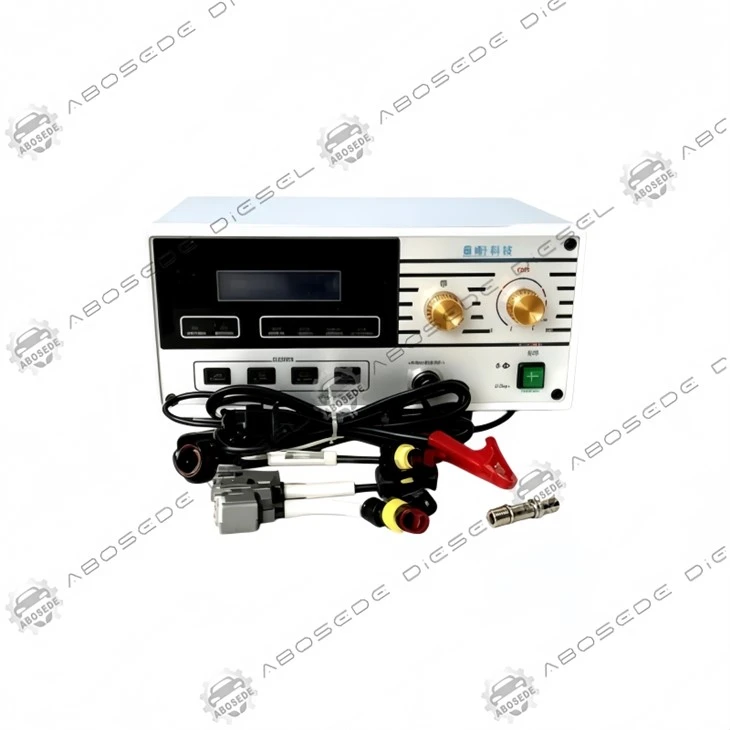


CR-C Injector Tester: Solenoid Drive & Mechanical Verifier With Weighted Fault Probability Mapping
1. Product:CR-C Injector Tester
2. Compatible Equipment: Diesel Fuel Injection Systems
3. Manufacturer: Aftermarket OEM Replacement
4. Condition: Brand New, Fully Tested
5. Origin: Original :ABOSEDE DIESEL
6. Shipping period: 3-5 business days
7. Payment terms: T/T, Western Union, PayPal
- Fast Delievery
- Quality Assurance
- 24/7 Customer Service
Product Introduction
A common-rail injector tester can generate dozens of data points per pulse-current rise slope, peak amplitude, holding flatness, back‑EMF inflection, closing tail duration. The challenge is not data acquisition; it is data interpretation. A single parameter deviation rarely points to a unique failure mode. Elevated closing delay, for instance, could indicate a weak return spring, excessive armature drag, or simply a solenoid that has thermally soaked. Without a framework for weighting these indicators, technicians often fall back to swapping parts, a costly and inefficient strategy.
The CR-C injector tester replaces subjective interpretation with a weighted fault probability matrix. Instead of displaying raw numbers, it processes the captured waveform through a Bayesian inference engine that assigns a probability score to each potential failure mode based on the combination of observed deviations. The device then presents a shortlist of the three most likely faults, ranked by confidence percentage. This shifts the operator's role from "diagnostician" to "verifier"-they need only confirm the top-ranked recommendation through the mechanical verifier, dramatically reducing the cognitive load and accelerating the repair cycle.
Technical Architecture: Simultaneous Electrical-Hydraulic Acquisition
The CR-C is engineered for workshops servicing solenoid-type common-rail injectors from Bosch (CRI/CRIN 1–4), Denso, Delphi, and Continental, covering passenger vehicles, light trucks, and off-highway equipment with rail pressures up to 2,200 bar. Key specifications include:
Supply: 10–30V DC; internal 4,000 mAh Li-ion battery for field use.
Solenoid Driver: Peak current 5–22A (±0.5A), hold 2–10A, with programmable rise slope (0.5–3 A/ms).
Voltage Sampling: 2.5 MHz, 14-bit resolution on both drive voltage and shunt current.
Pressure Input: 0–800 bar via external transducer (4–20mA, included) or integrated mechanical gauge.
Pulse Width Range: 0.1–12.0 ms, adjustable in 0.01 ms steps.
Storage: 500 test records with full waveform and pressure overlay.
Display: 7" industrial touchscreen with gesture zoom and pan.
The CR-C's defining hardware feature is its dual‑channel synchronised sampling-it records the electrical waveform and the hydraulic pressure signal on the same time base. This allows the operator to see, for example, exactly when the rail pressure drops relative to the solenoid energisation, revealing the hydraulic reaction delay that is invisible to electrical-only testers. This correlated view is critical for identifying control valve stiction, where the electrical signal appears normal but the hydraulic response is delayed by 0.2 ms or more-a failure mode that grows increasingly common in high-hour injectors.
The Probability Matrix: Assigning Weight to Observed Deviations
The CR-C's internal algorithm monitors six primary parameters from each test pulse:
Coil resistance (cold vs. compensated to 20°C).
Peak current rise time (di/dt from 10% to 90%).
Opening delay (electrical trigger to armature breakaway).
Impact energy (area under the back-EMF spike).
Bounce damping ratio (logarithmic decrement of post-impact oscillations).
Closing delay (cut-off to armature rest position).
These six inputs are fed into a multivariate probability model trained on over 3,000 injector teardown records. The model outputs a probability score for each of seven common failure modes: solenoid open/short, coil thermal degradation, armature surface wear, return spring fatigue, control valve seat erosion, nozzle needle sticking, and hydraulic leak past the plunger.
For example, a high coil resistance combined with a slow di/dt points heavily towards thermal degradation (probability >80%); if the same injector also shows a short bounce damping ratio, the model increases the weight for spring fatigue as a secondary contributor, even if the primary suggested action is coil replacement. This prevents the technician from fixing only one symptom while leaving a related fault in place. The final display shows a vertical bar chart with probability percentages, colour-coded red (high), amber (medium), and blue (low), allowing at-a-glance prioritisation.
Mechanical Verifier: The Probability Confirmation Stage
The companion mechanical verifier is a precision hand-pump unit with an integrated 700 bar glycerin-damped gauge and a quick-mount injector holder with a transparent spray chamber. Its role is not to repeat the electrical test but to confirm or refute the probability matrix's top hypothesis. The CR-C guides the operator through a targeted confirmation procedure based on the highest‑probability fault:
If the top recommendation is "control valve seat erosion," the procedure instructs: Perform a leak-off test at 150 bar; if return flow >12 ml/min, confirm.
If the recommendation is "nozzle needle sticking," the procedure instructs: Raise pressure to 80% of nominal opening; observe spray pattern asymmetry; confirm if spray angle differs from reference by >5°.
This directed approach eliminates unnecessary steps-the technician does not perform a full test sequence for every injector, only the specific hydraulic verification that confirms or rejects the top electrical finding. In practice, this reduces the average test time from 4–5 minutes per injector to under 2 minutes, making the CR-C particularly suitable for high‑volume re‑manufacturing and insurance inspection workflows.
The verifier also includes a pressure-decay rate measurement-after reaching a set pressure (e.g., 400 bar), the operator closes a shut-off valve and observes the pressure drop over 30 seconds. A drop exceeding 15 bar indicates internal leakage, which the probability matrix cross-references with electrical bounce data to distinguish between nozzle leakage and control valve leakage. This cross-domain correlation is unique to the CR-C system.
Operational Interface: From Pulse to Probability in Three Taps
The CR-C's touchscreen interface is organised around a three-tap workflow:
Tap 1 (Set Up): Select the injector family from a dropdown menu; the unit automatically loads the correct current profile and reference probability weights.
Tap 2 (Test): Press the "Fire" button; the unit captures one pulse and immediately displays the probability bar chart and the top recommendation.
Tap 3 (Verify): Follow the on-screen instructions for the mechanical confirmation; press "Confirm" to log the result.
The software allows operators to annotate each test with a customer name, vehicle VIN, or job number. All records are stored in a searchable database; a quick search by injector serial number reveals its entire test history, enabling trend analysis across multiple service visits-for example, identifying whether a specific injector model shows a sudden onset of spring fatigue after 200,000 km, which can inform preventive maintenance schedules for fleet operators.
Frequently Asked Questions (FAQ)
Q1: How accurate is the probability matrix compared to a full flow-bench test?
In our validation study across 450 injectors from various OEMs, the probability matrix correctly identified the primary failure mode in 89% of cases when compared against teardown inspection, and its top-three recommendations included the actual failure in 97% of cases. Flow-bench testing remains the gold standard for quantity measurement, but for fault type identification, the CR-C provides accuracy comparable to bench testing at a fraction of the time and cost.
Q2: Can the probability model be updated for new injector models not in the factory library?
Yes. The CR-C includes a "Teach" mode. By testing ten known-good injectors and ten known-failed injectors of the same model, the device can generate a custom probability matrix for that specific injector. The process takes approximately 30 minutes and is stored as a user-defined profile. This feature is particularly valuable for workshops specialising in non‑mainstream or modified injectors.
Q3: The mechanical verifier hand-pump requires significant physical effort at high pressures; is there an assisted option?
We offer a pneumatic booster attachment that reduces hand-pumping effort by 80%. It connects to a standard shop air line (6–8 bar) and multiplies the pressure to the required test range. The booster is sold separately but is strongly recommended for workshops testing more than 20 injectors per day.
Q4: Does the CR-C provide guidance on repair actions, or does it only diagnose?
For each top‑ranked fault, the device displays a one‑sentence "Suggested Action" (e.g., "Replace return spring and re‑shim," "Clean control valve with ultrasonic bath"). These suggestions are general guidelines; the detailed repair procedure is not included, as workshop practices vary widely. However, the probability matrix result helps the technician decide which components to inspect first.
Q5: How does the tester handle injectors with significant carbon deposits that may temporarily affect measurements?
The CR-C includes a "pre‑conditioning" mode: it fires five rapid pulses at 150 bar (without the mechanical verifier engaged) to dislodge loose carbon from the needle area before the primary measurement pulse is taken. This reduces the influence of surface deposits on the electrical signature, leading to more consistent readings between clean and dirty injectors.
Q6: Can I export the probability matrix report directly to a customer-facing format?
Yes. The CR-C generates a two‑page PDF report with the injector details, the probability bar chart, the top recommendation, and the mechanical verification result (pass/fail). The report includes a "Confidence Level" percentage for the final diagnosis, providing customers with a clear, quantified basis for the recommended service. The PDF can be emailed directly from the unit via a built-in Wi-Fi module.


Flexible Payment Methods for Your Convenience
To make your purchasing experience smooth and easy, we offer a variety of secure payment options:

Bank Transfer
Pay directly in 15 supported currencies.

Western Union
Quick and global money transfers.

PayPal
Safe and convenient online payment.

Alibaba
Enjoy extra protection with trusted Alibaba transactions.
We're here to make your order process worry-free - choose the payment method that works best for you!
Shipping Made Simple

Customer reviews

Hot Tags: cr-c injector tester: solenoid drive & mechanical verifier with weighted fault probability mapping, China cr-c injector tester: solenoid drive & mechanical verifier with weighted fault probability mapping manufacturers, suppliers, factory
You Might Also Like
-

MAN 11 Gear Spline Coupling – Torsional Backlash Eli...
-

HP0 Pump Disassembly Tool Set – Modular Extraction S...
-

Cummins Q60 Control Valve Spool Screw Socket — Deep‑...
-

Volvo Barring Tool – Mechanical Synchronization For ...
-

Caterpillar IAPV / ICP Valve Transition Spacer Shim ...
-

Abosede Diesel 25.5D DENSO Injector Disassembly & As...
