


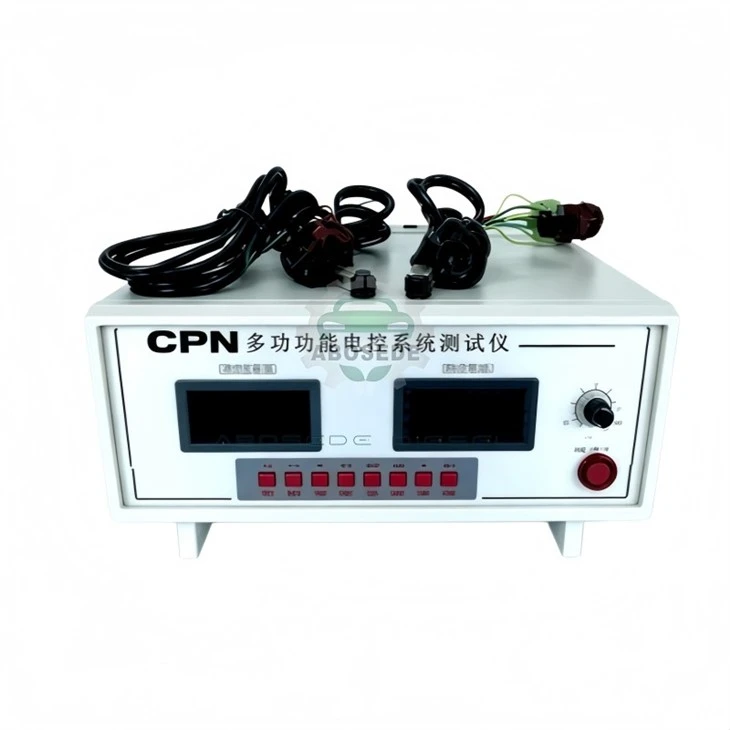
CPN High-Pressure Electronic Pump Tester: Metering Unit Drive & Euro-II Test Bench Integration For Rapid Pressure-Building Validation
1. Product:CPN High-Pressure Electronic Pump Tester
2. Compatible Equipment: Diesel Fuel Injection Systems
3. Manufacturer: Aftermarket OEM Replacement
4. Condition: Brand New, Fully Tested
5. Origin: Original :ABOSEDE DIESEL
6. Shipping period: 3-5 business days
7. Payment terms: T/T, Western Union, PayPal
- Fast Delievery
- Quality Assurance
- 24/7 Customer Service
Product Introduction
In common-rail systems, the high-pressure pump is the heart of the fuel delivery chain. Its primary function is not merely to achieve a target rail pressure but to reach that pressure within a defined time window-typically under 2 seconds from key-on to system-ready. A pump that eventually reaches 1,200 bar but takes 4 seconds to get there indicates internal leakage, plunger wear, or a sluggish metering unit. The final pressure value alone is a pass/fail threshold; the rate of pressure rise (ΔP/Δt) is a diagnostic window into the pump's internal condition.
The CPN-2000 high-pressure electronic pump tester leverages this principle by driving the pump's metering unit with a precise PWM signal while monitoring the pressure buildup curve on a companion Euro-II test bench. Instead of simply indicating "pressure OK" or "pressure low," the system calculates the instantaneous pressure slope at three key intervals: initial prime (0–200 bar), mid-range ramp (200–800 bar), and high-pressure asymptote (800–target). A slope that degrades disproportionately in the mid-range indicates plunger barrel wear; a slope that flattens early suggests a stuck metering unit or a compromised inlet restrictor. This level of granularity enables the technician to diagnose the root cause of poor building pressure, not just the symptom.
Technical Specifications: Metering Unit Driver & Synchronous Pressure Acquisition
The CPN-2000 is engineered for high-pressure common-rail pumps from Bosch (CP1, CP3, CP4), Denso (HP0–HP6), Delphi, and Continental, used in passenger cars, light commercials, trucks, and off-highway equipment. Its core specifications include:
Supply Voltage: 12V/24V auto-ranging (9–32V DC) with 100V load-dump protection.
Metering Unit Drive: PWM output 0–100% duty cycle, frequency 50–500 Hz (programmable), current up to 3A continuous.
Pressure Input: 0–2,500 bar transducer interface (0.5–4.5V ratiometric or 4–20mA).
Pressure Sampling Rate: 1 kHz with 16-bit resolution (records the full build-up transient).
Trigger Modes: Manual single-shot, automatic timed ramp, or external start signal.
Display: 7" colour TFT with real-time pressure/time graphing.
Storage: 200 test curves with overlay comparison capability.
A key feature of the CPN-2000 is its adaptive frequency dithering on the metering unit drive. Metering units (also known as inlet metering valves or IMVs) are susceptible to hysteresis, especially after prolonged service. The tester applies a low-amplitude, high-frequency dither (200–500 Hz) superimposed on the main PWM signal, which reduces static friction and ensures the metering spool responds linearly to the commanded duty cycle. This results in a smoother pressure buildup and prevents the "step" artifacts that often confound interpretation of the ΔP/Δt curve. The unit also measures the metering coil resistance and inductance during the pre-test sequence, alerting the operator to any electrical degradation that could affect pump performance.
The Euro-II Test Bench Integration: Bridging Electronic Control and Mechanical Load
The CPN-2000 is designed to interface with standard Euro-II pump test benches (e.g., Bosch EPS, Hartridge, or Denso equivalents) via a simple four-wire connection: power, ground, PWM output, and pressure feedback. The test bench rotates the pump at a controlled speed (typically 500–2,000 RPM), while the CPN-2000 drives the metering unit to command a specific fuel delivery rate. The pressure transducer mounted on the pump outlet provides real-time feedback to the tester, which then logs the entire pressure trajectory from zero to the pump's maximum rated pressure.
During a typical test sequence, the CPN-2000 executes a pressure sweep: starting from 0% duty cycle (fully closed metering unit), it increments the duty cycle in 5% steps, holding each step for 2 seconds while recording the resulting pressure plateau. The system then plots the duty-cycle-to-pressure transfer characteristic-a curve that should be monotonic and roughly linear in the mid-range. Any non-linearity, such as a flat response between 30–50% duty cycle, indicates a worn metering unit spool or a damaged inlet restrictor. The tester automatically calculates the pump's volumetric efficiency at each step by comparing the actual pressure rise against a stored reference for a known-good pump of the same model.
Additionally, the CPN-2000 includes a leakage compensation factor: during the hold phase at maximum pressure, the system measures the pressure decay rate over 10 seconds. A decay exceeding 5% of the target pressure indicates internal leakage past the plunger seals or the pressure relief valve-a common failure mode in high-hour pumps that is often missed by simple "will it build pressure" tests. The tester displays the decay rate as a numerical percentage and colour-codes it green (acceptable), amber (marginal), or red (replace).
Fault Triage via Pressure Curve Morphology: Four Distinct Failure Patterns
The CPN-2000's software includes a pattern library of four common failure signatures, each associated with a specific root cause:
Slow initial rise, normal mid-range → Inlet fuel restriction (clogged filter or collapsed hose).
Normal initial rise, plateau mid-range → Metering unit spool sticking (requires cleaning or replacement).
Steep rise to 60% target, then shallow asymptote → Plunger/barrel wear (internal bypass increasing with pressure).
Oscillating pressure during build-up → Air ingestion (suction side leak or aerated fuel).
The tester overlays the actual measured curve onto the selected reference curve and highlights the deviation area. The technician can visually confirm the pattern match within seconds, without needing to interpret numerical data. This pattern-matching approach reduces diagnostic time by approximately 70% compared to traditional manual interpretation of pressure gauge readings.
The device also supports curve overlay mode-the operator can compare the current pump's curve with a previously stored curve from the same pump (e.g., from a previous service) to track performance degradation over time. This feature is particularly valuable for fleet operators conducting periodic preventive maintenance inspections.
Operational Workflow: From Connection to Verdict in Five Minutes
The complete test procedure with the CPN-2000 and a Euro-II test bench is as follows:
Mount the pump on the test bench and connect the high-pressure outlet to the bench's pressure transducer.
Connect the CPN-2000 to the metering unit electrical connector (supplied adapter cables cover most pump models).
Select the pump model from the tester's dropdown menu-this loads the correct PWM frequency, current limits, and reference pressure curve.
Start the test bench at the specified RPM and initiate the automatic pressure sweep via the CPN-2000.
Review the results: The screen displays the pressure/time graph, the volumetric efficiency percentage, the leakage decay rate, and a pass/fail recommendation.
The entire process, from setup to a printed test report, typically takes less than five minutes. The tester stores the curve and all derived parameters for future reference, creating a service history for each pump serial number entered by the operator.
Frequently Asked Questions (FAQ)
Q1: Can the CPN-2000 test a pump with a faulty pressure relief valve that opens too early?
Yes. The leakage decay test at maximum pressure will show a rapid pressure drop when the relief valve opens prematurely. The tester identifies this as a separate failure mode-"relief valve bypass"-and recommends replacement of the valve assembly rather than condemning the entire pump. This saves the workshop from unnecessarily replacing a pump that only needs a minor component.
Q2: How does the tester handle pumps with different plunger counts (e.g., 3-plunger vs. 6-plunger)?
The pressure sweep reference curves are model-specific. When you select the pump model, the CPN-2000 automatically adjusts the expected volumetric efficiency and the smoothing filter for pressure ripple. The tester has a library of over 80 pump models, and new models can be added via firmware updates. The unit also supports a "Teach" mode for unlisted pumps.
Q3: Is it necessary to use a Euro-II test bench, or can the tester operate standalone?
The CPN-2000 requires an external rotation source to spin the pump-it cannot drive the pump mechanically. While a Euro-II test bench is the most common platform, any variable-speed drive capable of rotating the pump flange at the required RPM (with appropriate mounting adapters) will work. The tester only needs the pressure signal and the rotation speed to calculate volumetric efficiency correctly.
Q4: What is the allowable pressure decay rate for a pump considered "healthy"?
Our reference data suggests that a decay rate below 2% of the target pressure over 10 seconds indicates a tight pump with minimal internal leakage. A rate between 2% and 5% is marginal-the pump may still operate but will show reduced performance at high loads. Above 5%, we recommend overhauling the pump before it causes rail pressure instability in the vehicle.
Q5: Can the CPN-2000 test the pump's flow rate across different RPM points?
The pressure sweep is typically performed at a fixed RPM (e.g., 1,500 RPM). However, the unit includes a "multi-point" mode where it repeats the sweep at three different speeds (500, 1,500, and 2,500 RPM) and compares the volumetric efficiency across speeds. A pump that shows efficiency dropping more than 8% from 500 to 2,500 RPM has worn plungers that are losing sealing at higher speeds-a strong indicator of impending failure.
Q6: How often should the pressure transducer used with the CPN-2000 be calibrated?
The transducer should be calibrated annually against a certified dead-weight tester. The CPN-2000 includes a calibration offset feature that allows the operator to input correction values if the transducer is found to be slightly out of spec. We recommend using only transducers with a rated accuracy of ±0.5% FS for reliable pressure slope measurements.


Flexible Payment Methods for Your Convenience
To make your purchasing experience smooth and easy, we offer a variety of secure payment options:

Bank Transfer
Pay directly in 15 supported currencies.

Western Union
Quick and global money transfers.

PayPal
Safe and convenient online payment.

Alibaba
Enjoy extra protection with trusted Alibaba transactions.
We're here to make your order process worry-free - choose the payment method that works best for you!
Shipping Made Simple

Customer reviews

Hot Tags: cpn high-pressure electronic pump tester: metering unit drive & euro-ii test bench integration for rapid pressure-building validation, China cpn high-pressure electronic pump tester: metering unit drive & euro-ii test bench integration for rapid pressure-building validation manufacturers, suppliers, factory
You Might Also Like
-

Ultra‑High Pressure Injector 90° Inlet Adapter – M12...
-

Piezo Injector Spanner – Precision Inner Valve Nut T...
-

Oil Proof Shim Measuring Tools – Precision Shim Gaug...
-

Common Rail Injector Valve Testing Fixture With Cali...
-

Bosch Unit Pump Solenoid Screw Wrench – 5‑Star Hollo...
-

High-Performance DRV Repair Kit (Depressurization Va...
