


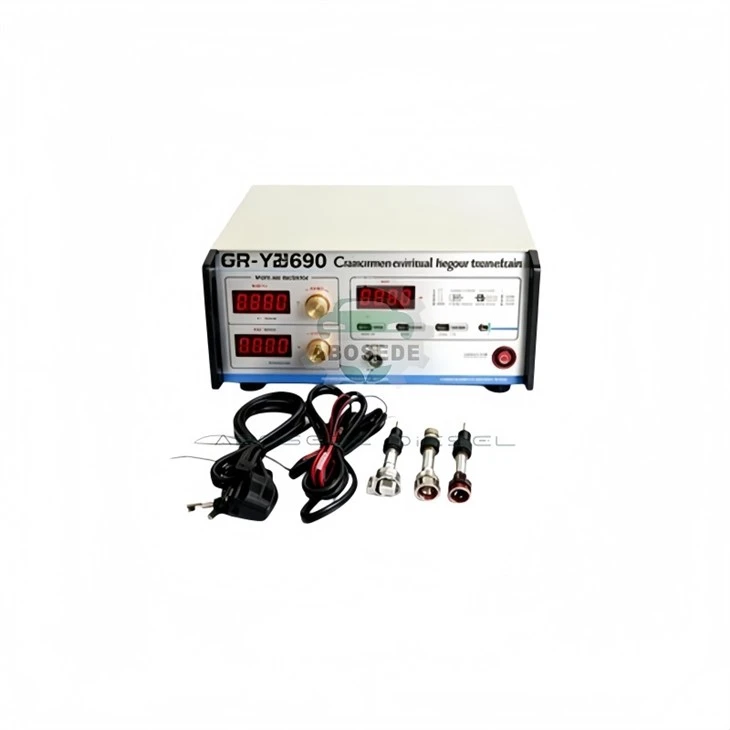
CR-YB690 Injector Tester: Solenoid Drive & Mechanical Verifier For Rapid Fault Triage
1. Product:CR-YB690 Injector Tester:
2. Compatible Equipment: Diesel Fuel Injection Systems
3. Manufacturer: Aftermarket OEM Replacement
4. Condition: Brand New, Fully Tested
5. Origin: Original :ABOSEDE DIESEL
6. Shipping period: 3-5 business days
7. Payment terms: T/T, Western Union, PayPal
- Fast Delievery
- Quality Assurance
- 24/7 Customer Service
Product Introduction
Diesel common-rail injectors are electromechanical transducers-they convert electrical energy into magnetic force, which then overcomes hydraulic pressure and spring preload to lift the needle. When an injector fails, the root cause resides in one of two domains: the electrical domain (solenoid coil degradation, wiring resistance, or armature stiction) or the mechanical domain (nozzle wear, spring fatigue, or valve seat erosion). The challenge for workshop technicians is rapidly isolating which domain is responsible without spending hours on a full tear-down.
The CR-YB690 injector tester resolves this diagnostic bottleneck through a dual-path verification strategy. On one path, it drives the injector solenoid with a calibrated current profile and measures the armature response time via back-EMF analysis-an electrical-domain check. On the other path, it integrates with a companion mechanical verifier (a hand-operated pressure pump and nozzle holder) to observe the actual spray pattern and opening pressure-a mechanical-domain check. By performing both checks in under 90 seconds, the technician gains a binary pass/fail indicator for each domain, quickly isolating the faulty component without the need for expensive flow benches or oscilloscopes.
Technical Specifications: Driver Stage & Sensor Feedback
The CR-YB690 is engineered to test a wide range of common-rail solenoid injectors from Bosch, Denso, Delphi, and Siemens-covering passenger car, light commercial, and heavy-duty applications (up to 2,500 bar system pressure). Its core specifications include:
Supply Voltage: 12V DC (internal battery) or external 12V adapter; 24V option available.
Drive Current: Peak 15A ±2%, hold 5A ±2% (programmable for various solenoid inductances).
Pulse Width Range: 0.2 – 8.0 ms (adjustable in 0.01 ms steps).
Back-EMF Sampling Rate: 1 MHz (captures the armature impact point with microsecond resolution).
Mechanical Verifier Pressure Range: 0 – 600 bar (integrated hand-pump with gauge).
Display: 4.3" TFT colour screen with waveform visualisation.
The tester's smart current profiling automatically detects the solenoid's inductance by applying a low-voltage probing pulse before the main drive. If the inductance falls outside the expected range (0.5–2.0 mH), the device alerts the operator to a possible shorted or open coil. During the main drive pulse, the unit samples the voltage drop across the internal shunt resistor every 2 µs, constructing a real-time current rise curve that is compared to a stored reference envelope-any deviation beyond ±5% triggers a "suspected coil fault" warning.
The Mechanical Verifier: Pressure-Decay and Needle Lift Observation
The companion mechanical verifier is a compact, hand-operated hydraulic pump with an integrated pressure gauge and a transparent nozzle chamber. The operator mounts the injector into the verifier, primes the system with test fluid (calibration oil or diesel), and manually pumps to raise the pressure. As the pressure approaches the injector's nominal opening pressure (typically 250–450 bar for common-rail nozzles), the technician observes the gauge for the characteristic pressure drop and listens for the audible "click" of the needle lifting.
When used in tandem with the electrical driver, the CR-YB690 performs a synchronised test: the electrical pulse is fired at a user-selected pressure point (e.g., 80% of opening pressure). If the injector opens electrically but no spray is observed, the nozzle is blocked or the needle is seized-a mechanical failure. Conversely, if spray occurs before the electrical pulse is fired, the injector is leaking hydraulically-again a mechanical failure. This cross-referenced logic effectively triages the fault into actionable categories without requiring a flow measurement.
The tester also includes a leak-off test mode: with the injector pressurised but not electrically triggered, the operator measures the return fuel volume over one minute. A return flow exceeding 10 ml/min indicates a worn control valve seat-a common failure in high-mileage common-rail injectors that leads to rail pressure instability.
Waveform Interpretation: The "Impact Signature" Method
One of the CR-YB690's distinguishing features is its ability to display the back-EMF waveform graphically on the screen-not as an abstract oscilloscope trace, but as a simplified "impact signature" with highlighted event markers. The waveform shows three critical points: the excitation start, the armature impact (when the moving part hits the pole piece), and the bounce plateau (residual oscillations). A healthy injector exhibits a sharp impact with a single bounce cycle that damps out within 0.15 ms. A sticking armature produces a rounded impact with multiple bounce cycles, while a weak spring shows an extended bounce plateau.
The device automatically annotates these events with time stamps and compares them against a built-in library of known-good signatures for popular injector models. The display uses colour coding: green for "within spec," yellow for "marginal," and red for "failure." This visual approach reduces the interpretation burden on technicians who are not trained oscilloscope operators, making rapid fault triage accessible to general diesel workshops.
Portability and Shop-Floor Integration
Unlike traditional injector test benches that require compressed air, high-voltage power, and a steady supply of calibration fluid, the CR-YB690 is a self-contained portable unit. The internal rechargeable battery (Lithium-ion, 3,000 mAh) provides up to 4 hours of continuous testing, and the hand-pump eliminates the need for an external hydraulic power pack. The complete kit weighs less than 6 kg and fits into a carrying case, allowing mobile service providers to perform on-site injector inspections at the vehicle location.
The unit also stores the last 50 test results internally, with each record including the injector model, test pressure, measured opening delay, and a pass/fail verdict. Results can be exported via a USB port as a CSV file for integration into workshop management software or for sharing with customers as diagnostic evidence.
Frequently Asked Questions (FAQ)
Q1: Can the CR-YB690 differentiate between a weak solenoid and a stuck needle?
Yes. The electrical driver test isolates the solenoid: if the back-EMF shows a normal armature impact but no spray is observed during the mechanical verifier test, the fault is a stuck needle. If the back-EMF shows no impact or a weak signature, the solenoid or armature is the issue. This separation is the core value of the device.
Q2: What is the maximum pressure the mechanical verifier can generate for opening pressure testing?
The hand-pump is rated to 600 bar, which covers the opening pressure range of most common-rail injectors (250–450 bar). For ultra-high-pressure injectors (e.g., third-generation common-rail with 500 bar opening), we recommend using the CR-YB690 with an external booster pump instead of the hand-pump.
Q3: How does the tester handle injectors with different coil resistances (e.g., 0.5Ω vs. 1.2Ω)?
The unit performs an automatic coil resistance measurement during the pre-test probe cycle. It then selects the appropriate current profile from its internal library. If the resistance is outside the library range, the operator can manually enter the nominal resistance and the unit adapts the drive parameters accordingly.
Q4: Can the device test piezo-actuated injectors, or is it limited to solenoid types?
The CR-YB690 is designed exclusively for solenoid-type injectors. Piezo injectors require a high-voltage charge/discharge driver (typically 100–150V) and have a different electrical signature. We manufacture a separate model (CR-YB700) for piezo applications-please confirm your injector type before ordering.
Q5: What maintenance does the mechanical verifier require to ensure accurate readings?
The hand-pump seals should be inspected every 200 test cycles and replaced if any leakage is observed. The pressure gauge should be calibrated annually against a reference gauge. We recommend flushing the verifier with clean test fluid after each use to prevent residue build-up inside the nozzle chamber.
Q6: Is there a way to use the CR-YB690 without the mechanical verifier for a quick coil check?
Absolutely. The electrical driver functions independently. You can connect the injector via the supplied cable, select the "Quick Coil" mode, and the unit will perform a pulsed excitation test, reporting the resistance and confirming whether the solenoid is electrically sound. This takes less than 5 seconds and is useful for a preliminary check without any hydraulic setup.


Flexible Payment Methods for Your Convenience
To make your purchasing experience smooth and easy, we offer a variety of secure payment options:

Bank Transfer
Pay directly in 15 supported currencies.

Western Union
Quick and global money transfers.

PayPal
Safe and convenient online payment.

Alibaba
Enjoy extra protection with trusted Alibaba transactions.
We're here to make your order process worry-free - choose the payment method that works best for you!
Shipping Made Simple

Customer reviews

Hot Tags: cr-yb690 injector tester: solenoid drive & mechanical verifier for rapid fault triage, China cr-yb690 injector tester: solenoid drive & mechanical verifier for rapid fault triage manufacturers, suppliers, factory
You Might Also Like
-

Bosch 120 Series Injector Armature Stroke & Dynamic ...
-

Caterpillar Actuation Pump Poppet Spool Extractor — ...
-

Kinds Of A Type Pump (12pcs/set) – Professional Comm...
-

P TYPE PUMP (6 PCS) Φ11.5 – Precision Fuel Injection...
-

Professional Injector Dismounting Stand – Heavy-Duty...
-

Cylinder Pressure Meter For Diesel Trucks – Accurate...
