


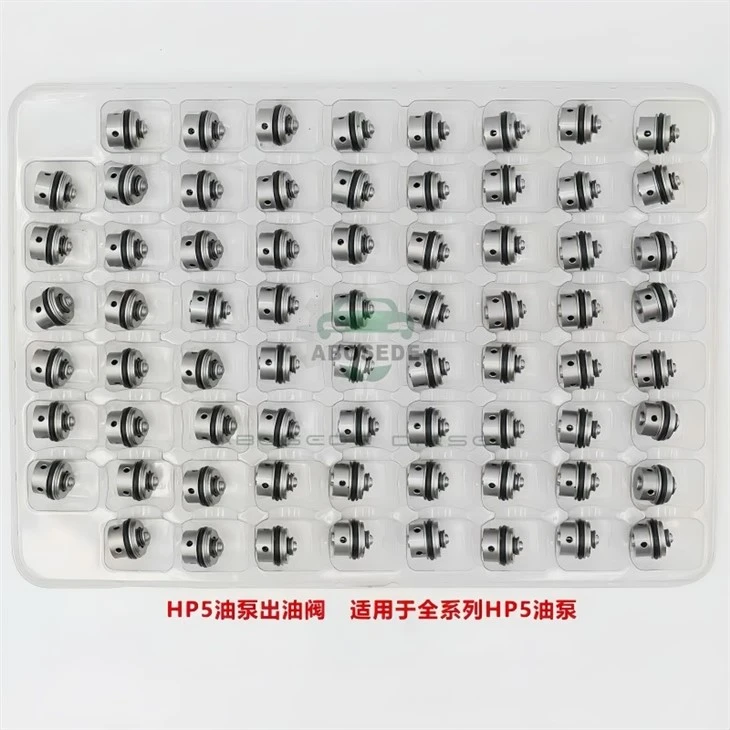
HP5 Delivery Valve – Cutting Overhead, Not Corners, in High-Pressure Fuel Management
1. Product: HP5 Delivery Valve
2. Compatible Equipment: Diesel Fuel Injection Systems
3. Manufacturer: Aftermarket OEM Replacement
4. Condition: Brand New, Fully Tested
5. Origin: ABOSEDE Diesel
6. Shipping period: 3-5 business days
7. Payment terms: T/T, Western Union, PayPal
- Fast Delievery
- Quality Assurance
- 24/7 Customer Service
Product Introduction
For any diesel repair shop or aftermarket supplier, the real cost of a common rail failure isn't just the replacement part-it's the tow-in, the diag hour, the comebacks, and the customer who doesn't return. The HP5 delivery valve sits right at that intersection. When this outlet check begins to drift off-spec, the entire rail loses its hydraulic rhythm. Yet replacing it remains one of the most underutilized fixes in the workshop, largely because most buyers treat it as a passive commodity rather than what it actually is: a pressure-retaining gatekeeper that directly dictates pump longevity and injector survival.
🔧Where the HP5 Pump Actually Wears First
The HP5 pump family-whether single or dual-piston-cycles fuel at extreme repetition rates. Over 200,000 miles, the delivery valve seat and its hardened ball endure millions of sealing impacts. The wear doesn't announce itself with a fault code. Instead, it shows up as a gradual rail pressure droop under load, longer crank times when the engine is hot, and a measurable rise in return flow that throws off the entire fuel quantity calculation. Workshops chasing intermittent drivability complaints often swap sensors, meters, and even injectors before landing on this valve. That diagnostic detour eats profit. Distributors who understand this failure pattern can stock the HP5 outlet valve as a high-turnover remedial SKU, not a dusty shelf-warmer.
🚛One Valve, One Cross-Reference, Multiple European Badges
Rather than juggling separate listings for BMW, Mercedes, VW, Audi, or PSA applications, this component consolidates inventory because the HP5 platform shares a unified outlet geometry. The critical fitment checkpoint isn't the vehicle badge-it's the pump head thread and the 120 Nm seating torque that guarantees the seat stays immobile under pulsation. For cross-border wholesalers, that interchangeability translates to fewer SKUs per container and faster turnaround on mixed orders. For the workshop, it means pulling one bin number for the majority of Euro 5 and Euro 6 HP5-equipped vehicles rolling through the bay, regardless of whether the pump carries a Bosch, DENSO, or Delphi label.
⚙️Installation Discipline That Prevents Repeat Visits
The mechanical routine appears straightforward: seat the valve, place the ball and spring, torque the socket. Yet field returns tell a different story. The dominant failure mode after replacement isn't component quality-it's O-ring pinching during insertion or under-torquing that allows micro-movement at the seat interface. Over time, that movement hammers the sealing surfaces, recreating the very pressure instability the repair was meant to cure. A conical mandrel for seating the valve seat, combined with fresh seals and a rigid 120 Nm final torque, eliminates that variability. Suppliers who include installation notes highlighting these exact pitfalls reduce their technical support load and build trust with shops that value first-time-fix rates over cheap pricing.
📉Why Smart Inventory Managers Treat This as a Consumable
Fleet operators running HP5-powered commercial vehicles typically schedule pump attention around the 200,000–250,000 km mark, but biodiesel blends and extended drain intervals accelerate seal degradation. Rather than waiting for a tow-truck event, proactive distributors position the delivery valve as a preventive maintenance companion to fuel filter changes-low enough in cost to justify routine replacement, yet high enough in impact to prevent injector nozzle damage from pressure fluctuation. That positioning shifts the conversation from "repair" to "protection," which resonates with cost-conscious fleet buyers who track total operating expense per mile, not just part price.
❓FAQ – For Shop Owners and Batch Buyers
Q1: How do I verify if a returned HP5 delivery valve failed from installation error versus material defect?
A: Inspect the O-ring for scuffing or asymmetrical compression-pinch marks point to insertion issues. Also check the ball face for off-center impact patterns; a concentric wear ring suggests normal fatigue, while edge wear indicates seat misalignment during torquing.
Q2: What return rate should I realistically expect from workshops using this valve?
A: With proper installation, sub-0.5% field failure rates are achievable. Most returns stem from torque deviation or reused seals, not manufacturing variance. Providing a one-page torque-and-seat pictorial with each bulk order cuts that number significantly.
Q3: How does this valve behave with high-blend biodiesel (B20–B30) compared to standard diesel?
A: B20+ blends reduce lubricity and accelerate O-ring hardening. We recommend seal inspection at 150,000 km for biodiesel-heavy fleets, though the metal valve components themselves show no accelerated wear due to the nitrided ball and seat materials.
Q4: Can I consolidate HP5 delivery valve inventory across my US and EU warehouses?
A: Yes, the physical dimensions and torque spec are globally identical. However, regional packaging and labeling requirements may differ; we can supply bulk cartons for EU and individually sleeved units for US distributors upon request.
Q5: What is the typical lead-time for restocking 500-unit orders during Q4 peak season?
A: Current production scheduling allows 15-working-day turnaround for quantities under 1,000 pieces, provided advanced forecasting is shared. We recommend placing Q4 orders by late August to avoid airfreight surcharges.
Q6: Does replacing just the delivery valve address rail pressure oscillation, or is pump calibration required afterward?
A: No calibration is mandatory because the valve is a purely mechanical flow limiter-it doesn't interact with the ECU. However, we recommend verifying rail pressure at idle and full load post-installation to confirm the repair, as this also uncovers any underlying metering-unit drift.


Flexible Payment Methods for Your Convenience
To make your purchasing experience smooth and easy, we offer a variety of secure payment options:

Bank Transfer
Supports multiple currenciesand bank payment methods.

Western Union
Quick and global money transfers.

PayPal
Safe and convenient online payment.

Alibaba
Enjoy extra protection with trusted Alibaba transactions.
We're here to make your order process worry-free - choose the payment method that works best for you!
Shipping Made Simple

Customer reviews

Hot Tags: hp5 delivery valve – cutting overhead, not corners, in high-pressure fuel management, China hp5 delivery valve – cutting overhead, not corners, in high-pressure fuel management manufacturers, suppliers, factory, denso valve
You Might Also Like
-

Hardened Gold Coated 34# Injector Valve Plate Ideal ...
-

Denso 096710-0062 – The SCV With Controlled Port Flo...
-

294200-0390 Denso Suction Control Valve – Swirl-Stab...
-

294200-0370 Common Rail Pressure Relief Valve – High...
-

Denso 294180-0080 Gear / Rotor Set – The Small Part ...
-

Pressure Limiting Valve (PLV) For Toyota Common Rail...
