


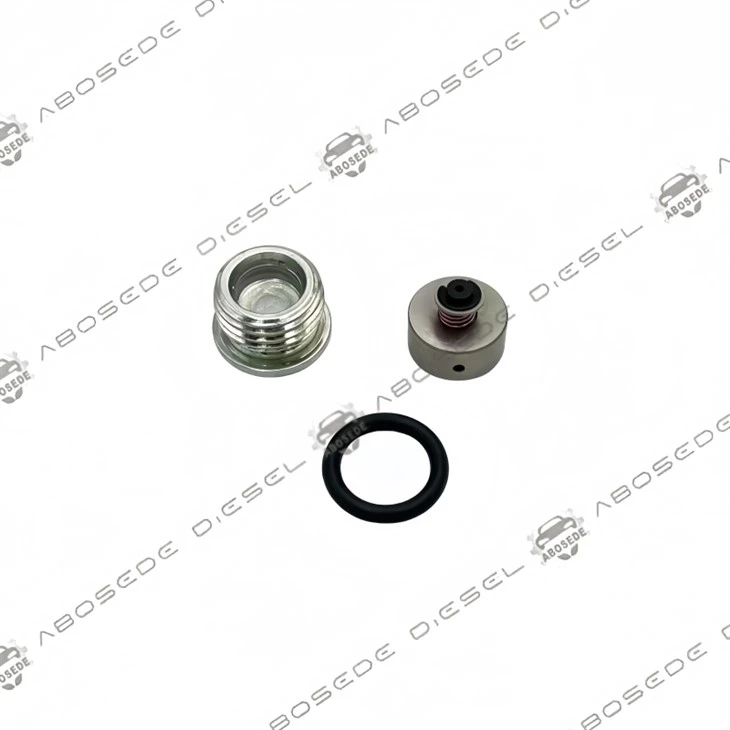

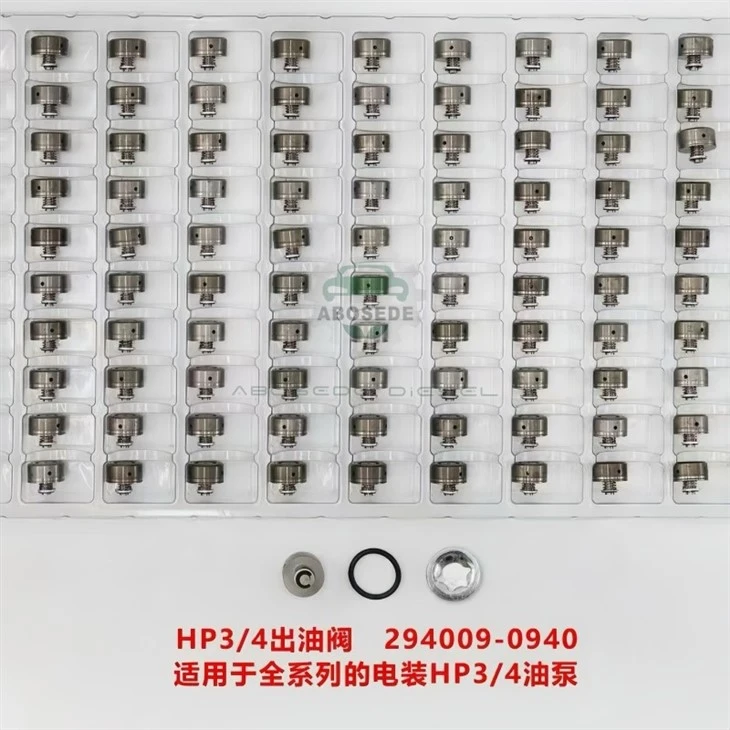
Denso 294009-0940 Delivery Valve – Direct-Fit Pressure Retention Component For HP3/HP4 Rotary Pumps
1. Product:294009-0940
2. Compatible Equipment: Diesel Fuel Injection Systems
3. Manufacturer: Aftermarket OEM Replacement
4. Condition: Brand New, Fully Tested
5. Origin: ABOSEDE Diesel
6. Shipping period: 3-5 business days
7. Payment terms: T/T, Western Union, PayPal
- Fast Delievery
- Quality Assurance
- 24/7 Customer Service
Product Introduction
This outlet valve restores the hydraulic sealing integrity within Denso HP3 and HP4 high-pressure fuel pumps, addressing the primary wear point that allows pressurized fuel to bleed back into the low-pressure gallery. Cataloged under 294009-0940, this spring-loaded check unit directly replaces the factory-installed component without requiring pump bench recalibration. Workshops encountering fault logs pointing to sluggish rail pressure ascent or extended cranking intervals will find this valve resolves those symptoms at a fraction of the cost of pump core exchange, while retaining the original injection timing maps programmed into the engine ECU.
⚙️Dimensional and Metallurgical Benchmarks
The valve assembly consists of a case-hardened guide piston, a chromium-alloy ball, a ground-rate coil spring, and a lapped seat insert. The sealing interface between the ball and the seat undergoes a matched-lapping process to guarantee zero-permeability closure under static pressure. Operating clearance between the guide piston and its bore measures within 8 to 12 micrometres, a tolerance band that directly governs the valve's dynamic response. The 294009-0940 carries an upstream crack pressure setting of 2.2 bar – this figure determines the residual pressure retained in the rail during engine-off soak periods, which in turn affects hot-start vapor lock prevention. All exposed surfaces receive a manganese-phosphate conversion coating to resist oxidative degradation from water-in-fuel emulsions frequently encountered in marine and off-highway service.
🚛Vehicle and Engine Platform Coverage
This valve integrates seamlessly with Denso HP3 (twin-plunger) pumps mounted on 4-cylinder truck engines and Denso HP4 (triple-plunger) pumps used in 6-cylinder heavy configurations. Direct application includes the Hino J05D and J08E series, Isuzu 4HK1 and 6HK1, Nissan Diesel (UD) MD92, and Mitsubishi 4M50 – all platforms that have logged extensive hours in regional distribution and construction fleets. Off-highway compatibility covers Komatsu PC200-8 and Hitachi ZX200 hydraulic excavators, where pump access is often constrained, making a drop-in valve service strategy operationally advantageous. Cross-reference databases list this outlet valve as a service equivalent to the pump-side component referenced in Denso repair kit groupings, confirming its standing as a broadly stocked consumable rather than a model-restricted specialty item.
🔩 Installation Protocol and Fastener Management
Prior to installing the replacement valve, thoroughly cleanse the pump head recess using lint-free wipes and isopropyl alcohol to eliminate carbonised fuel residue. The old seat often bonds to the aluminium housing through galvanic interaction; application of a localized thermal shock using a hot-air tool at 120°C for two minutes breaks the oxide bond without distorting the bore. Introduce the new seat squarely, then seat the ball, spring, and retainer in sequence. The hollow retaining nut demands a torque application of 118–122 Nm – an under-torqued nut induces micro-motion fretting at the seat interface, while over-torquing distorts the seat lip and provokes internal bypass leakage. Post-tightening, cycle the ignition to prime the low-pressure circuit, then observe the rail pressure build-up rate during key-off restarts; the pressure should reach 250 bar within the first three compression strokes to confirm correct valve operation.
📊Commercial Justification for Valve-Level Servicing
Replacing the outlet valve at the component level offers a demonstrable return on investment for independent diesel shops and fleet maintenance depots. The complete HP3 or HP4 pump carries a remanufacturing cost that typically exceeds the valve replacement cost by a factor of six to eight, with core-exchange logistics adding downtime of several days. More critically, a degrading outlet valve directly affects injection quantity stability under transient load – an unseen contributor to DPF soot loading and EGR cooler fouling. By restoring the valve's crack pressure and reseal velocity, the engine regains its original rail pressure slew rate, which in turn maintains the injector energising time tables stored in the ECM. For a workshop offering diagnostic-based repairs, this valve serves as a high-impact, low-complexity intervention that produces measurable improvements in throttle response and a measurable drop in cranking-cycle fuel consumption – advantages that translate directly into customer satisfaction and repeat service bookings.
❓FAQ
Q1: What diagnostic data confirms I am dealing with the delivery valve and not the pump's suction control valve?
A: Monitor the rail pressure setpoint vs. actual value during a wide-open-throttle pull from 1,200 to 2,200 rpm. A failing delivery valve shows a persistent negative deviation exceeding 100 bar specifically during the second half of the acceleration ramp, whereas SCV issues manifest as deviation across the entire load spectrum. Additionally, perform a leak-back test on the rail pressure sensor signal during engine-off; pressure should not drop below 50 bar within the first 60 seconds – a steeper decay points directly to outlet valve seat leakage .
Q2: Can I swap this valve between HP3 and HP4 pumps without altering the pump's flow calibration?
A: Yes. The 294009-0940 maintains identical flow coefficient values across both pump families because the valve only dictates the pressure-holding function, not the volumetric filling rate controlled by the SCV. Swapping it requires no pump recalibration or injector code re-entry, as the ECU adaptation values remain within their learnable range .
Q3: What is the typical failure mechanism for this outlet valve in high-hour construction equipment?
A: Abrasive wear from silica particles that bypass the primary fuel filter is the leading cause. These particles erode the lapped seat, producing a circumferential groove that prevents the ball from achieving full surface contact. The secondary failure mode is spring fatigue – after roughly 6 million compression cycles, the spring free-length reduces, lowering the crack pressure and allowing pre-injection fuel weep into the injector return lines .
Q4: Is there a visual inspection method to differentiate a genuine Denso-spec valve from a generic substitute?
A: Yes. The factory-spec valve displays a micro-engraved 3-character lot code on the outer rim of the retaining flange. Generic substitutes lack this engraving and often show a visibly coarser surface finish on the seat lapping angle. A quick magnification check will confirm whether the valve meets the RA 0.2 surface roughness requirement essential for proper sealing .
Q5: How does replacing this valve affect the pump's prime retention during fuel filter changes?
A: The valve directly preserves the column of fuel within the high-pressure head. With a fresh seat, the pump holds prime for up to 48 hours of engine-off time, which means after a filter change, the hand-primer pump requires roughly 30% fewer strokes to re-pressurise the system – a practical time-saver for field service technicians performing routine maintenance .
Q6: If the engine exhibits a rough idle with rail pressure oscillations of ±40 bar, is this valve a probable cause?
A: Rough idle with low-frequency oscillation is not typical for a failed delivery valve; that profile more closely matches a sticky SCV or a worn pump plunger. The delivery valve failure at idle usually produces a steady but permanently offset pressure reading (e.g., command 350 bar, actual 280 bar) rather than oscillation. Check SCV duty-cycle first before condemning the outlet valve .


Flexible Payment Methods for Your Convenience
To make your purchasing experience smooth and easy, we offer a variety of secure payment options:

Bank Transfer
Supports multiple currenciesand bank payment methods.

Western Union
Quick and global money transfers.

PayPal
Safe and convenient online payment.

Alibaba
Enjoy extra protection with trusted Alibaba transactions.
We're here to make your order process worry-free - choose the payment method that works best for you!
Shipping Made Simple

Customer reviews

Hot Tags: denso 294009-0940 delivery valve – direct-fit pressure retention component for hp3/hp4 rotary pumps, China denso 294009-0940 delivery valve – direct-fit pressure retention component for hp3/hp4 rotary pumps manufacturers, suppliers, factory, denso valve
You Might Also Like
-

18# Titanium Alloy Golden Coating Injector Control P...
-

294200-2750 Denso Suction Control Valve – High-Bandw...
-

294200-0167 Denso Fuel Inlet Regulator Solenoid, OEM...
-

A6860VM09A Denso Suction Control Valve SCV Valve Com...
-

294200-2960 — Suction Control Valve (SCV) For Diesel...
-

China New High Quality Diesel Fuel Injector Valve Pl...
