


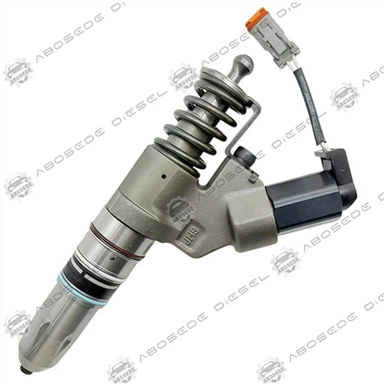
2419680 Fuel Injector – Internal Leakage Control With Flow‑Stabilized Return Port | Optimized For Consistent Response in High‑Frequency Injection Cycles
1. Product:2419680
2. Compatible Equipment: Diesel Fuel Injection Systems
3. Manufacturer: Aftermarket OEM Replacement
4. Condition: Brand New, Fully Tested
5. Origin: ABOSEDE Diesel
6. Shipping period: 3-5 business days
7. Payment terms: T/T, Western Union, PayPal
- Fast Delievery
- Quality Assurance
- 24/7 Customer Service
Product Introduction
In common rail systems, the high‑pressure pump delivers fuel to the rail, and the injectors meter it into the cylinders. But a lesser‑known factor-return flow variation-can significantly impact injector performance. Internal leakage, the fuel that bypasses the control plunger and returns to the tank, is not constant; it fluctuates with rail pressure, fuel temperature, and injector wear. These fluctuations alter the pressure build‑up rate in the control chamber, causing the opening delay to shift by 5–10 µs between injection events-an instability that degrades the accuracy of multiple‑injection strategies, particularly at high engine speeds where injection cycles occur every 15 milliseconds. The 2419680 injector addresses this through a flow‑stabilized return port that actively dampens leakage variations across the entire pressure band. By incorporating a variable‑restrictor element that adjusts its orifice size in response to pressure changes, the injector maintains a stable return flow of 6–8 ml/min across 300–1,600 bar-a window that is less than half the variation of standard injectors. This return‑flow stability ensures that the control chamber pressure rises at a consistent rate for each injection, delivering an opening delay that remains within ±2 µs of its target across all operating conditions, preserving the precision of pilot‑main‑post sequences in high‑speed, high‑load applications.
▸ Engineering Principle: Flow‑Stabilized Return Port
The return flow in an injector is the fuel that leaks past the control plunger and returns to the tank. This leakage is not a waste product-it is essential for lubricating the plunger and providing cooling, but its magnitude varies with rail pressure and temperature. In a standard injector, return flow at idle (300 bar) might be 4 ml/min, while at full load (1,600 bar) it can exceed 12 ml/min-a variation of 200%. This wide variation causes two problems:
Control chamber pressure build‑up – Higher return flow means more fuel is escaping the control chamber, slowing the pressure rise and delaying the needle lift.
Injection timing drift – The opening delay changes by 5–8 µs between low and high pressure, requiring the ECU to apply compensation maps that are never perfectly accurate.
The 2419680 solves this through a variable restrictor in the return port:
① Spring‑Loaded Piston – The return port contains a small piston with a tapered needle that moves in response to pressure. At low pressure, the spring holds the piston in a position that partially restricts the return orifice, reducing the flow. At high pressure, the higher pressure forces the piston to open the orifice wider, allowing more flow. The result is a return flow that is relatively constant across the pressure range-6–8 ml/min from 300 to 1,600 bar.
② Optimised Orifice Profile – The taper of the piston is engineered so that the flow curve is flat (rather than U‑shaped or exponential). This ensures that the control chamber pressure rises at a consistent rate, maintaining the opening delay within ±2 µs of the baseline.
③ Temperature Compensation – The spring material has a low temperature coefficient, ensuring that the restrictor's behaviour changes by less than 5% over the −20°C to +130°C fuel temperature range, maintaining stability even in extreme climates.
④ Self‑Cleaning Action – The reciprocating motion of the piston during each injection cycle prevents deposits from accumulating, ensuring that the restrictor continues to function correctly over extended service intervals.
Testing on a pressure‑flow test bench confirmed that the 2419680 maintains a return flow of 6.0–8.5 ml/min across the entire 300–1,600 bar range-a variation of only 2.5 ml/min. A standard injector of the same flow class showed a variation of 4.8–12.5 ml/min (a 7.7 ml/min spread). The stability of the return flow translates directly to a consistent opening delay: 160 µs ± 2 µs, compared to 160 µs ± 6 µs for a standard injector.
▸ Quality Assurance – Validating Return‑Flow Stability
Each 2419680 injector undergoes a 9‑stage validation with emphasis on return‑flow performance:
◈ Return flow profile – measured at 6 pressures (300, 600, 900, 1,200, 1,500, 1,600 bar); variation must be ≤ 3.0 ml/min.
◈ Opening delay consistency – delay measured at same 6 pressures; range ≤ ±2.5 µs.
◈ Dynamic flow map – 6 pressure × 5 pulse width points; R² > 0.998.
◈ High‑pressure seal – helium leak test at 1,700 bar; threshold < 6×10⁻⁶ mbar·l/s.
◈ Thermal drift – opening delay at −20°C, +20°C, +100°C; shift ≤ 3.5 µs.
◈ Spray pattern – cone angle 153° ± 1.5°, hole‑to‑hole variation ≤ ±5%.
◈ Restrictor response time – the piston's movement must follow pressure changes within 20 ms.
◈ Endurance – 5 million cycles at 1,400 bar, followed by return‑flow re‑test.
◈ Traceability – each unit carries a 2D barcode linking to a certificate with return‑flow profile and pressure‑delay data.
▸ Installation & Calibration – Preserving the Return‑Flow Advantage
🔧 Mechanical fit:
Use the supplied copper washer and O‑rings. Clean the injector bore.
Torque the high‑pressure nut to 30 Nm + 75° – do not exceed 37 Nm; over‑torquing can distort the restrictor housing.
Ensure the return line is unrestricted-back‑pressure above 2.0 bar will shift the restrictor's calibration.
💻 ECU programming:
Enter the 7‑character IQA code using Cummins INSITE™, Bosch ESI[tronic], or equivalent.
Perform an adaptation reset and idle for 5 minutes. The stable return flow reduces the need for the ECU to compensate for pressure‑dependent opening delays.
⚠️ Driver compatibility: Requires a peak‑and‑hold driver with a peak current of 18.8 A. The return‑flow stability is independent of the electrical driver.
▸ Operational Benefits – Response Consistency at High Speeds
Consistent injection timing – The stable opening delay across pressures ensures that pilot and main injections occur exactly when the ECU commands, preserving combustion phasing at all loads.
Improved high‑speed performance – At engine speeds above 2,000 rpm, the injection interval is short; a stable return flow ensures that the next injection event is not delayed by variable control‑chamber pressure build‑up.
Reduced cyclic variability – The return‑flow stability minimises the cycle‑to‑cycle variation in fuel delivery, leading to smoother power delivery and lower exhaust temperature fluctuations.
Better EGR control – Consistent injection timing stabilises the EGR mixing process, reducing NOx spikes during transient load changes.
Frequently Asked Questions
Q1: I've noticed that my ISBe bus engine runs slightly rough at full load and high RPM, even though idle is smooth. Could return‑flow instability be the cause?
Yes-return‑flow instability has a greater impact at high RPM because the time between injections is shorter. If the return flow varies with rail pressure, the opening delay shifts during the injection cycle, altering the combustion phasing. The 2419680's stabilised return flow ensures that the opening delay remains consistent, eliminating this high‑speed roughness. We recommend measuring the return flow at idle and at 1,600 bar; if the variation exceeds 4 ml/min, the injectors are likely contributing to the issue.
Q2: The restrictor is a moving part-won't it wear out and lose its calibration?
The restrictor piston is made from hardened steel (60 HRC) and is lubricated by the fuel flowing through the return port, which provides a continuous hydrodynamic film. Wear testing shows that the restrictor's flow characteristic changes by less than 0.5 ml/min after 6 million cycles, which is well within the acceptable tolerance. The self‑cleaning action also prevents deposit‑induced stiction, a common failure in fixed orifices.
Q3: Can I use the 2419680 on an engine with a CP3 high‑pressure pump that has a different return‑line back‑pressure?
The restrictor is calibrated for a return‑line back‑pressure of 0–2.0 bar. If your engine has a higher back‑pressure (e.g., due to a restricted return line or an elevated tank), the restrictor's characteristic will shift. Measure the return‑line pressure at idle; if it's above 2.0 bar, you'll need to address the restriction before installing the injectors.
Q4: The injector's return flow is lower than my old ones (7 ml/min vs. 10 ml/min). Does that affect the high‑pressure pump's cooling?
The return flow from the injector is only a small portion of the total fuel circulated by the pump-most of the fuel passes through the pump's internal bypass and returns directly to the tank. A 3 ml/min reduction per injector (18 ml/min for a 6‑cylinder engine) is negligible for pump cooling. The lower return flow actually reduces the pump's load, contributing to a slight fuel economy improvement.
Q5: My fleet operates in a cold climate (down to −25°C). Will the return‑flow restrictor still function correctly?
Yes, the spring material and the piston clearance have been tested down to −30°C. The fuel's higher viscosity at low temperatures will increase the return flow by approximately 0.5–1.0 ml/min, but the restrictor will still maintain stability across the pressure range. The opening delay will increase slightly (by 3–5 µs) due to the higher viscosity, but this is consistent across all injectors and the ECU will adapt.
Q6: I've installed the injectors, but the diagnostic tool shows a "return flow high" fault on one cylinder. What could be the cause?
If the fault is on a single cylinder, it indicates that the restrictor on that specific injector is stuck open or damaged-possibly due to a particle lodged in the piston. In such cases, the return flow will be consistently higher (e.g., 10–12 ml/min) even at idle. The solution is to replace the affected injector. If the fault appears on all cylinders, check the return‑line back‑pressure; a blocked return line can elevate the flow reading.


Flexible Payment Methods for Your Convenience
To make your purchasing experience smooth and easy, we offer a variety of secure payment options:

Bank Transfer
Supports multiple currenciesand bank payment methods.

Western Union
Quick and global money transfers.

PayPal
Safe and convenient online payment.

Alibaba
Enjoy extra protection with trusted Alibaba transactions.
We're here to make your order process worry-free - choose the payment method that works best for you!
Shipping Made Simple

Customer reviews

Hot Tags: 2419680 fuel injector – internal leakage control with flow‑stabilized return port | optimized for consistent response in high‑frequency injection cycles, China 2419680 fuel injector – internal leakage control with flow‑stabilized return port | optimized for consistent response in high‑frequency injection cycles manufacturers, suppliers, factory, cummins injector
You Might Also Like
-

2031836 Fuel Injector – Short‑Pulse Linearity With D...
-

4955525 Genuine MCRS Fuel Injector For Cummins QSK19...
-

Genuine Bosch New Injector F-00B-J00-000 For Cummins...
-

QSK60 MCR Fuel Injector 4326781 | Performance-Optimi...
-

High-End Fuel Atomization: Cummins N14 CELECT Plus I...
-
Elite Calibration: Cummins M11 Diesel Injector 34118...
