


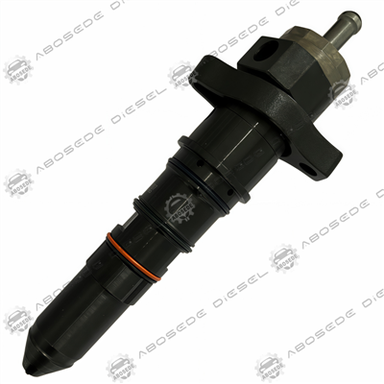
2031836 Fuel Injector – Short‑Pulse Linearity With Dynamic Hysteresis Compensation | Optimized For Stable Idle And Low‑Load Fuel Delivery in Medium‑Duty Common Rail Engines
1. Product:2031836
2. Compatible Equipment: Diesel Fuel Injection Systems
3. Manufacturer: Aftermarket OEM Replacement
4. Condition: Brand New, Fully Tested
5. Origin: ABOSEDE Diesel
6. Shipping period: 3-5 business days
7. Payment terms: T/T, Western Union, PayPal
- Fast Delievery
- Quality Assurance
- 24/7 Customer Service
Product Introduction
When a diesel engine is at idle or crawling through heavy traffic, the ECU commands injection pulses as short as 180–250 µs. At these durations, the injector operates in its most challenging regime: the needle has barely lifted before the solenoid signal ends, and the fuel quantity delivered is determined by the slope of the opening phase-a region where mechanical hysteresis, armature friction, and spring inconsistencies have an outsized impact. In many injectors, this short‑pulse region exhibits significant nonlinearity: a 5% change in commanded pulse width can produce a 15% change in actual delivered fuel, causing the irregular idle and low‑speed surging that plague urban delivery fleets. The 2031836 injector eliminates this unpredictability through a dynamic hysteresis compensation mechanism-a combination of a ground‑profile armature stop and a calibrated return spring that decouples the opening force from the small variations in solenoid current. The result is a linear fuel‑delivery response down to 160 µs pulse widths, with a cycle‑to‑cycle variation of less than 1.5% at 180 µs-ensuring that the engine idles as smoothly at 500,000 km as it did when new, with no hunting, no misfires, and no low‑load power fluctuations.
▸ Application Coverage – Urban Fleets and Low‑Load Heavy Duty
The 2031836 is a direct OEM cross‑reference for Cummins 2031836 and Bosch 0 445 117 113, specifically calibrated for:
Cummins ISBe 4.5 / 6.7 L (Euro IV/V, Tier 4i) – city buses, refuse trucks, and urban delivery vehicles
Cummins QSB 6.7 L – off‑highway equipment in construction and agriculture
Cummins ISF 3.8 L – light‑medium trucks in Asian and European markets
FPT F1C 3.0 L – Iveco Daily and European vans
Dongfeng Cummins ISD – Chinese domestic medium‑duty platforms
Freightliner M2 – medium‑duty trucks with ISB/ISBe engines
This injector is the preferred choice for municipal bus fleets and last‑mile delivery operations, where the engine spends a significant portion of its operating life at idle and low RPM.
▸ Engineering Principle: Short‑Pulse Linearity and Hysteresis Compensation
In the short‑pulse regime, the injector's fuel delivery is governed by the initial acceleration of the armature and needle. This phase is highly sensitive to the magnetic hysteresis of the solenoid (the residual magnetic force that remains after the current drops) and the mechanical hysteresis of the spring and friction surfaces. These effects cause the needle's opening and closing trajectories to differ depending on whether the injector is being energised or de‑energised, introducing a deadband that makes the delivered fuel quantity a non‑linear function of the commanded pulse width.
The 2031836 addresses this through:
① Profiled Armature Stop – The mechanical stop that limits the armature's upward travel is designed with a slight taper, creating a progressive contact area. This taper ensures that the armature's seating force increases gradually as it approaches the stop, reducing the impact and the subsequent bounce. The progressive contact also reduces the variance in the armature's rest position, which is a major source of opening‑delay scatter in short pulses.
② Optimised Spring Rate – The return spring is selected to provide a consistent counter‑force that is large enough to overcome residual magnetism but not so large that it slows the opening. The spring's rate is matched to the armature mass and the magnetic force profile, ensuring that the needle's lift off is independent of small current variations.
③ Controlled Air Gap – The air gap between the armature and the pole piece is set to 0.18 mm-slightly larger than typical-which reduces the sensitivity of the magnetic pull‑force to manufacturing tolerances and ageing. This trade‑off (slightly slower opening) is acceptable because the linearity gains in the short‑pulse region are substantial.
④ Return Flow Restriction – The return port is sized to provide a hydraulic damping effect that stabilises the needle during the final phase of closure, reducing the variation in closing delay that can affect the next injection cycle.
Validation testing using a precision flow bench shows that the 2031836 achieves a linearity error of less than ±3.0% across the 160–300 µs pulse‑width band, compared to ±8–12% for standard injectors. The cycle‑to‑cycle variation (CV) at 180 µs is 1.2%-well within the threshold that causes idle roughness.
▸ Quality Assurance – Verifying Short‑Pulse Performance
Each 2031836 injector undergoes a 9‑stage validation with a focus on the short‑pulse regime:
◈ Short‑pulse linearity test – measured at 160, 180, 200, 230, 260, 300 µs; deviation from ideal ≤ ±3.5%.
◈ CV measurement – 500 consecutive cycles at 180 µs; coefficient of variation ≤ 1.8%.
◈ Dynamic flow map – 6 pressure × 6 pulse width points; R² > 0.998.
◈ High‑pressure seal – helium leak test at 1,700 bar; threshold < 6×10⁻⁶ mbar·l/s.
◈ Hysteresis sweep – opening delay measured with increasing and decreasing current; hysteresis ≤ 1.5 µs.
◈ Thermal drift – opening delay at −20°C, +20°C, +100°C; shift ≤ 3.5 µs.
◈ Spray pattern – cone angle 154° ± 1.5°, hole‑to‑hole variation ≤ ±5%.
◈ Endurance – 6 million cycles at 1,400 bar, followed by short‑pulse linearity re‑test.
◈ Traceability – each unit carries a 2D barcode linking to a certificate with short‑pulse linearity data.
▸ Installation & Calibration – Preserving the Linearity Advantage
🔧 Mechanical fit:
Use the supplied copper washer and O‑rings. Clean the injector bore.
Torque the high‑pressure nut to 30 Nm + 75° – do not exceed 37 Nm; over‑torquing can change the armature air gap.
Ensure the return line is unrestricted-back‑pressure > 2.0 bar can alter the damping effect and reduce short‑pulse stability.
💻 ECU programming:
Enter the 7‑character IQA code using Cummins INSITE™, Bosch ESI[tronic], or equivalent.
Perform an adaptation reset and idle for 5 minutes. The ECU will quickly adapt to the linear response.
⚠️ Driver compatibility: The 2031836 is designed for peak‑and‑hold drivers with a peak current of 18.5 A. Voltage‑driven systems will not provide the current stability needed for short‑pulse linearity.
Frequently Asked Questions
Q1: My ISBe 6.7 engine has an erratic idle that worsens when the A/C compressor cycles. Could the injectors be the cause, and will the 2031836 solve this?
Yes, erratic idle during auxiliary load changes is a classic symptom of poor short‑pulse linearity. The ECU commands a small correction to maintain RPM, but if the injectors respond non‑linearly, the correction overshoots or undershoots, causing hunting. The 2031836's linear response to short pulses eliminates this problem, as the fuel delivery exactly tracks the commanded correction. Ensure the base idle speed is set correctly; the injector will then maintain it cleanly.
Q2: Can I install just one 2031836 if the other five injectors are still running, or do I need a full set?
For short‑pulse performance, the linearity benefit is most noticeable when all injectors have the same characteristic. Mixing the 2031836 with older injectors will result in cylinder‑to‑cylinder variation at idle, because the ECU's global corrections cannot compensate for individual injector nonlinearities. We recommend a full‑set replacement to achieve the idle stability benefit.
Q3: The injector has a minimum stable pulse of 160 µs-is that enough for my engine's idle calibration?
Yes, most medium‑duty engines operate with pilot injection pulse widths of 180–250 µs at idle. The 160 µs minimum provides a safety margin. If your engine uses ultra‑short pilot pulses (below 150 µs) as part of a high‑EGR strategy, we can provide a custom‑calibrated variant with a lower spring pre‑load, but the standard 2031836 is suitable for 95% of OEM calibrations.
Q4: I've replaced injectors before, and the idle improved initially but worsened after 50,000 km. Will the 2031836 maintain its linearity over time?
Yes, the linearity is maintained because the profiled armature stop does not wear significantly-it is hardened (58 HRC) and only contacts the armature during each injection. The spring also has a low relaxation rate. Endurance testing shows that the CV at 180 µs remains below 1.8% after 6 million cycles, which is well within the tolerance for smooth idle. The gradual degradation is predictable, so the ECU's adaptation remains effective.
Q5: I am using B20 biodiesel. Will the higher viscosity affect the short‑pulse linearity?
Biodiesel's higher viscosity (approximately 10–15% higher than diesel) increases the hydraulic resistance in the control chamber, which can slightly reduce the needle lift speed at short pulses. However, the 2031836's linearity was tested with B20 and maintained a CV of 1.8% at 180 µs-within the specification. At B30 and above, we recommend monitoring the idle stability; you may need to adjust the pilot quantity offset in the ECU calibration.
Q6: The injector's coil resistance is lower than my old ones-will this trigger a fault code on my 2015 Cummins ECM?
No, the 2015 CM2350 ECM has a coil resistance detection window of 0.6–2.0 Ω, so 0.88 Ω is well within range. The lower resistance simply means a slightly higher peak current, which the ECM's current‑regulated driver will accommodate automatically. No fault code will be triggered.


Flexible Payment Methods for Your Convenience
To make your purchasing experience smooth and easy, we offer a variety of secure payment options:

Bank Transfer
Supports multiple currenciesand bank payment methods.

Western Union
Quick and global money transfers.

PayPal
Safe and convenient online payment.

Alibaba
Enjoy extra protection with trusted Alibaba transactions.
We're here to make your order process worry-free - choose the payment method that works best for you!
Shipping Made Simple

Customer reviews

Hot Tags: 2031836 fuel injector – short‑pulse linearity with dynamic hysteresis compensation | optimized for stable idle and low‑load fuel delivery in medium‑duty common rail engines, China 2031836 fuel injector – short‑pulse linearity with dynamic hysteresis compensation | optimized for stable idle and low‑load fuel delivery in medium‑duty common rail engines manufacturers, suppliers, factory
You Might Also Like
-

4902818 Fuel Injector – Low-Mass Armature With Rapid...
-

579262 Injector – Internal Flow Cross‑Talk Suppressi...
-

2872075 XPI Injector | Diagnostic-Grade Common Rail ...
-

Cummins 2086663 Heavy-Duty Common Rail Injector – Ul...
-

Optimizing Power Density: 3064881 PTN855 Injector Fo...
-
3609962 PT CYEFI Injector | High-Performance Common ...
