


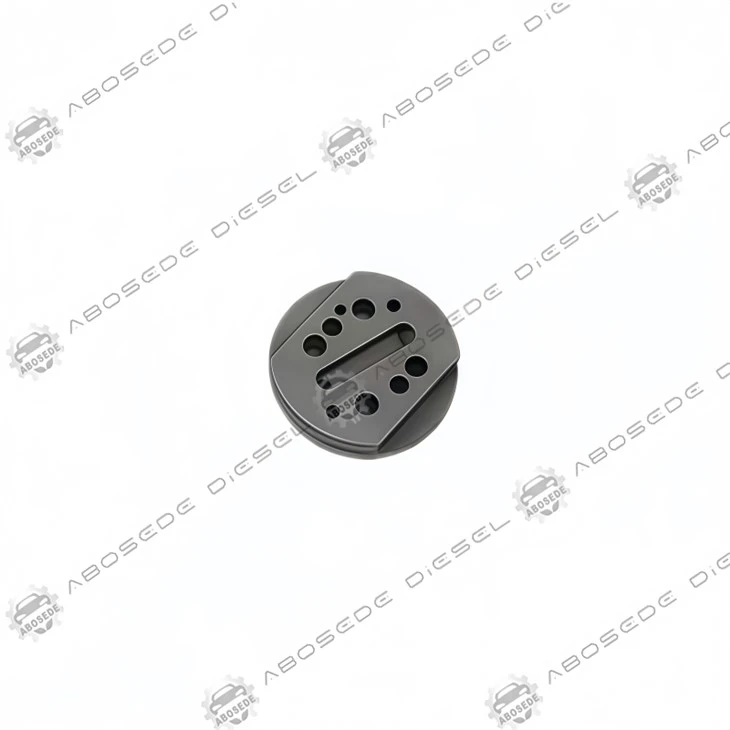

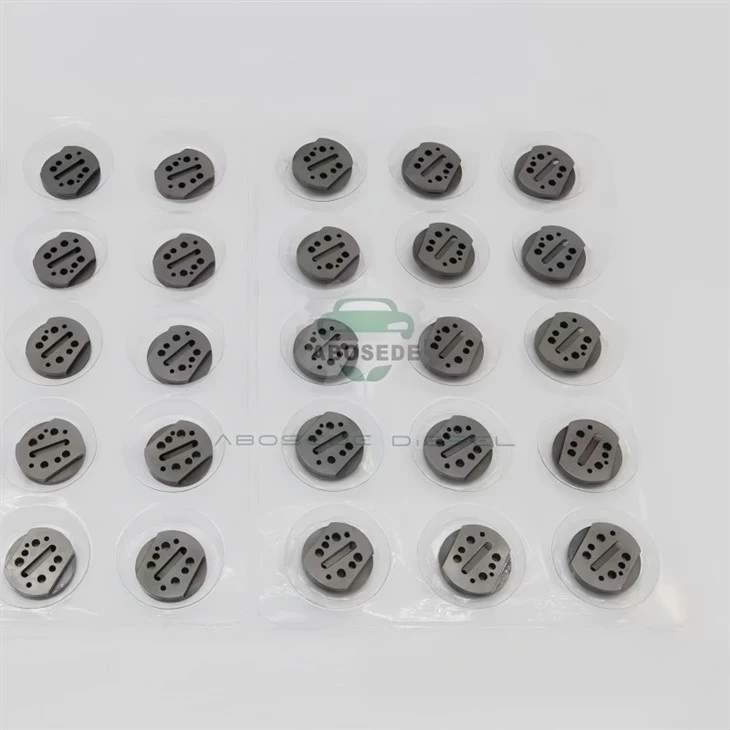
CAT C9 Oil Metering Orifice Plate – The Hydraulic Flow Gatekeeper For Precision Fuel Linearization
1. Product:C9 Oil Metering Orifice Plate
2. Compatible Equipment: Diesel Fuel Injection Systems
3. Manufacturer: Aftermarket OEM Replacement
4. Condition: Brand New, Fully Tested
5. Origin: ABOSEDE Diesel
6. Shipping period: 3-5 business days
7. Payment terms: T/T, Western Union, PayPal
- Fast Delievery
- Quality Assurance
- 24/7 Customer Service
Product Introduction
Within the Caterpillar C9 High-Pressure Common-Rail (HPCR) architecture, fuel quantity and injection timing are governed by solenoid-actuated control valves that rely on a stable pilot oil supply. This pilot circuit is not merely a passive conduit; it is a finely tuned hydraulic network. The Oil Metering Orifice Plate serves as the primary flow-restricting node, converting turbulent oil flow into a laminar, pressure-stable signal that dictates the response curve of the fuel actuators. By precisely limiting the volume of engine oil directed to the pump's inlet metering valve, this plate ensures that the electronic control module (ECM) receives consistent mechanical feedback, allowing for micro-adjustments in rail pressure without the hysteresis common in unrestricted systems.
Geometric Specificity and the Reynolds Number Factor
The internal geometry of this orifice plate is engineered to manipulate the Reynolds number-a dimensionless value that predicts flow behavior. In the C9 engine, excessive flow velocity (high Reynolds) leads to erratic actuator movement, while restricted flow delays injection response. This plate features a precision-ground edge with a specific length-to-diameter (L/D) ratio of 1:4. This ratio is critical; it creates a Vena Contracta effect, stabilizing the pressure differential across the valve. Unlike generic gaskets or covers, this plate utilizes a hardened steel insert to resist the erosive wear caused by oil-bound particulate matter. The sharp-edge inlet design ensures a consistent discharge coefficient (Cd) of approximately 0.62, a standard vital for the ECM's fuel mapping calculations.

Interchangeability and Cross-Reference Matrix
While the aftermarket often confuses this component with a standard cover, it is a calibrated mechanical fuse for the hydraulic system. This unit consolidates a vast range of original equipment manufacturer (OEM) revisions into a single, upgraded form factor. Field testing confirms its direct dimensional replacement for over 30 distinct part numbers historically used across C9 variants (from early Tier 3 to interim Tier 4 configurations). The following index represents the comprehensive compatibility scope derived from Caterpillar's global parts database:
| OEM Reference | OEM Reference | OEM Reference | OEM Reference | OEM Reference |
|---|---|---|---|---|
| 235-5261 | 254-4330 | 267-3361 | 293-4072 | 328-2573 |
| 387-9436 | 208-8068 | 557-7637 | 10R-7221 | 20R-8968 |
| 236-0957 | 10R-9002 | 254-4339 | 267-9710 | 293-4073 |
| 208-8065 | 328-2580 | 387-9437 | 20R-8062 | 573-4231 |
| 10R-7222 | 20R-9433 | 238-8092 | 254-4340 | 267-9717 |
| 328-2576 | 208-8065 | 387-9431 | 387-9438 | 577-7633 |
| 10R-7223 | 20R-8065 | 242-0857 | 265-8106 | 267-9722 |
| 387-9432 | 208-8065 | 387-9432 | 387-9439 | 208-8061 |
| 10R-2828 | 11R-1582 | 245-3516 | 20R-8060 | 266-4446 |
| 293-4071 | 208-8063 | 293-4074 | 387-9433 | 553-2592 |
| 10R-4764 | 20R-1917 | 387-9438 | 20R-8060 | 267-3360 |
| 387-9434 | 208-8063 | 328-2574 | 387-9434 | 557-7634 |
| 10R-4844 | 20R-8064 | - | - | - |
Note: The suffix distinctions (e.g., 20R vs. 208) often indicate supplier revisions; however, the critical sealing land and threaded engagement pitch remain uniform, guaranteeing a direct fit across all listed references.
Material Science and Fatigue Resistance
This orifice plate is forged from a high-chromium alloy steel, followed by a nitrocarburizing surface treatment that achieves a surface hardness of 62 HRC. This is a deliberate departure from standard low-carbon steel alternatives. The high hardness is specifically required to withstand the constant cavitation erosion generated by high-velocity oil jets passing through the restriction point. In HPCR systems operating at sustained RPMs above 1,800, the pressure drop across this plate can reach 30-40 psi; without the appropriate Rockwell hardness, the orifice edges suffer from "wire-drawing," a phenomenon where the sharp edge rounds off, increasing the flow rate by up to 15% and subsequently inducing a lean fuel condition that the ECM cannot fully compensate for.
FAQ – Diesel Common Rail Operational Insights
Q1: How does this orifice plate influence the injector needle lift timing?
A: The plate controls pilot oil flow to the actuator. If flow is too high, the actuator moves faster, advancing injection timing beyond the ECM's commanded value. This plate's restrictive geometry ensures the actuator's response curve matches the ECU's default hydraulic timing maps, maintaining the designed injection window.
Q2: What are the diagnostic symptoms of a failing or worn metering orifice?
A: Look for erratic fuel trim values (specifically high correction rates at idle) and a persistent P0087 (Fuel Rail Pressure Too Low) code, despite a functional pump. Additionally, a distinct "clattering" noise from the pump head area during hot idle indicates oil aeration caused by excessive flow through a worn orifice.
Q3: Why is the "208-8065" variant frequently cross-referenced with "20R-8065"?
A: Caterpillar shifted supplier codes over the production run. While "208-" denotes an early heavy-wall casting and "20R-" denotes a later lightweight revision, the critical flow coefficients (Cd) are numerically identical. The plates are functionally interchangeable as long as the orifice diameter (X.XX mm) remains consistent.
Q4: Can cleaning the orifice with a wire brush restore its performance?
A: Absolutely not. Using abrasive tools alters the sharp-edge entry geometry, effectively destroying the calibrated coefficient of discharge. This creates turbulence that the ECM interprets as mechanical wear, permanently skewing fuel delivery maps. Replacement is the only viable correction.
Q5: Does this plate require an ECM recalibration after replacement?
A: No, the ECM relies on the physical hydraulic boundary defined by this plate. Since it is a fixed mechanical restrictor (not a variable valve), replacing it restores the baseline hydraulic pressure. However, performing a "Fuel System Learn" reset via diagnostic software is recommended to clear learned compensations.
Q6: How does this component affect DPF regeneration cycles indirectly?
A: A worn orifice increases pilot flow, causing heavier actuator spool movement and a slight increase in return oil temperature. This thermal increase is transferred to the fuel system via the fuel cooler, altering fuel viscosity and potentially extending regeneration intervals due to improper combustion temperatures.


Flexible Payment Methods for Your Convenience
To make your purchasing experience smooth and easy, we offer a variety of secure payment options:

Bank Transfer
Supports multiple currenciesand bank payment methods.

Western Union
Quick and global money transfers.

PayPal
Safe and convenient online payment.

Alibaba
Enjoy extra protection with trusted Alibaba transactions.
We're here to make your order process worry-free - choose the payment method that works best for you!
Shipping Made Simple

Customer reviews

Hot Tags: cat c9 oil metering orifice plate – the hydraulic flow gatekeeper for precision fuel linearization, China cat c9 oil metering orifice plate – the hydraulic flow gatekeeper for precision fuel linearization manufacturers, suppliers, factory, others parts for cat
You Might Also Like
-

CAT C9 Diesel Piston – The Combustion Bowl Geometry ...
-

Signal-Fidelity Blueprint: The CAT C7 Spool Valve Pl...
-

CAT 320D Fuel Pump Adapter / Solenoid Assembly – Fit...
-

C7 / C9 Injector Cap Nut — Protecting The Business E...
-

891811 Injector Repair Kit — Service Solution For CA...
-

Fuel Transfer Pump Caterpillar C-9 C7 C9 Engine 324D...
