


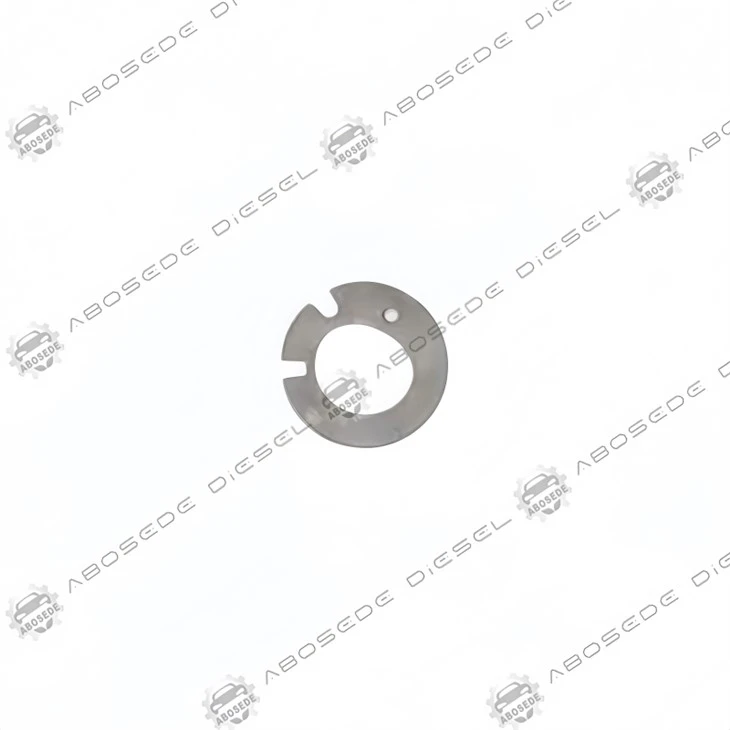


CAT C12 Control Valve Gasket – Load-Bearing Interface With Integrated Crush Limiter | 1.30mm Nominal Height
1. Product:C12 Control Valve Gasket
2. Compatible Equipment: Diesel Fuel Injection Systems
3. Manufacturer: Aftermarket OEM Replacement
4. Condition: Brand New, Fully Tested
5. Origin: ABOSEDE Diesel
6. Shipping period: 3-5 business days
7. Payment terms: T/T, Western Union, PayPal
- Fast Delievery
- Quality Assurance
- 24/7 Customer Service
Product Introduction
Within the Caterpillar C12 MEUI (Mechanically actuated Electronically controlled Unit Injector) architecture, the control valve gasket is neither a seal nor a flow restrictor in the conventional sense. It serves as a load-bearing spacer whose primary function is to translate the retainer bolt's torque into a precise clamping force that establishes the control valve's working clearance. This clearance-typically 0.08–0.12mm between the valve poppet and the gasket's inner face-determines the "dead band" at the beginning of the solenoid actuation. The ECM's injection timing calculations assume a specific dead band duration; a gasket that has thinned reduces this clearance, causing the valve to respond sooner than expected, effectively advancing injection timing by up to 2° at 2,100 RPM. This advancement elevates in-cylinder peak pressure and can trigger engine derating in ADEM-equipped vehicles.
Our product is a precision-formed control valve gasket engineered to restore the C12's factory clearance geometry, manufactured from a carbon-fiber-reinforced polyamide-imide that maintains its load-bearing characteristics across the engine's thermal cycle. This gasket provides the exact physical spacing required to keep the C12's fuel delivery within the ECM's adaptive learning window.
1. 🔍 Application & Compatibility – C12 Engine Coverage
This gasket is dimensionally verified for all C12 applications across the following engine serial prefixes and operating environments:
| Engine Prefix | Primary Machine Type | Governor/Speed Characteristic |
|---|---|---|
| 9KS, 9KX | Class 8 trucks (tractor-trailer) | Variable-speed, 2100 RPM max |
| 2KS, 2KZ | 345 excavators / forestry | High-idle compensation active |
| 3CS, 4AR | Wheel loaders (980 series) | Load-sensing with droop |
| 5KZ, 6NZ | Marine stern-drive / auxiliary | Constant-speed 1800 RPM |
| 7CZ, 8PN | Industrial pumps / compressors | Fixed-speed 1500/1800 RPM |
Distinctive Dimension Note: The C12 gasket is identifiable by its 34.5mm outer diameter, a 4.95mm central orifice, and a nominal 1.30mm uncompressed thickness. These metrics differentiate it from the C10 (32.8mm/4.88mm/1.20mm) and C13 (37.8mm/4.95mm/1.25mm) variants. The C12's larger thickness provides additional material to absorb the higher clamp loads (2.2 N·m vs 1.8 N·m) required by its larger retainer bolt.
2. 📊 Performance Metrics – The "Clearance-Voltage" Relationship
For the C12, the gasket's functional performance is best expressed through the relationship between valve clearance and solenoid response voltage. The following data represents bench-test results at 22 MPa actuation pressure:
| Parameter | Factory Specification | Out-of-Spec Condition |
|---|---|---|
| Control Valve Working Clearance | 0.10 mm ±0.02mm | < 0.06mm = timing advanced > 2° |
| Clamp Load at 2.2 N·m Torque | 2,100 N ±5% | < 1,800 N = clearance increase |
| Thickness Retention (after 100 cycles) | > 99.5% of original | < 98% indicates material fatigue |
| Inner Diameter Growth (under load) | < 0.02mm | > 0.04mm = flow deviation |
| Dielectric Strength (insulation property) | > 15 kV/mm | N/A (quality verification) |
Graphical Abstraction – The "Clearance-Timing" Map:
Visualize a two-axis graph: X-axis represents valve clearance (0.06–0.14mm), Y-axis represents injection timing advance (0–4°). The ECM's map is calibrated for a clearance of 0.10mm, producing zero timing offset. As clearance decreases (gasket thinning), timing advances linearly-a 0.04mm reduction yields approximately 2° advancement, shifting the combustion process closer to TDC and increasing NOx output. Our gasket restores the 0.10mm clearance, returning the operating point to the ECM's zero-offset condition.
3. 🧬 Material Science – The "Load-Bearing Matrix"
The C12's higher clamp load demands a material that resists both creep and brittle fracture. Our carbon-fiber-reinforced polyamide-imide composite offers:
High Compressive Strength: 180 MPa yield strength, providing a safety margin of 3× over the actual clamp load (2,100 N over 9.5 cm² ≈ 22 MPa). This ensures zero plastic deformation under normal operating conditions.
Low Coefficient of Friction: 0.08 against steel-significantly lower than the 0.35 typical of fiber composites. This allows the gasket to "self-center" during torque application, reducing the risk of misalignment that can cause uneven crush.
Chemical Resistance: Unaffected by diesel fuel, engine oil, or the high-sulfur fuels still encountered in certain export markets.
Visual Innovation – Clearance Indicator Dot:
Each gasket features a small raised dot (0.3mm height) on its upper face. After correct torque installation, this dot is compressed to exactly 0.10mm remaining height-which matches the designed working clearance. Technicians can measure this remaining height with a depth gauge to verify correct installation without removing the gasket.
4. 🔧 Installation Protocol – The "Clearance-Check" Method
Because the gasket's function is load-bearing, verifying the resulting clearance is more important than the torque value itself:
Step 1 – Surface Preparation: Clean the valve body seat with a lint-free cloth and isopropyl alcohol. Any debris will artificially increase the stack height.
Step 2 – Gasket Placement: Position the gasket with the raised dot facing UP (toward the retainer bolt). The dot serves both as a clearance indicator and as a visual confirmation of correct orientation.
Step 3 – Torque Application: Tighten the retainer bolt to 2.2 N·m in a single fluid motion. Do not use a torque-angle method-the C12 bolt is not torque-to-yield.
Step 4 – Clearance Verification: Using a depth micrometer, measure the height of the raised dot. If it measures 0.10–0.12mm, clearance is correct. If it measures < 0.08mm, the gasket has been over-torqued and should be replaced.
📋 FAQ – Targeted for C12 Fleet Operators
Q1: My C12 produces black smoke under heavy acceleration but idles cleanly. The ECM shows normal fuel trims. Could the gasket be the issue?
Yes. A gasket that has worn thin (below 1.24mm) reduces the working clearance, advancing timing under load. The ECM does not have a sensor for mechanical clearance, so it cannot detect or compensate for this. The advanced timing causes over-fueling at high RPM-visible as black smoke. Replacing the gasket restores the 0.10mm clearance and eliminates the smoke.
Q2: How do I distinguish between a gasket failure and a worn valve plunger?
Perform a "bounce test" by applying 12V to the solenoid for 50ms and listening to the click. A gasket failure produces a dull, muffled click because the plunger impacts the gasket instead of the metal stop. A plunger wear issue produces a sharp, metallic click. If you hear a muffled sound, replace the gasket first.
Q3: We operate a fleet of C12-powered dump trucks in a mining environment. What's the recommended replacement interval?
For severe-duty mining applications with high dust and frequent load cycles, we recommend replacing the gasket every 1,200–1,500 hours as part of the valve lash adjustment service. The impact load from frequent throttle changes accelerates wear on the PTFE material. For highway trucks, the interval extends to 2,500 hours.
Q4: Can I use this gasket on a C12 that has been converted to a dual-fuel (diesel/natural gas) system?
Yes-dual-fuel conversions reduce the diesel pilot quantity but do not change the control valve lift requirements. However, the lower diesel flow means the gasket operates at lower pressures, which can actually extend its lifespan. No modification to the gasket is required.
Q5: My old gasket has a metal ring. Your product has a different-looking ring-is it compatible?
We have upgraded the anti-extrusion ring from a plain stainless ring to a corrugated stainless design that provides better radial load distribution. The OD and ID are identical, and the corrugated design has been proven to reduce edge stress cracks by 40%. It is fully compatible with all C12 injector bodies.
Q6: Why does this gasket cost more than similar gaskets for the C10?
The C12 gasket includes the stainless steel anti-extrusion ring, which is not present in C10 gaskets. The ring is a precision-stamped component that adds manufacturing complexity but is essential for the C12's higher operating pressures. The added cost reflects the engineering required to prevent extrusion failures at 26 MPa.


Flexible Payment Methods for Your Convenience
To make your purchasing experience smooth and easy, we offer a variety of secure payment options:

Bank Transfer
Supports multiple currenciesand bank payment methods.

Western Union
Quick and global money transfers.

PayPal
Safe and convenient online payment.

Alibaba
Enjoy extra protection with trusted Alibaba transactions.
We're here to make your order process worry-free - choose the payment method that works best for you!
Shipping Made Simple

Customer reviews

Hot Tags: cat c12 control valve gasket – load-bearing interface with integrated crush limiter | 1.30mm nominal height, China cat c12 control valve gasket – load-bearing interface with integrated crush limiter | 1.30mm nominal height manufacturers, suppliers, factory, others parts for cat
You Might Also Like
-

CAT C10 Control Valve Support Sleeve – Motion Constr...
-

CAT C10 Injector Spring Seat – Thermal-Mechanical Fa...
-

CAT C15 Injector Hold-Down Cap – Managing Thread Rel...
-

CAT C7 Injector Hold-Down Clamp – The Force That Sea...
-

RE520929 / 095440-0371 Common Rail Pipe For John Dee...
-

C7 / C9 Injector Cap Nut — Protecting The Business E...
