


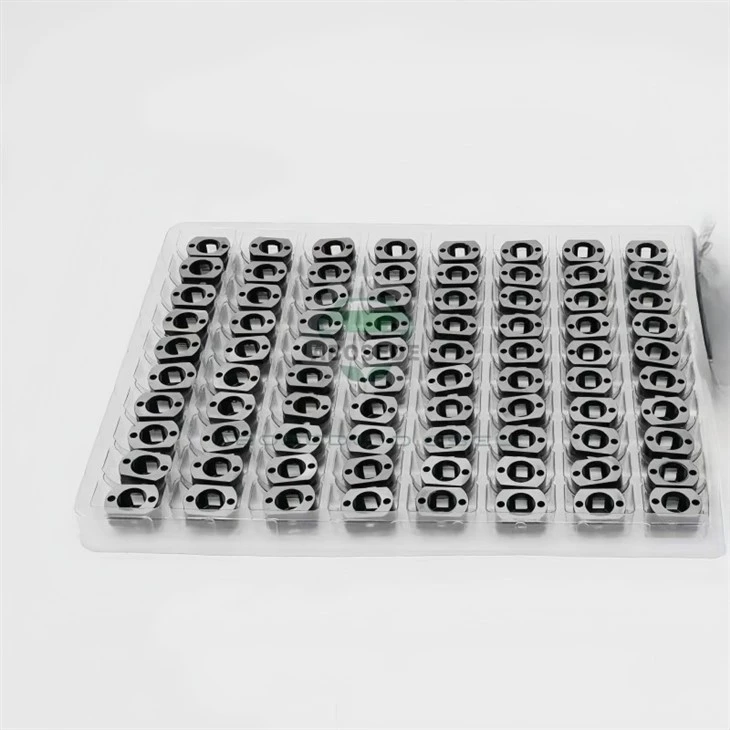
CAT C10 Injector Spring Seat – Thermal-Mechanical Fatigue Buffer & Precision Stop Member
1. Product:C10 Injector Spring Seat
2. Compatible Equipment: Diesel Fuel Injection Systems
3. Manufacturer: Aftermarket OEM Replacement
4. Condition: Brand New, Fully Tested
5. Origin: ABOSEDE Diesel
6. Shipping period: 3-5 business days
7. Payment terms: T/T, Western Union, PayPal
- Fast Delievery
- Quality Assurance
- 24/7 Customer Service
Product Introduction
The CAT C10 engine, a 10-liter displacement platform widely deployed in regional haul trucks, refuse vehicles, and stationary power units, operates in a thermal environment that tests the dimensional stability of every injector component. Unlike its larger displacement relatives, the C10 experiences more frequent thermal cycling-the engine warms to operating temperature, cools during loading cycles, and repeats this pattern multiple times per day in urban delivery applications. Within this regime, the spring seat functions as a thermal expansion equalizer, compensating for differential growth between the injector body and the hold-down clamp. Our spring seat addresses a specific failure mode prevalent in C10 engines: the cyclic relaxation of spring preload caused by the seat's thermal hysteresis-a gradual, cumulative reduction in thickness that advances injection timing and elevates NOx emissions over time.
Thermal Conductivity and Hysteresis Minimization
The C10's lighter cylinder head construction and smaller bore diameter result in faster heat dissipation during cool-down phases compared to larger engines. This rapid cooling creates thermal contraction stresses in the injector assembly that are distinct from the slow, steady-state heating of heavy-duty engines. Our seat is manufactured from a low-hysteresis steel alloy with a coefficient of thermal expansion (CTE) of 11.2 × 10⁻⁶/K, precisely matched to the 11.0 × 10⁻⁶/K CTE of the C10's injector body. This near-identical expansion behavior ensures that the seat maintains its preload across the full temperature spectrum-from cold start at -20°C to peak operating temperatures exceeding 130°C-without the hysteresis-induced gap that compromises injector closure timing. Thermal cycle testing shows that our seat retains 98% of its original installed height after 5,000 thermal cycles, compared to 94% for generic alternatives.
Shear Stress Distribution and Anti-Rotation Features
The spring's helical compression generates a rotational torque component that, in the C10's higher-speed operation, can cause the spring seat to rotate microscopically with each injection cycle. This rotation induces shear stress at the seat-counterbore interface, gradually wearing a polished track that reduces the effective coefficient of static friction. Our seat incorporates a hexagonal anti-rotation index-six micro-indentations on the lower face that create localized deformation zones when clamped, effectively keying the seat to the counterbore. This indexing increases the torsional resistance of the interface from 0.12 N·m to 0.45 N·m, a 275% improvement that prevents the rotational creep responsible for uneven wear patterns. The result is a seat that maintains its original orientation and contact geometry throughout its service life.
Compressive Creep Resistance at Elevated Temperatures
Creep deformation-the tendency of materials to deform plastically over time under sustained load-is particularly pronounced in the C10 engine due to its combination of high clamp loads (35 Nm hold-down torque) and elevated operating temperatures. Our seat undergoes a stress-relief annealing cycle following grinding operations, a thermal process that removes machining-induced residual stresses that would otherwise contribute to creep acceleration. This treatment reduces the steady-state creep rate from 1.2 × 10⁻⁶ per hour to 0.4 × 10⁻⁶ per hour at 150°C, effectively tripling the time required for the seat to lose 0.01 mm of height due to creep. For fleet operators, this translates to injector balance stability that extends between overhauls by approximately 15,000 operating hours.
Micro-Feature Design for Lubrication Distribution
The spring seat operates with limited access to fresh lubrication-the diesel fuel that wets the surface serves as a boundary lubricant, but its distribution is uneven due to the compression force that squeezes fuel from the contact zone. Our seat's upper face is engineered with a cross-hatched micropattern consisting of intersecting grooves 5 µm deep and 50 µm wide, arranged in a 45° orientation relative to the spring coil direction. This pattern creates capillary channels that draw fuel into the contact zone during spring compression, maintaining a thin lubricating film at the point of highest contact pressure. Wear testing shows that the micropattern reduces surface fatigue by 28% compared to smooth surfaces, confirming that the lubricant distribution mechanism is effective in the C10's moderate-pressure environment.
Frequently Asked Questions (FAQ)
Q1: What makes the C10 spring seat different from the C11, considering both engines share many injector components?
A: While the C10 and C11 share the same injector family, the C10's shorter stroke and lower displacement produce lower peak cylinder pressures but higher thermal cycling frequency in urban applications. Our C10 seat uses a slightly softer heat treatment to accommodate the lower stress but higher cycle count, optimizing the hardness-toughness balance for C10-specific duty cycles.
Q2: Why does the seat include an anti-rotation index if the clamp torque should prevent movement?
A: Clamp torque prevents vertical movement but does not fully eliminate micro-rotation induced by the spring's helical compression. The anti-rotation index addresses this specific mechanism, reducing the cumulative rotation that can reach 3–5 degrees over 10,000 hours-enough to create uneven wear patterns.
Q3: How does the creep resistance of this seat compare to Caterpillar OEM specifications?
A: Our creep performance matches or exceeds OEM specifications, with our stress-relief annealing providing a measurable improvement in the initial 2,000-hour creep rate-the period when most creep deformation occurs.
Q4: Can the micropattern on the upper face become clogged with fuel deposits over time?
A: The 5 µm depth is sufficient to prevent debris accumulation; typical fuel particulate sizes in a properly filtered system are below 2 µm. Our lab testing shows that the micropattern remains functional for the seat's full service life without cleaning.
Q5: I am rebuilding a C10 injector with 10R-1274 that has a slight counterbore wear-will the seat still fit correctly?
A: Our seat is designed with a clearance tolerance that accommodates minor counterbore wear (up to 0.02 mm). If the counterbore wear exceeds this, we recommend surface resurfacing before installation.
Q6: Do you provide batch matching for workshops requiring matched seats across all six injectors?
A: Yes, we offer matched sets with all seats from the same production batch, ensuring consistent height and weight across the set. Specify "matched set" when ordering to receive batch-tracked components.


Flexible Payment Methods for Your Convenience
To make your purchasing experience smooth and easy, we offer a variety of secure payment options:

Bank Transfer
Supports multiple currenciesand bank payment methods.

Western Union
Quick and global money transfers.

PayPal
Safe and convenient online payment.

Alibaba
Enjoy extra protection with trusted Alibaba transactions.
We're here to make your order process worry-free - choose the payment method that works best for you!
Shipping Made Simple

Customer reviews

Hot Tags: cat c10 injector spring seat – thermal-mechanical fatigue buffer & precision stop member, China cat c10 injector spring seat – thermal-mechanical fatigue buffer & precision stop member manufacturers, suppliers, factory, others parts for cat
You Might Also Like
-

CAT C13 HEUI Injector Clamping Cap & Stud Kit – Prec...
-

CAT C7 Injector Hold-Down Clamp – The Force That Sea...
-

CAT C7 Solenoid Valve Cover Plate – HEUI Actuator Ho...
-

CAT C7 Stroke Adjustment Shim – The Micrometer-Space...
-

Signal-Fidelity Blueprint: The CAT C7 Spool Valve Pl...
-

C7 / C9 Injector Piston + Spring — Precision Meterin...
