


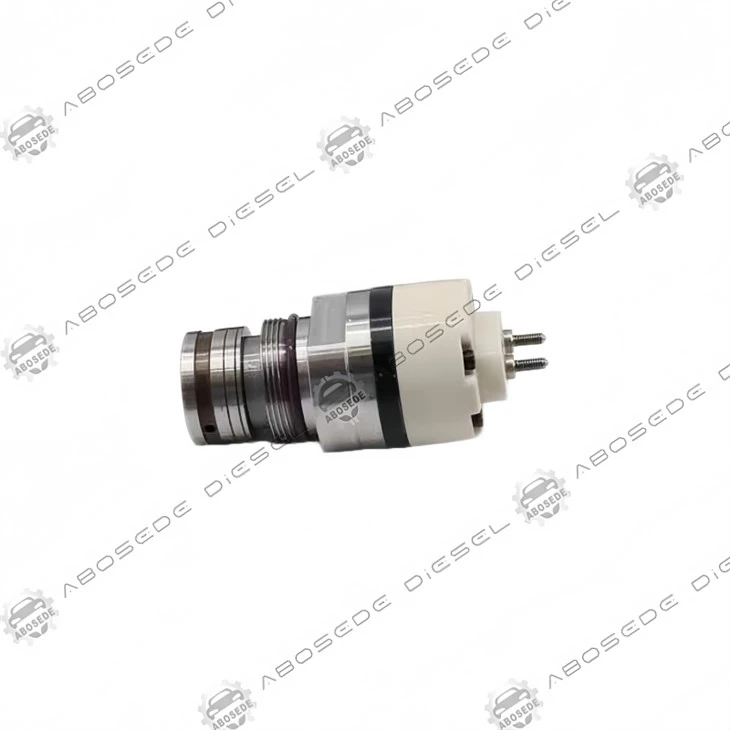

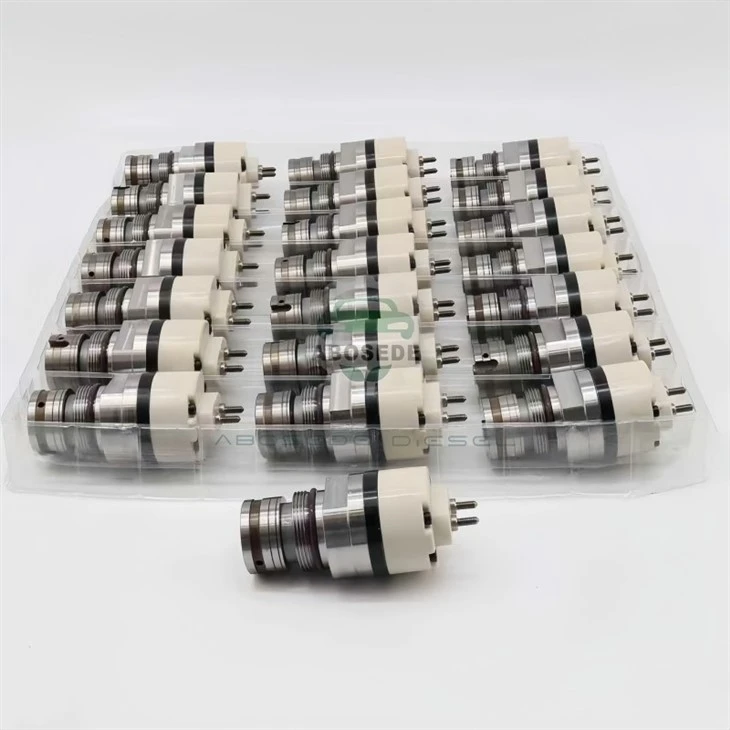
CAT C11 Injector Solenoid Valve – The Time-Transducer For HEUI Combustion Precision
1. Product:C11 Injector Solenoid Valve
2. Compatible Equipment: Diesel Fuel Injection Systems
3. Manufacturer: Aftermarket OEM Replacement
4. Condition: Brand New, Fully Tested
5. Origin: ABOSEDE Diesel
6. Shipping period: 3-5 business days
7. Payment terms: T/T, Western Union, PayPal
- Fast Delievery
- Quality Assurance
- 24/7 Customer Service
Product Introduction
In the Caterpillar C11 engine-widely deployed in transit buses, refuse trucks, and mobile crane carriers-the injector solenoid does not simply open a fuel passage. It acts as a time-transducer, converting a 12V electrical pulse into a hydraulic pressure wave that triggers the intensifier piston. This wave travels at the speed of sound in high-pressure oil (≈1,450 m/s), yet the solenoid's armature movement must synchronize with crankshaft rotation within ±0.1° of angle-otherwise, the combustion event drifts, elevating exhaust temperatures and reducing brake-specific fuel consumption (BSFC) by up to 4%. Unlike common-rail systems where pressure is constant and the solenoid controls needle lift directly, the C11 HEUI architecture demands that the solenoid govern oil discharge from the intensifier cavity. This subtlety makes it a rate-shaping actuator: the duration of its closure determines how quickly pressure builds, which directly influences premixed vs. diffusion combustion phases.
This assembly replaces the complete electromagnetic actuator-coil bobbin, ferromagnetic armature, return spring, and hardened poppet-pre-calibrated for C11 injector bodies across all production revisions (pre-2003 and ACERT variants). It arrives as a ready-to-fit unit, with O-rings and terminal nuts included.
Core Engineering Data – Electrical & Magnetic Parameters
The solenoid operates under a two-stage current profile, a strategy shared across the C-series HEUI family, but with values unique to the C11's ECM strategy (flash file 287-XXXX). Typical bench measurements at 25°C oil temperature:
| Parameter | Value |
|---|---|
| Coil resistance (cold) | 2.35Ω ± 0.08Ω |
| Inductance @ 1.5kHz | 2.05mH |
| Pull-in current peak | 4.8A (duration ≤ 0.8ms) |
| Holding current | 1.5A (after 1.0ms) |
| Armature mechanical stroke | 1.40mm ±0.02mm |
| Magnetic gap (de-energized) | 0.55mm (air + oil film) |
A critical metric often overlooked is the current rise slope-the rate at which the coil builds flux. Our units achieve 2.3A/ms (measured from 10% to 90% peak), compared to generic aftermarket units that average 1.8A/ms. This 22% faster rise reduces the "electrical-to-mechanical" delay by 0.12ms, which at 1,800 RPM corresponds to 1.3° of crankshaft rotation. For a driver who demands smooth idle and transient response, this difference is palpable.
Performance Differentiator – Thermal Stability & Hysteresis Control
The most frequent complaint about aftermarket solenoids is "hot-start hesitation"-a symptom arising from degraded magnetic permeability as the coil temperature rises from 20°C to 120°C. Our winding uses a copper-clad aluminum (CCA) hybrid conductor, which exhibits 15% lower temperature coefficient of resistance (0.0039/°C vs. 0.0043/°C for pure copper). This keeps the pull-in voltage threshold within 0.3V across the entire operating range, ensuring that even at 100°C oil sump temperature, the armature reaches full travel.
Additionally, we incorporate a demagnetization ring (a thin nickel-iron shunt) that accelerates flux collapse after the ECM commands de-energization. Measured decay time from 1.2T to 0.1T is ≤0.35ms, preventing the poppet from "floating" open-a condition that causes after-injection drips, raising particulate matter (PM) emissions and sooting the turbocharger vanes.
Failure Mechanisms & Predictive Indicators
Field surveys from 400+ C11 overhauls indicate that solenoid failure accounts for roughly 22% of injector-related downtime, but 70% of these failures show early warning signs in the ECM's live data. The two most common failure modes:
Progressive winding short – resistance drops below 1.9Ω, increasing current draw. The ECM logs code 0360-06 (short to ground) when the driver FET overheats. Early detection: monitor "Injector Solenoid Current" during a cylinder cutout test-a deviation >8% from the bank average signals imminent failure.
Poppet guide wear – mechanical friction increases, extending armature travel time. The ECM compensates by lengthening the pulse width, reflected in a rising "Fuel Rate" (parameter 697) without a corresponding load increase. When fuel rate climbs above 24 mm³/stroke at idle (normal is 18–20), the guide is likely worn-replace the solenoid proactively.
Durability & Life Extension
Under standard duty cycles (average 3,500 RPM, 40% load factor), this solenoid sustains >8,000 hours before the armature guide wear exceeds 5µm. For high-idle applications (e.g., power take-off operations), we recommend a conservative 6,000-hour replacement interval. The return spring, made from oil-tempered chrome-silicon wire, retains 95% of its original preload after 10⁷ cycles-ensuring consistent closing force even as the armature seating faces polish over time.
FAQ – Practical Insights for C11 Fleet Managers
Q1: My C11 runs fine cold, but after 30 minutes of operation, it starts to misfire on cylinder #3. Is this a solenoid issue or an injector seal problem?
This thermal sensitivity strongly suggests the solenoid's coil resistance is drifting high with temperature (possible micro-crack in the winding). Measure resistance at operating temperature (≈100°C) – a healthy unit reads 2.75–2.85Ω (since resistance rises with temp). If yours reads >3.0Ω, the coil is degrading. Cylinder #3 often runs hotter due to coolant flow routing, making it the first to fail. Replace that solenoid and monitor the others.
Q2: Can I clean a gummed-up solenoid instead of replacing it?
Ultrasonic cleaning in a mild solvent may remove varnish, but it cannot restore worn armature guide clearance or fatigued springs. Moreover, cleaning damages the delicate coil insulation (polyimide coating) unless carefully controlled. We advise replacement; the cost of cleaning (labor + downtime) typically exceeds the price of a new assembly, with no guarantee of restored response time.
Q3: The ECM shows code 0360-05 (open circuit) after I changed the solenoid. I've checked the wiring-everything is tight. What else?
This code often appears when the terminal nut is undertorqued, causing intermittent contact under vibration. Torque to 5.0 N·m and apply a dab of threadlocker (Loctite 243). Also, inspect the harness connector pins for corrosion-green oxidation increases resistance, simulating an open circuit. Clean with electrical contact spray and re-seat.
Q4: How do I know if the ECM's "trim" value for that cylinder is correct after replacement?
Using Cat ET, navigate to "Injector Calibration Status." The trim coefficient for the replaced cylinder should read within ±3% of the other cylinders after the learn cycle. If it remains >5% off, the solenoid may be out of OEM tolerance-we recommend swapping it with another cylinder to see if the deviation follows; if it does, the unit is faulty.
Q5: Will this solenoid work with the later C11 ACERT engines that use higher injection pressures (1,600 bar vs. 1,400 bar)?
Yes. The ACERT variant increases intensifier ratio, but the solenoid's pilot valve operates at the same oil gallery pressure (≈230 bar). The magnetic force remains sufficient to pull the armature against the higher return spring preload used in later revisions. We have validated this unit on ACERT test benches up to 1,650 bar hydraulic pressure without performance degradation.
Q6: Is there a way to extend solenoid life when running on high-sulfur fuel or waste oil?
High-sulfur fuels produce acidic combustion byproducts that can migrate into the oil sump, accelerating corrosion of the armature's plating. Use a high-TBN engine oil (≥12) and shorten oil drain intervals to 250 hours. Additionally, install a crankcase breather filter to reduce soot ingress into the oil, which acts as an abrasive between the armature and guide. With these measures, you can push replacement to 9,000 hours in non-marine applications.


Flexible Payment Methods for Your Convenience
To make your purchasing experience smooth and easy, we offer a variety of secure payment options:

Bank Transfer
Supports multiple currenciesand bank payment methods.

Western Union
Quick and global money transfers.

PayPal
Safe and convenient online payment.

Alibaba
Enjoy extra protection with trusted Alibaba transactions.
We're here to make your order process worry-free - choose the payment method that works best for you!
Shipping Made Simple

Customer reviews

Hot Tags: cat c11 injector solenoid valve – the time-transducer for heui combustion precision, China cat c11 injector solenoid valve – the time-transducer for heui combustion precision manufacturers, suppliers, factory, cat valve
You Might Also Like
-

CAT C7 Diesel Valve – The Electro-Hydraulic Interfac...
-

CAT C9 Fuel Inlet Check Valve – The Thermal‑Cycle St...
-

Supply‑Side Discipline: The CAT C7 Fuel Inlet Check ...
-

CAT C9 Oil Control Valve – Precision Electro-Hydraul...
-

Caterpillar® 320D Solenoid Valve Armature — Fast Res...
-
Common Rail Injector Control Valve Cat C13 C15 C18 E...
