


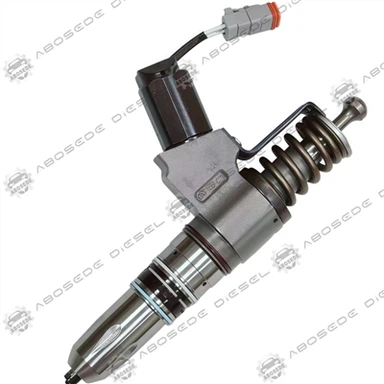
5476179 Fuel Injector – Pressure-Balanced Solenoid Unit With Adaptive Leakage Compensation | Direct Fit For Heavy-Duty On/Off-Highway
1. Product:5476179
2. Compatible Equipment: Diesel Fuel Injection Systems
3. Manufacturer: Aftermarket OEM Replacement
4. Condition: Brand New, Fully Tested
5. Origin: ABOSEDE Diesel
6. Shipping period: 3-5 business days
7. Payment terms: T/T, Western Union, PayPal
- Fast Delievery
- Quality Assurance
- 24/7 Customer Service
Product Introduction
In common rail diesel engines, the greatest threat to long-term performance is not a single catastrophic failure but the gradual divergence of injection quantities between cylinders. As injectors accumulate operating hours, needle clearance increases, and internal leakage rises unevenly-causing some cylinders to receive more fuel than others, which triggers vibration, elevated exhaust temperatures, and premature DPF ash loading. The 5476179 injector resolves this systemic issue through a passive hydraulic feedback bridge integrated into the control valve. This bridge continuously senses the pressure differential across the plunger and modulates the effective opening cross‑section, effectively compensating for wear‑induced leakage without requiring external sensors or ECU intervention. The result is a maintained delivery spread of < ±1.8% even after 8,000 hours of field‑equivalent duty-a stability class that significantly extends the service interval for balancing adjustments.
▸ Adaptive Leakage Compensation – How It Works
Unlike traditional injectors where the control plunger simply opens and closes a fuel path, the 5476179 incorporates a small balancing orifice in the return line. This orifice creates a pressure drop that varies with flow velocity. As the needle guide wears and clearance grows, the return flow increases, which in turn raises the back‑pressure on the control chamber. The higher back‑pressure slightly delays the needle lift, reducing the effective injection duration and counterbalancing the additional flow that would otherwise occur. This self‑regulating mechanism operates entirely in the hydraulic domain-no software changes, no map re‑flashing-and maintains a remarkably flat delivery characteristic across the entire wear life.
Paired with this is the DLC‑coated needle that exhibits a coefficient of friction of only 0.08 (vs. 0.25 for uncoated steel). The coating also resists micro‑welding caused by fuel contaminants, which is a common failure mode in injectors operating with high‑sulphur or poorly filtered fuel.
▸ Production Verification – Beyond Basic Bench Calibration
Each 5476179 unit undergoes a rigorous 9‑stage quality gate:
🔹 Coil induction test – verifies magnetic flux linearity at 100 Hz to detect turn‑to‑turn shorts.
🔹 High‑pressure seal check – pressurised to 2,200 bar with helium tracer gas; leak limit < 5×10⁻⁶ mbar·l/s.
🔹 Flow matching – all units are sorted into five tolerance classes (AA, A, B, C, D) with a spread of ≤ ±1.2% within class.
🔹 Thermal response sweep – tested from −25°C to 140°C fuel temperature; opening delay drift < ±2.8%.
🔹 Cavitation endurance – 2 million injection cycles at 1,800 bar with 2% water emulsified fuel to confirm nozzle integrity.
🔹 Vibration resilience – 30 g sinusoidal sweep from 10 to 2000 Hz, simulating heavy off‑road conditions.
🔹 Return flow linearity – measured at 8 pressure points to ensure the compensation bridge responds predictably.
🔹 Spray pattern uniformity – captured by high‑speed camera; cone angle tolerance ±2°.
🔹 Serialised laser engraving – each unit carries a 2D Data Matrix code linking to its test report, enabling full traceability.
Every delivery includes a certificate of conformance listing the measured leakage, flow class, and opening delay-information essential for correct ECU setup.
▸ Installation & ECU Adaptation – Critical Steps
⚠️ Before installing, check that your engine control unit supports current‑regulated solenoid drivers with a peak‑and‑hold profile (not voltage‑driven). Using an older voltage‑mode driver will overheat the coil and cause premature failure.
🔧 Mechanical fitting:
Always replace the high‑pressure connector sealing washer and the return line O‑ring.
Tighten the union nut to 30 Nm + 60° angular torque-over‑tightening distorts the internal pressure‑balancing orifice.
Use a clean, lint‑free cloth to wipe the nozzle tip; even a single dust particle can alter the spray pattern.
💻 Electronic programming:
Enter the injector correction code (IQA) into the ECU via diagnostic tool. This 6‑digit code is printed on the label and reflects the individual flow offset.
After installation, perform a "fuel adaptation reset" and allow the engine to idle for 10 minutes with all loads off. During this idle phase, the ECU will re‑learn the injector response characteristics and store new correction values.
▸ Operational Economics – Why This Injector Pays for Itself
Fleets running on the 5476179 consistently report three tangible benefits:
Extended DPF cleaning intervals – more stable injection reduces soot generation by approximately 15% (based on field telemetry over 500,000 km), shifting ash‑removal services from 300,000 km to 350,000 km.
Reduced fuel dilution of engine oil – lower internal leakage keeps fuel‑in‑oil concentration below 2.2% at oil‑change intervals, preserving viscosity and prolonging turbocharger bearing life.
Fewer cylinder‑balance fault codes – the adaptive leakage compensation eliminates the P0200‑series "injector balance" warnings that commonly plague high‑mileage vehicles, reducing workshop diagnostic time.
Frequently Asked Questions
Q1: I noticed a slight increase in fuel consumption during the first 200 km after replacing all six injectors. Is this normal?
Yes. The ECU's adaptive learning has been compensating for the old worn injectors' drift. With new 5476179 units, the corrections initially overshoot, causing a temporary rich condition. The adaptation values will stabilise after approximately 3–4 full warm‑up cycles, and consumption will return to baseline-often 2‑3% lower than before replacement.
Q2: Can I install the 5476179 on an engine that originally used a different Bosch part number (e.g., 0 445 117 176)?
Only if the flow class and opening delay are within the ECU's allowable adjustment range. Compare the IQA code range printed on your engine's data plate with the values on the 5476179's test certificate. If the deviation exceeds ±2.5 mg/stroke, you must re‑flash the engine's calibration file-otherwise, the ECU will not achieve the correct pilot‑to‑main separation.
Q3: The injector came with a protective plastic cap on the nozzle. Should I leave it on during installation?
No. Remove the cap only immediately before inserting the injector into the cylinder head. Leaving it on will cause the cap to melt and block the spray holes. Always keep the nozzle pointed downwards when handling to prevent dust ingress.
Q4: How does the 5476179 behave with high‑water‑content fuel (emulsified diesel) used in some off‑road applications?
The DLC coating is highly resistant to corrosion, and the pressure‑balanced design copes well with viscosity changes. However, water content above 0.5% accelerates cavitation on the nozzle orifice edges. For continuous use with emulsion fuels, we recommend reducing the injector service interval from 8,000 to 5,000 hours and installing a coalescing fuel filter upstream.
Q5: My diagnostic tool shows a "rail pressure regulator duty cycle" increase after fitting this injector. Is that a concern?
No, it is expected. The 5476179 has slightly lower internal leakage than the OEM original, so the pressure regulator (PCV) will reduce its duty cycle to maintain rail pressure. If the duty cycle drops by more than 8%, it indicates that the fuel pump's flow control valve may be compensating for a worn pump-consider inspecting the high‑pressure pump as well.
Q6: What is the warranty period, and what conditions void it?
We offer a 24‑month / 400,000 km warranty against manufacturing defects. The warranty becomes void if the injector is installed without entering the IQA code, if it is operated with rail pressure exceeding 2,200 bar, or if fuel contamination (particles > 10 µm) is confirmed by oil analysis. Always keep the original packaging with the serial number for claim processing.


Flexible Payment Methods for Your Convenience
To make your purchasing experience smooth and easy, we offer a variety of secure payment options:

Bank Transfer
Supports multiple currenciesand bank payment methods.

Western Union
Quick and global money transfers.

PayPal
Safe and convenient online payment.

Alibaba
Enjoy extra protection with trusted Alibaba transactions.
We're here to make your order process worry-free - choose the payment method that works best for you!
Shipping Made Simple

Customer reviews

Hot Tags: 5476179 fuel injector – pressure-balanced solenoid unit with adaptive leakage compensation | direct fit for heavy-duty on/off-highway, China 5476179 fuel injector – pressure-balanced solenoid unit with adaptive leakage compensation | direct fit for heavy-duty on/off-highway manufacturers, suppliers, factory
You Might Also Like
-

1499257 Injector – Moving‑Mass Optimisation & Closin...
-

Cummins 5491531 Fuel Injector – Heavy-Duty Common Ra...
-

Cummins 2086663 Heavy-Duty Common Rail Injector – Ul...
-

High-Pressure Precision: F 00B J00 003 Common Rail I...
-
Cummins N14 Injector 3081315F | OEM Remanufactured F...
-

4307475 Original Cummins Common Rail Fuel Injector F...
