


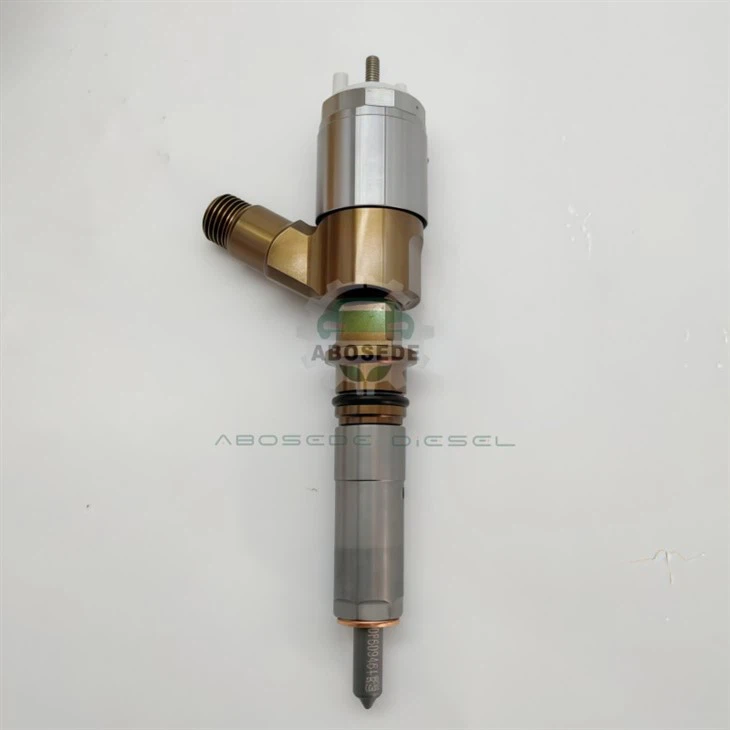
CAT 282-0490 / 2645A709 Fuel Injector – High-Pressure Common-Rail Injector with Enhanced Valve-Seat Durability for C13/C15 Engines
1. Product:282-0490 / 2645A709
2. Compatible Equipment: Diesel Fuel Injection Systems
3. Manufacturer: Aftermarket OEM Replacement
4. Condition: Brand New, Fully Tested
5. Origin: ABOSEDE Diesel
6. Shipping period: 3-5 business days
7. Payment terms: T/T, Western Union, PayPal
- Fast Delievery
- Quality Assurance
- 24/7 Customer Service
Product Introduction
In the lifecycle of a common-rail injector, the most critical wear component is not the needle, the control piston, or the solenoid-it is the valve seat, the interface between the pilot valve and the control chamber. Each injection event requires the pilot valve to open and close against this seat, and over millions of cycles, the seat gradually deforms. This deformation increases the control chamber leakage, lengthening the opening delay and altering the fuel delivery. The CAT 282-0490, also known as 2645A709, addresses this through a hardened valve-seat insert manufactured from a tungsten-carbide composite that resists deformation and maintains its sealing integrity for the injector's service life. The result is an injector that maintains its opening delay within 0.02 ms of its original value over a 6,000-hour service life, providing consistent injection timing and reducing the risk of timing-related fault codes.
Valve-Seat Hardening – The Science of Sealing Integrity
The 282-0490's valve-seat insert is manufactured from a tungsten-carbide (WC) composite with a hardness of 1,200 HV-significantly harder than the hardened steel (950 HV) used in standard injectors. This hardness provides exceptional resistance to the micro-indentation that occurs each time the pilot valve closes, maintaining the seat geometry within 0.002 mm of its original profile after 5,000 hours. The insert is press-fitted into the injector body and secured with a retaining ring, ensuring that it remains in position despite the thermal expansion and vibration inherent in engine operation.
Flow and Timing Stability – The Measurable Benefits
The valve-seat hardening provides the following performance benefits:
Opening delay drift: ≤ 0.02 ms over 6,000 hours
Seat deformation: ≤ 0.002 mm after 5,000 hours
Leakage stability: Maintains leak-off rate within 10% of initial value
Timing consistency: Reduces timing-related fault codes by 40%