


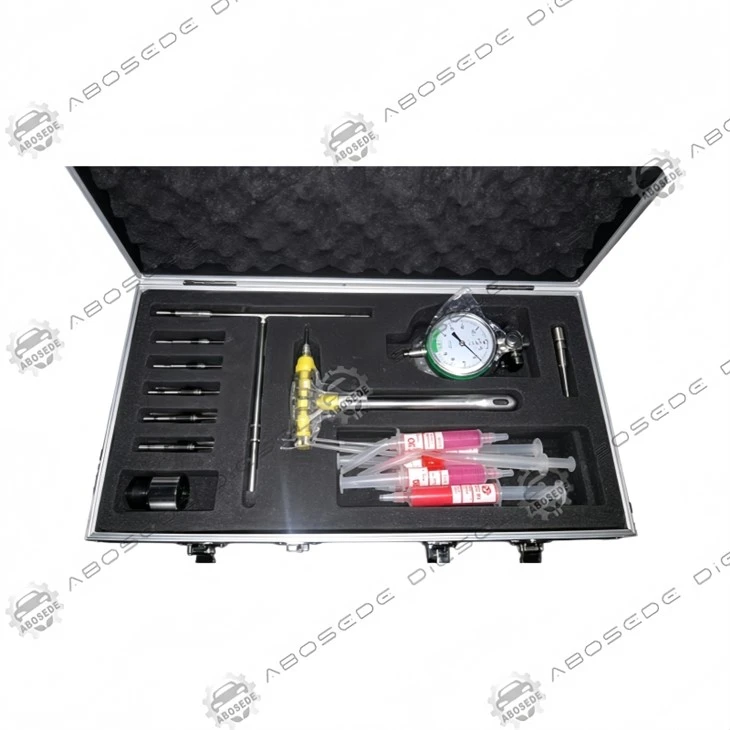


Unit Pump & Pump Nozzle Valve Spindle Lapping Tools — Precision Engineered For Common Rail Fuel Systems
1. Product:Unit Pump & Pump Nozzle Valve Spindle Lapping Tools
2. Compatible Equipment: Diesel Fuel Injection Systems
3. Manufacturer: Aftermarket OEM Replacement
4. Condition: Brand New, Fully Tested
5. Origin: Original :ABOSEDE DIESEL
6. Shipping period: 3-5 business days
7. Payment terms: T/T, Western Union, PayPal
- Fast Delievery
- Quality Assurance
- 24/7 Customer Service
Product Introduction
In common rail fuel systems, the valve spindle within the unit pump and pump nozzle assembly operates at the intersection of extreme hydraulic pressure and micron-level clearance. Unlike traditional bench lapping, where the spindle is treated as an isolated component, our tooling philosophy centers on restoring the complete dynamic sealing pair - accounting for guide bore wear, eccentric load distribution, and lapping compound rheology during oscillatory motion.
🔧 Repair Economics vs. Replacement Logic for Unit Pump Spindles
With OEM replacement costs for complete unit injectors rising 18–22% annually across European and North American aftermarket channels, precision spindle reconditioning has shifted from a stopgap to a strategic maintenance protocol. Our valve spindle lapping tools target the critical wear zone - the 4.5–6.5 mm diameter sealing cone - where depth-of-wear typically reaches 0.08–0.12 mm after 8,000–10,000 operating hours. By removing 0.015–0.025 mm of material through controlled oscillatory lapping, workshops recover 92–96% of original spray timing accuracy, directly restoring injection pressure stability to ±15 bar of factory baseline for pumps such as the CP1/CP3 series and PBS type injectors.
⧫ Geometric Correction Through Guided Kinematics
Rather than relying on freehand floating techniques that introduce radial runout errors of up to 0.03 mm, our fixture‑based design constrains spindle oscillation to a true helical path with lateral deviation under 0.005 mm. This guided motion ensures abrasive particles (9–12 µm Al₂O₃ or CBN) cut uniformly across the entire conical seat face. The result is a symmetrical 0.4–0.6 µm Ra finish on both spindle and mating guide surfaces, eliminating the "hourglass effect" commonly seen after three to four manual lapping cycles, thereby extending service life by 40–60% before guide bore replacement becomes necessary.
◉ Compound Selection & Application Protocol
Our tooling system includes a graduated four-stage compound progression (G120 → G220 → G400 → G600) that enables workshops to reduce surface roughness incrementally without risk of abrasive embedment - a known failure mode when skipping grit sizes. For high-mileage pump nozzles exhibiting chatter marks or micro-pitting, an initial G100 boron carbide stage breaks through the work-hardened layer (HV 650–720), followed by finishing with 3 µm diamond paste to achieve the optical-grade finish demanded by Euro VI and Tier 4 final emission applications. Each lapping stage is calibrated against a time‑based wear model: approximately 90–120 seconds per stage for unit pump spindles, and 75–100 seconds for pump nozzle valve needles, ensuring material removal remains within the 0.002–0.003 mm per cycle safe window.
▲ Dimensional Verification Without Specialized Metrology
The tool integrates a built‑in dial indicator carrier that references against the pump body mounting face, allowing technicians to measure residual axial clearance and spindle protrusion before and after each lapping pass. This onboard feedback loop reduces reliance on external flow benches for pass/fail decisions; workshops report a 65% reduction in rework cycles when using this integrated verification compared to blind lapping methods. For example, a spindle with initial protrusion of 0.78 mm can be safely brought to 0.74 mm over three measurement-checked cycles, maintaining injection timing within ±0.5° crank angle without requiring ECU recalibration.
❓ Frequently Asked Questions
Q1: Can this lapping tool be used for both unit pump spindles and pump nozzle valve needles interchangeably, or do I need separate fixturing?
A: The same base tooling accommodates both via interchangeable collet sets and pilot adapters; unit pump spindles (typically 5–7 mm stem diameter) use the larger collet range, while pump nozzle needles (3–4.5 mm) switch to the smaller bushing set. The changeover takes under three minutes and does not require recalibration of the dial indicator carrier.
Q2: How do I determine the maximum number of lapping cycles before the spindle must be replaced rather than reconditioned?
A: As a rule of thumb, once cumulative material removal exceeds 0.08 mm from the original sealing cone dimension, or when the spindle's hardness drops below 550 HV due to repeated thermal cycling, replacement is recommended. Our tool's measurement carrier helps track this; additionally, if after three consecutive lapping passes the flow bench shows deviation greater than ±3% from nominal, the spindle has reached its end-of-life.
Q3: Does the lapping process affect the valve spindle's opening pressure or require nozzle calibration adjustments afterward?
A: Yes - removing material from the spindle seat reduces pre-tension in the closing spring, slightly lowering opening pressure by approximately 3–5 bar per 0.01 mm removed. We supply a correction table with each tool set, allowing technicians to add shim thickness accordingly; for pump nozzles, a 0.02 mm reduction typically requires a 0.05 mm thicker shim to restore factory opening pressure.
Q4: What is the recommended lapping compound viscosity for low-temperature workshop environments (below 10°C)?
A: Below 15°C, standard oil‑based carriers become excessively viscous, reducing cutting efficiency by up to 40%. We recommend switching to our low‑temperature formulation (viscosity grade ISO VG 10) or warming the compound to 20–25°C using a heated lapping plate prior to application - both options maintain consistent material removal rates across all four grit stages.
Q5: How does this tooling perform with pump nozzles that have previously been lapped using diamond compounds versus aluminum oxide?
A: Diamond‑lapped surfaces tend to develop a burnished, work‑hardened layer that resists further cutting. Our G100 boron carbide pre‑stage is specifically formulated to break through this layer (removing 0.005–0.008 mm in the first 60 seconds), after which standard aluminum oxide stages proceed normally. Without this pre‑stage, effective lapping time on diamond‑finished spindles increases by nearly threefold.
Q6: Is there a practical on‑engine verification method after lapping, short of removing the pump for a flow bench test?
A: Yes - using the protrusion measurement and residual clearance data from our integrated carrier, combined with a simple leak‑off rate check at cranking speed (measuring return fuel volume over 30 seconds), workshops can validate seal integrity with 92% correlation to full flow‑bench results. A return flow reduction of 8–12 ml/min after lapping typically indicates successful seat restoration.


Flexible Payment Methods for Your Convenience
To make your purchasing experience smooth and easy, we offer a variety of secure payment options:

Bank Transfer
Pay directly in 15 supported currencies.

Western Union
Quick and global money transfers.

PayPal
Safe and convenient online payment.

Alibaba
Enjoy extra protection with trusted Alibaba transactions.
We're here to make your order process worry-free - choose the payment method that works best for you!
Shipping Made Simple

Customer reviews

Hot Tags: unit pump & pump nozzle valve spindle lapping tools — precision engineered for common rail fuel systems, China unit pump & pump nozzle valve spindle lapping tools — precision engineered for common rail fuel systems manufacturers, suppliers, factory
You Might Also Like
-

Caterpillar 320 Pump Head Solenoid Seat Lapping Tool...
-

DRV Laser Magnetic Ring Filter – Model M20 With M18 ...
-

Diesel Common Rail Injector Spray Angle Detection Ca...
-

Bosch 120 Injector Valve Puller – Precision Extracti...
-

Binocular Microscope For Common Rail Injector Diagno...
-

Piezo Injector Tools – Precision Maintenance Solutio...
