


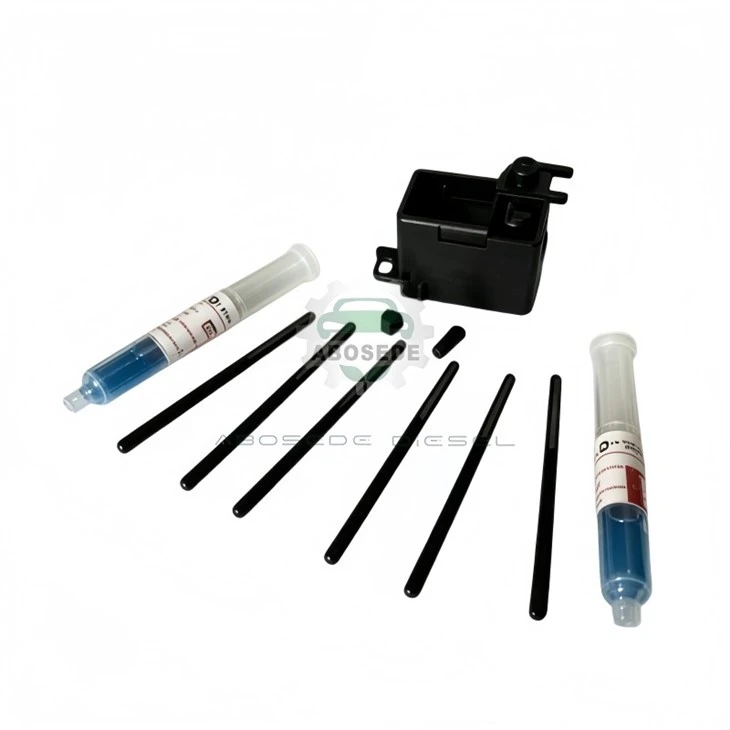
Transfer Pump Poppet Valve Lapping Tool – Guided Lapping Fixture With Dual‑Stage Pressure Control
1. Product: Transfer Pump Poppet Valve Lapping Tool
2. Compatible Equipment: Diesel Fuel Injection Systems
3. Manufacturer: Aftermarket OEM Replacement
4. Condition: Brand New, Fully Tested
5. Origin: Original :ABOSEDE DIESEL
6. Shipping period: 3-5 business days
7. Payment terms: T/T, Western Union, PayPal
- Fast Delievery
- Quality Assurance
- 24/7 Customer Service
Product Introduction
The transfer (lift) pump in a common rail fuel system delivers a steady supply of fuel from the tank to the high‑pressure pump. Its internal poppet valve-a spring‑loaded check valve-opens and closes with each pump stroke, maintaining a consistent inlet pressure for the high‑pressure stage. When the poppet valve seat becomes worn or pitted, the valve fails to seal completely, allowing fuel to leak back into the supply line. This reduces the transfer pump's delivery pressure (normally 4–6 bar) by as much as 1.5 bar, starving the high‑pressure pump and causing erratic rail pressure-a problem that is often misdiagnosed as a faulty pressure sensor or injector. This Transfer Pump Poppet Valve Lapping Tool provides a controlled method for resurfacing both the valve disc and its mating seat, restoring a leak‑tight seal without the need to replace the entire transfer pump.
Guided Lapping Fixture – Maintaining the 30° Seat Angle
The poppet valve seat is typically ground to a 30° included angle (some variants use 45°), and this angle must be preserved during lapping-a deviation of even 1° reduces the sealing contact area by over 20%. The lapping tool includes a guide fixture that positions a lapping disc at the correct angle, ensuring that the disc contacts the seat uniformly around its circumference. The fixture consists of a hardened steel guide sleeve (440C, 58 HRC) that fits over the transfer pump's valve guide bore, and a driver that holds the lapping disc. The driver is connected to a hand‑operated handle with a swivel joint, allowing the technician to apply a figure‑eight lapping motion without tilting the disc. A spring‑loaded pressure head applies a controlled lapping force of 3–6 N, which is adjustable to match the severity of wear. The same fixture can be used for lapping the valve disc itself-a separate disc holder with a vacuum‑type suction grip holds the valve disc, allowing it to be lapped against a reference flat.
Dual‑Stage Lapping Process – Coarse and Fine Resurfacing
The tool is supplied with two sets of lapping discs: coarse (15 µm diamond grit) and fine (5 µm diamond grit). The coarse discs are used to remove pitting and scratches, typically requiring 50–80 lapping cycles (where one cycle is 20 figure‑eight movements). The fine discs are then used for final polishing, requiring 30–40 cycles. A built‑in cycle counter (mechanical) records the number of strokes, enabling consistency across multiple pumps. After each stage, the components are cleaned and inspected under magnification-the seat should show a continuous, uniform grey band, and the valve disc should have a mirror‑like finish. The lapping compound is a non‑embedding diamond paste, supplied in syringes, which ensures that the abrasive particles do not become embedded in the seal material.
Application Coverage – Transfer Pumps from Major Manufacturers
This lapping tool is compatible with the poppet valve assemblies in the following transfer pumps, which are used in common rail and EUI systems:
Bosch transfer pumps (CP1/CP3/CP4 attached pumps) – seat angle 30°, valve disc diameter 8.0–10.0 mm
Delphi transfer pumps – seat angle 30°, disc diameter 8.5 mm
Denso transfer pumps – seat angle 45°, disc diameter 9.5 mm
Stanadyne transfer pumps – seat angle 30°, disc diameter 8.0 mm
Cummins PT fuel system pumps – seat angle 30°, disc diameter 10.0 mm
The tool includes a set of guide sleeves for different valve guide bore diameters: 8.0 mm, 8.5 mm, 9.0 mm, 9.5 mm, and 10.0 mm. A reference card lists the correct lapping force and cycle count for each pump model.
Material and Mechanical Design – Built for Workshop Durability
The guide sleeve and driver are manufactured from 440C stainless steel, hardened to 58 HRC, with ground internal bores to ensure a sliding fit with the valve guide. The lapping discs are bonded with a phenolic resin matrix and diamond grit, with a diameter of 20 mm (matching the valve seat). The handle is made from 6061‑T6 aluminium, hard‑anodised, with a soft‑touch grip. The spring‑loaded pressure head is adjustable via a knurled collar, with an integrated scale that indicates the applied force (3 N, 4.5 N, 6 N). A storage case is provided, with compartments for the guide sleeves, lapping discs, and compound syringes.
Frequently Asked Questions
Q1: Can this tool be used for lapping the poppet valve in a high‑pressure pump (e.g., CP3 inlet valve)?
No – the tool is designed for transfer (low‑pressure) pumps, which operate at 4–6 bar. High‑pressure pumps have different seat geometries and require specialised tools. Use the correct tool for the specific pressure stage.
Q2: How do I know if the seat is worn beyond lapping?
If the pitting depth exceeds 0.1 mm, lapping may not remove all defects. In this case, the valve should be replaced. Also, if the seat is out‑of‑round (run‑out > 0.02 mm), lapping will not correct it-the seat needs to be re‑machined or the pump replaced.
Q3: What is the purpose of the cycle counter?
The cycle counter ensures repeatability-it tells you exactly how many figure‑eight cycles you have performed. This is important because lapping removes a specific amount of material per cycle; over‑lapping can remove too much material and alter the valve's stroke.
Q4: Can I use the tool on a transfer pump that is still mounted on the engine?
In theory, yes – you can remove the valve assembly from the pump without removing the pump from the engine. However, the confined space may make it difficult to perform the lapping motion. We recommend removing the pump for a more controlled lapping process.
Q5: How do I clean the lapping compound from the components?
After lapping, clean the valve seat and the valve disc with brake cleaner or diesel. Use a lint‑free cloth to wipe away all traces of the compound. Then, inspect the components under magnification-any residual compound can cause leakage.
Q6: How long does a set of lapping discs last?
Each disc is rated for approximately 200 lapping cycles (with the recommended force and motion). The discs are consumable items; replacement discs are available separately.


Flexible Payment Methods for Your Convenience
To make your purchasing experience smooth and easy, we offer a variety of secure payment options:

Bank Transfer
Pay directly in 15 supported currencies.

Western Union
Quick and global money transfers.

PayPal
Safe and convenient online payment.

Alibaba
Enjoy extra protection with trusted Alibaba transactions.
We're here to make your order process worry-free - choose the payment method that works best for you!
Shipping Made Simple

Customer reviews

Hot Tags: transfer pump poppet valve lapping tool – guided lapping fixture with dual‑stage pressure control, China transfer pump poppet valve lapping tool – guided lapping fixture with dual‑stage pressure control manufacturers, suppliers, factory
You Might Also Like
-

T04 Injector Stand – Precision Holding Fixture For C...
-

Rapid Return Oil Adaptor For Common Rail Injector Le...
-

Denso Injector Solenoid Adjustable Wrench – Rapid‑Si...
-

Coupling Spider 3046200 Flexible Drive Coupler Eleme...
-

500W Diesel Injector Dedicated Adjustable Power Supp...
-

CAT 320D Injector Tools – Precision Equipment For Ef...
