


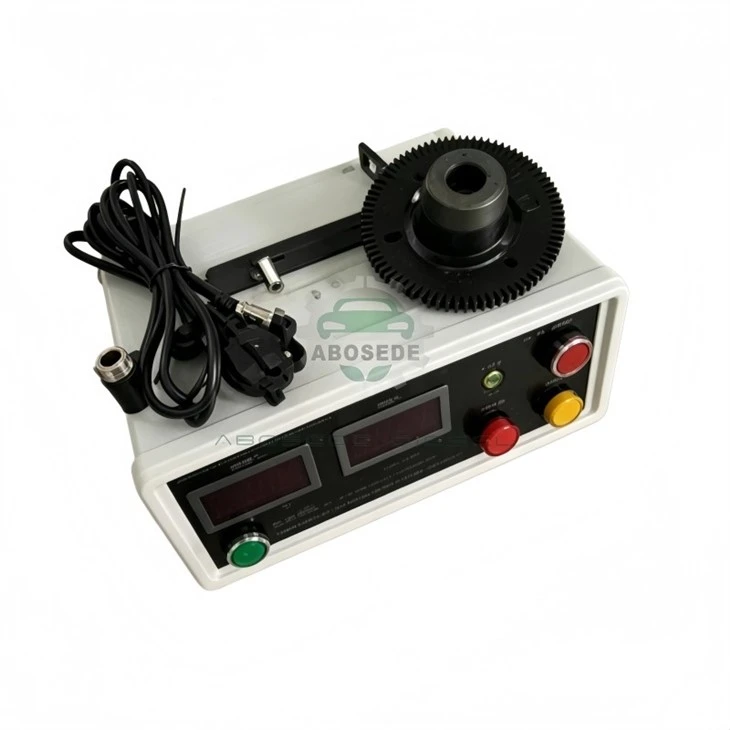
Caterpillar 320 High-Pressure Pump Tester: Timing Valve Drive & Euro-II Bench Integration For Flow/Pressure Dual-Parameter Validation
1. Product:Caterpillar 320 High-Pressure Pump Tester
2. Compatible Equipment: Diesel Fuel Injection Systems
3. Manufacturer: Aftermarket OEM Replacement
4. Condition: Brand New, Fully Tested
5. Origin: Original :ABOSEDE DIESEL
6. Shipping period: 3-5 business days
7. Payment terms: T/T, Western Union, PayPal
- Fast Delievery
- Quality Assurance
- 24/7 Customer Service
Product Introduction
In the Caterpillar 320 mechanically governed high-pressure pump-widely used in excavators, wheel loaders, and industrial engines-the electronic timing valve (often referred to as the "fuel injection timing actuator" or "spill valve") determines both the start and the duration of fuel delivery to the injectors. Unlike common-rail systems where pressure and timing are independently controlled, this pump couples timing, pressure, and fuel quantity into a single hydraulic event. The timing valve's opening point dictates when the plunger spill port is closed, which directly determines the start of injection; the closing point governs the effective stroke and thus the fuel volume delivered.
The HPT-3200 pump tester is purpose-built to interrogate this coupled behavior. By driving the electronic timing valve with a precisely controlled PWM signal while rotating the pump on a Euro-II test bench, the system captures two critical outputs simultaneously: fuel delivery rate (quantity per stroke) and injection line pressure (peak pressure at the delivery valve). The device then plots these outputs against the commanded timing advance, revealing the phase-response characteristic-a curve that should be smooth and monotonic. Any non-linearity, hysteresis, or discontinuity in this curve indicates a worn timing valve spool, a degraded solenoid, or internal pump leakage that compromises the fundamental timing-quantity relationship.
Technical Specifications: Timing Valve Driver & Dual-Channel Synchronous Acquisition
The HPT-3200 is engineered for Caterpillar 320 family pumps (including 320B, 320C, and 320D variants with mechanical governor and electronic timing control), used in off-highway equipment and stationary power units. Core specifications include:
Supply Voltage: 12V/24V auto-ranging (9-32V DC) with reverse polarity and load-dump protection.
Timing Valve Drive: PWM output 0-100% duty cycle, 50-500 Hz, current up to 2.0A continuous with programmable rise/fall slopes.
Pressure Input: 0-1,500 bar transducer interface (0.5-4.5V ratiometric or 4-20mA) for injection line pressure.
Flow Measurement: High-frequency turbine flow meter input (0-50 L/h, 0.5-10V output) for instantaneous and cumulative fuel delivery.
Sampling Rate: 2 kHz simultaneous on pressure and flow channels (captures individual injection events).
Crank Angle Synchronization: External TTL input from bench encoder (1 pulse/degree) for angle-domain analysis.
Display: 8" industrial touchscreen with real-time strip-chart and XY plotting.
Storage: 150 test records with full waveform data and parameter sets.
A key hardware feature is the microsecond-resolution trigger delay-the tester can phase-shift the timing valve drive pulse relative to the pump's top dead center (TDC) signal, allowing the operator to sweep the injection timing across the entire operating range (typically 0-30° crank advance). This is essential for mapping the pump's full timing characteristic, as the mechanical governor sets the baseline rack position while the electronic timing valve provides the dynamic advance. The HPT-3200 records the resulting pressure and flow at each timing point, constructing a complete operational map.
The Coupling Analysis: How Timing Errors Propagate to Quantity and Pressure
In a healthy pump, advancing the timing (closing the spill port earlier) produces three predictable effects: higher peak injection pressure, increased fuel quantity (up to the point of mechanical stroke limit), and earlier start of injection. The relationships are roughly linear in the mid-range. The HPT-3200 quantifies these relationships and identifies deviations using a three-axis deviation pattern:
Pattern 1 - Normal timing advance with pressure rise but no quantity increase: This indicates a worn plunger that is bypassing oil past the barrel wall. The pressure builds but the volume delivered remains constant because the leakage increases proportionally with pressure-the pump is "bleeding off" the additional volume instead of delivering it to the injector. Recommendation: replace plunger and barrel assembly.
Pattern 2 - Quantity increases but pressure remains flat: This indicates a faulty delivery valve that is not sealing properly. The plunger moves the fuel, but the delivery valve leaks back during the pressure rise, preventing the line pressure from reaching its peak. Recommendation: inspect and replace delivery valve and spring.
Pattern 3 - Both quantity and pressure respond, but with a 5+ degree phase lag: This indicates a sticking timing valve spool or a sluggish solenoid response. The electrical signal is correct, but the mechanical/hydraulic reaction is delayed, causing the injection event to occur later than commanded. This is a common failure mode in high-hour pumps where varnish buildup restricts spool movement. Recommendation: ultrasonic cleaning of the timing valve assembly.
Pattern 4 - Non-monotonic response (quantity drops then rises as timing advances): This indicates internal cavitation or air ingestion, often caused by a restricted inlet filter or a failed lift pump. The erratic response is a classic symptom of insufficient suction head. Recommendation: inspect the fuel supply circuit.
The tester automatically classifies the observed deviation pattern into one of these four categories, providing a clear diagnostic path without requiring the technician to interpret raw data.
The Euro-II Test Bench Integration: Crank-Angle Synchronized Profiling
The HPT-3200 interfaces with standard Euro-II pump test benches (Bosch EPS 200/708, Hartridge, or Denso equivalents) through a universal connection harness. The bench rotates the 320 pump at a controlled speed (typically 500-2,400 RPM), while the tester drives the timing valve and logs the injection pressure and fuel delivery. The system supports three test modes designed for comprehensive pump assessment:
Mode 1 - Timing Sweep at Fixed Speed: The pump is rotated at a constant speed (e.g., 1,400 RPM), and the timing valve duty cycle is stepped from 10% to 90% in 5% increments. The tester records the pressure and flow at each step, plotting the response curve. This mode is used for baseline timing calibration verification.
Mode 2 - Load-Responsive Timing Mapping: The pump speed is varied from idle to rated speed while the timing valve is commanded to follow a pre-programmed profile that mimics real-world engine load conditions (e.g., excavator digging cycle, wheel loader bucket-fill). This mode reveals transient response issues that do not appear in steady-state testing.
Mode 3 - Delivery Valve Leakage Quantification: The pump is held at a fixed speed and timing setting, and the pressure decay after each injection event is measured. A delivery valve with worn sealing surfaces will show a rapid pressure drop between injections, indicating internal leakage that reduces effective fuel delivery at high speeds.
The tester stores the full time-based log of all three test modes, allowing the operator to compare current test results against historical records for the same pump serial number, tracking performance degradation over time.
Operational Workflow: Complete Pump Assessment in Under 15 Minutes
Mount the 320 pump on the Euro-II test bench using the appropriate drive adapter and connect the high-pressure lines to the bench's injector nozzles or pressure sensor.
Connect the timing valve harness to the tester; connect the pressure transducer and flow meter sensors.
Connect the crank angle encoder (if available) for angle-domain analysis, or use the bench's internal speed signal for time-domain testing.
Select the pump model and test mode from the tester's internal library-this loads the correct PWM frequency, current limits, timing range, and reference curves.
Start the test: The tester runs the selected sequence automatically, recording pressure and flow data in real time.
Review the results: The screen displays the timing/pressure/flow graphs, the deviation pattern classification, and a pass/fail recommendation.
The tester can generate a three-page PDF report containing the full graphs, numerical data, deviation analysis, and recommended actions, which can be printed or exported via USB.
Frequently Asked Questions (FAQ)
Q1: How does the HPT-3200 distinguish between a faulty timing valve solenoid and a mechanical issue in the pump?
The tester performs a separate solenoid resistance and inductance measurement before the hydraulic test. If the electrical parameters are within spec but the timing sweep shows a phase lag or non-linearity, the fault is mechanical (sticking spool or worn plunger). If the electrical parameters are out of spec, the solenoid or wiring is at fault. The tester's diagnostic report clearly separates electrical and mechanical findings, enabling targeted repairs.
Q2: Can the tester be used on a pump that has been modified with non-standard timing settings?
Yes. The HPT-3200 includes a "Custom Range" mode where the operator can manually define the minimum and maximum duty cycle for the timing sweep. The tester will then generate the response curve within that custom range. This is useful for pumps that have been recalibrated for non-OEM applications or converted for different engine types.
Q3: What fuel viscosity range is the flow meter calibrated for?
The turbine flow meter is calibrated for diesel fuel with a viscosity range of 2-6 cSt at 40°C, covering standard summer and winter diesel grades. For testing with calibration fluid (ISO 4113), the meter includes a calibration offset factor that can be entered via the setup menu. The flow meter's accuracy is ±1% of reading within the calibrated range.
Q4: How does the tester handle a pump where the timing valve is not installed (mechanical-only version)?
For mechanical-only pumps (no electronic timing valve), the HPT-3200 can be used in a "Passive Monitor" mode-it does not drive the timing valve but still logs pressure and flow data while the test bench runs the pump at different rack positions. This provides quantity and pressure measurements, but timing analysis is not possible without the electronic valve. The passive mode is useful for verifying basic pump functionality before installing the timing valve.
Q5: What is the recommended test speed for the timing sweep?
We recommend performing the timing sweep at the pump's maximum torque speed (typically 1,400-1,600 RPM for the 320 platform) as this is where timing accuracy is most critical for engine performance. The tester also offers a multi-speed option (sweep at 800, 1,400, and 2,000 RPM) for comprehensive characterization of the pump's timing response across its full operating range.
Q6: How often should the pressure transducer be recalibrated?
The pressure transducer should be calibrated annually against a certified reference gauge or dead-weight tester. The HPT-3200 includes a calibration offset feature that allows the operator to input correction values. We recommend using transducers with a rated accuracy of ±0.5% FS for reliable pressure measurements. A calibration reminder can be set in the tester's software to notify the operator when annual calibration is due.


Flexible Payment Methods for Your Convenience
To make your purchasing experience smooth and easy, we offer a variety of secure payment options:

Bank Transfer
Pay directly in 15 supported currencies.

Western Union
Quick and global money transfers.

PayPal
Safe and convenient online payment.

Alibaba
Enjoy extra protection with trusted Alibaba transactions.
We're here to make your order process worry-free - choose the payment method that works best for you!
Shipping Made Simple

Customer reviews

Hot Tags: caterpillar 320 high-pressure pump tester: timing valve drive & euro-ii bench integration for flow/pressure dual-parameter validation, China caterpillar 320 high-pressure pump tester: timing valve drive & euro-ii bench integration for flow/pressure dual-parameter validation manufacturers, suppliers, factory
You Might Also Like
-

Multifunctional Electronic Fuel Pump Mounting Stand ...
-

Bosch CRIN4.2 Comprehensive Inspection Kit – Modular...
-

Caterpillar Fuel Control Actuator (FCA) Disassembly ...
-

CAT 320D C7/C9/C-9 Tools With Shims – Precision Adju...
-

17-Piece Diesel Injector Seat Cutter & Carbon Remove...
-

Shims Measure Tools – Precision Measurement For Dies...
