


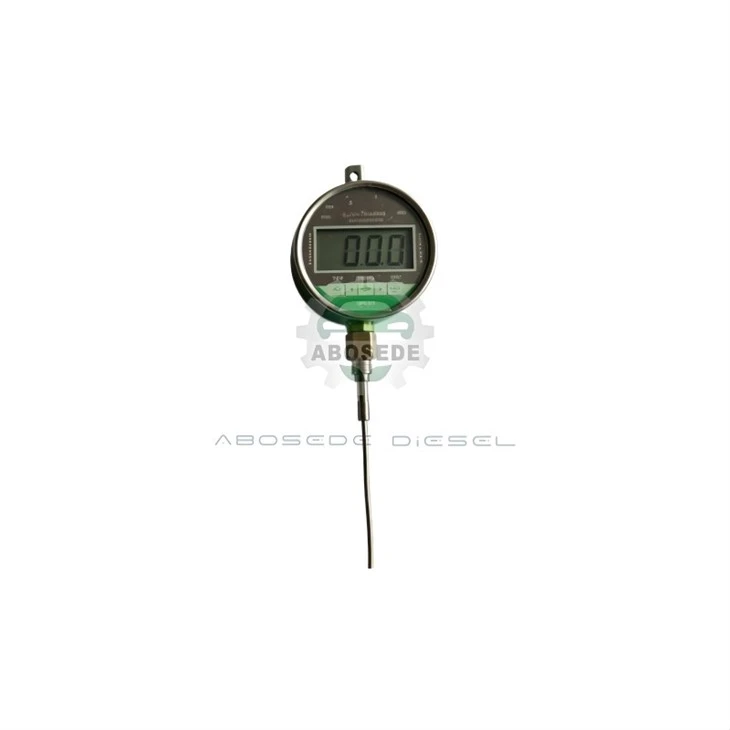
C7/C9 & C-9 Dynamic Armature Lift Gauge Stand – Velocity-Based Displacement Measurement For HEUI Injector Response Validation
1. Product:C7/C9 & C-9 Dynamic Armature Lift Gauge Stand
2. Compatible Equipment: Diesel Fuel Injection Systems
3. Manufacturer: Aftermarket OEM Replacement
4. Condition: Brand New, Fully Tested
5. Origin: Original :ABOSEDE DIESEL
6. Shipping period: 3-5 business days
7. Payment terms: T/T, Western Union, PayPal
- Fast Delievery
- Quality Assurance
- 24/7 Customer Service
Product Introduction
In a HEUI injector, the solenoid's magnetic field pulls the armature upward, compressing the return spring and allowing high-pressure oil to enter the intensifier chamber. This dynamic lift-the armature's actual displacement during the injection event-is not a fixed constant; it varies with oil temperature, rail pressure, and solenoid wear. Yet most workshops measure armature lift statically (with the injector de-energized), which reveals only the resting position, not the functional stroke under working conditions. The C-Series Dynamic Armature Lift Gauge Stand changes this by incorporating a spring-loaded contact probe that tracks the armature's movement while the solenoid is electrically energized, capturing both the maximum lift amplitude and the lift onset delay-two parameters that directly influence injection timing and quantity. Unlike static measurement, dynamic lift reflects the real-world electro-mechanical response of the injector, identifying issues such as worn armature guides, weak return springs, or incipient solenoid demagnetization that static checks would miss.
The Physics of Dynamic Armature Lift – Beyond Simple Stroke
The armature's dynamic behavior is governed by a balance of three forces:
Magnetic force (proportional to the square of coil current and inversely proportional to the air gap squared)
Spring force (linearly proportional to displacement)
Hydraulic damping (from oil film between armature and guide)
The resulting displacement over time follows a non-linear trajectory: a rapid initial acceleration, a plateau at maximum lift, and a slower return. The critical parameter is the time to reach 90% of maximum lift-a metric that captures the combined health of the magnetic circuit and the mechanical guide clearance. The dynamic lift gauge stand provides both the amplitude (0.08–0.13 mm for C7/C9 HEUI) and the time constant (typically 1.8–2.5 ms), enabling workshops to classify injectors into "fast," "nominal," and "sluggish" response categories.
Gauge Stand Architecture – High-Speed Contact Measurement
The C-Series Dynamic Lift Gauge Stand builds upon the rigidity of the static gap stand but adds a high-bandwidth measurement module:
Low-inertia probe – a ceramic-tipped stylus (mass ≤ 1.2 g) that follows the armature's movement with < 0.2 ms tracking delay. The probe is preloaded with a constant-force spring (0.5 N) to maintain contact without impeding armature motion.
Integrated LVDT sensor – linear variable differential transformer with a range of 0–0.5 mm, resolution of 0.001 mm, and frequency response of 5 kHz (sufficient to capture the armature's 200–300 Hz oscillation).
Signal conditioning unit – amplifies the LVDT output and provides a buffered analog voltage (0–10 V) for connection to an oscilloscope or data acquisition system.
Solenoid driver – a built-in current-controlled pulse generator that can energize the injector's solenoid with a programmable pulse (50–2000 µs, up to 5 A), replicating the ECU's drive signal.
Trigger input – accepts an external TTL signal to synchronize the measurement with the engine's crank angle (for on-engine testing).
The stand's base remains identical to the static version, ensuring that the injector is positioned consistently for both measurements.
Measurement Protocol – Capturing the Dynamic Response
The dynamic lift measurement is a three-step process:
Mounting and electrical connection – place the injector into the stand's locating ring and connect the solenoid driver leads to the injector's terminals (polarity-sensitive; the stand includes a reverse-protection circuit).
Probe positioning – lower the contact probe until it just touches the armature surface; zero the LVDT output.
Pulse application and recording – send a 1,500 µs energizing pulse (standard for C7/C9 HEUI) and record the displacement versus time waveform using an oscilloscope or the optional USB data logger.
The system automatically computes:
Maximum lift (L_max) – peak displacement during the pulse.
Rise time (t_10-90) – time from 10% to 90% of L_max.
Settling time – time to reach stable maximum lift.
Return delay – time from pulse end to armature contact with the stop.
Specifications and Acceptance Criteria
| Parameter | C7/C9 HEUI | C-9 HEUI |
|---|---|---|
| Maximum lift (nominal) | 0.100–0.115 mm | 0.095–0.110 mm |
| Rise time t_10-90 | ≤ 2.2 ms | ≤ 2.0 ms |
| Settling time | ≤ 3.5 ms | ≤ 3.2 ms |
| Return delay | ≤ 1.2 ms | ≤ 1.0 ms |
| Recommended test pulse | 1,500 µs @ 2.5 A | 1,200 µs @ 3.0 A |
Injectors exceeding the rise time limit typically suffer from:
Excessive guide clearance (>0.020 mm) causing oil-damping losses.
Weak return spring (reduced preload) delaying the armature's initial acceleration.
Solenoid coil degradation (increased DC resistance > 1.2 Ω) reducing magnetic force.
Frequently Asked Questions (FAQ)
Q1: Can the dynamic lift measurement be performed on an injector that has already been installed in the engine?
No-the gauge stand requires the injector to be removed and placed in the fixture. The solenoid driver must be connected directly to the injector terminals, which is not possible with the injector mounted.
Q2: How does oil temperature affect the dynamic lift reading?
Oil viscosity affects hydraulic damping-warmer oil reduces damping, yielding slightly higher lift and shorter rise times. We recommend performing the test at 40°C ±2°C (standard workshop temperature). The included thermocouple probe can monitor oil temperature if the injector is pre-heated.
Q3: What is the maximum energizing current the internal driver can supply?
The driver is rated for 8 A peak and 5 A continuous, which covers all HEUI injector variants. The pulse duration is programmable up to 5,000 µs for diagnostic purposes, though the standard test uses 1,500 µs.
Q4: Can I use the dynamic lift stand to test injectors from non-Caterpillar HEUI engines (e.g., Perkins)?
Yes-provided the injector uses the same solenoid mounting geometry. The stand includes a universal adapter plate with interchangeable locating rings. For specific guidance, refer to the adapter compatibility table in the manual.
Q5: What is the recommended sampling rate for capturing the lift waveform?
We recommend 10 kHz or higher. The LVDT module's analog output can be sampled with any standard oscilloscope or DAQ. For workshops without a scope, we offer a USB data logger that captures 1,000 points per pulse and displays the waveform on a computer.
Q6: How do I know if the armature lift is insufficient, even if the maximum lift is within spec?
Check the rise time-if the t_10-90 exceeds the limit but the maximum lift is correct, the armature accelerates slowly due to oil contamination or guide wear. This condition often precedes a loss of maximum lift by 500–1,000 operating hours, so early detection allows preventive maintenance.


Flexible Payment Methods for Your Convenience
To make your purchasing experience smooth and easy, we offer a variety of secure payment options:

Bank Transfer
Pay directly in 15 supported currencies.

Western Union
Quick and global money transfers.

PayPal
Safe and convenient online payment.

Alibaba
Enjoy extra protection with trusted Alibaba transactions.
We're here to make your order process worry-free - choose the payment method that works best for you!
Shipping Made Simple

Customer reviews

Hot Tags: c7/c9 & c-9 dynamic armature lift gauge stand – velocity-based displacement measurement for heui injector response validation, China c7/c9 & c-9 dynamic armature lift gauge stand – velocity-based displacement measurement for heui injector response validation manufacturers, suppliers, factory
You Might Also Like
-

NTS300 High Pressure Common Rail Injector Test Bench
-

Caterpillar C12/C13/C15 Injector Line Speed Wrench –...
-

Cummins QSK Flange Coupling Kit – Torsional Vibratio...
-

Iveco Unit Injector Repair Kit – Comprehensive Overh...
-

Volvo Barring Tool – Crank Positioning With Torque-L...
-

Piezo Injector Tools – Precision Maintenance Solutio...
