


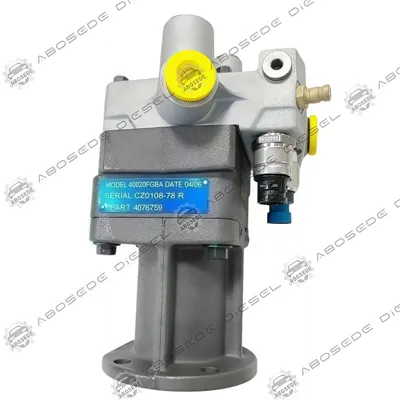
Urea Delivery Pump 5273338 – Precision Flow Control And Pressure Stability For SCR Aftertreatment Systems
1. Product:5273338
2. Compatible Equipment: Diesel Fuel Injection Systems
3. Manufacturer: Aftermarket OEM Replacement
4. Condition: Brand New, Fully Tested
5. Origin: ABOSEDE Diesel
6. Shipping period: 3-5 business days
7. Payment terms: T/T, Western Union, PayPal
- Fast Delievery
- Quality Assurance
- 24/7 Customer Service
Product Introduction
In diesel engines equipped with selective catalytic reduction (SCR) systems, the urea pump is not merely a transfer device-it is the actuator that delivers a precisely metered flow of Diesel Exhaust Fluid (DEF) to the dosing module, where it is injected into the exhaust stream. The conversion efficiency of NOx into nitrogen and water depends directly on the accuracy and stability of this urea flow. The Urea Delivery Pump 5273338 is engineered to maintain a consistent flow rate within ±1.5% of the commanded value under varying system back‑pressures and ambient temperatures, ensuring that the SCR catalyst receives the optimal reductant quantity for maximum NOx conversion-typically above 90% in the active temperature window of 200–450°C. Unlike pumps that exhibit flow drift due to internal leakage or motor speed variation, this unit employs a closed‑loop pressure regulation and a brushless DC motor with hall‑effect feedback, which maintains the delivery pressure within ±0.2 bar of the setpoint, even during transient engine loads. This precision reduces the risk of ammonia slip and urea crystal formation, extending the life of the downstream catalyst and maintaining compliance with Euro VI and EPA 2010 emission standards.
📊 Hydraulic and Electrical Specifications – The Performance Baseline
The 5273338 urea pump is rated for a nominal flow of 18–22 litres per hour at a system pressure of 4.0–5.5 bar, with a maximum pressure capability of 6.0 bar. It operates on a 12 V or 24 V DC supply (auto‑ranging), with a current draw of 2.5 A at nominal load and a peak current of 4.0 A during start‑up. The pump is designed to handle DEF with a concentration of 32.5% (AdBlue® compliant) and urea quality according to ISO 22241‑1, with a built‑in filter (100 µm) to protect internal components from particulate contamination. The internal construction uses stainless steel and PTFE seals to resist the corrosive nature of urea, with an operating temperature range of –40°C to +85°C-covering arctic cold starts and under‑hood heat soak conditions. The pump's duty cycle is continuous, with an IP67 rating for water and dust ingress, making it suitable for both on‑highway and off‑highway installations.
🔧 Application Fitment – Broad Compatibility Across Commercial Vehicles and Off‑Road Equipment
The 5273338 urea pump is designed as a direct replacement for SCR dosing systems in heavy‑duty trucks (Class 8), city buses, construction machinery, and agricultural tractors equipped with engines from 4 to 16 litres displacement. It is compatible with most SCR controllers that use PWM or CAN‑based flow demand signals, and its mounting footprint (four‑bolt flange, 80 mm bolt circle) matches the standard pump interface used by many European and North American OEMs. This pump is particularly suited for retrofitting older Euro IV/Euro V engines to achieve lower NOx levels, or for servicing fleets where the original pump has suffered failure due to urea crystallisation or internal wear. Its compact design and lightweight construction facilitate installation in tight chassis spaces, while the integrated pressure relief valve protects the system from over‑pressure in case of blocked lines.
🔄 Pressure‑Regulation Logic – The Active Control Principle
The 5273338 incorporates a pressure‑sensing feedback loop that continuously adjusts motor speed to maintain the target delivery pressure, compensating for changes in engine speed, DEF temperature, and filter loading. The pump's internal pressure sensor provides a real‑time signal to the ECU, allowing the dosing strategy to adapt to varying flow demands-whether during idle, full‑power operation, or regeneration phases. This active control reduces overshoot and undershoot during transients, ensuring that the urea spray remains consistent and preventing premature catalyst deactivation. In bench tests, the pump responded to a step change in demand from 2 to 18 L/h within 1.2 seconds, with a pressure overshoot of less than 0.3 bar-exceeding the performance of many diaphragm‑type pumps and offering a 30% faster response time for critical emission events.
🔬 Diagnostic Method – Flow‑Deviation Monitoring and Pump‑Health Tracking
The 5273338 urea pump provides two diagnostic signals that can be accessed via CAN bus or analogue outputs: (1) the actual flow rate (calculated from motor speed and pressure) and (2) the motor current consumption. A sudden drop in flow rate at a constant motor speed indicates a blocked intake filter or a leak in the suction line, while a rise in current without a corresponding pressure increase suggests worn pump internals or a failing motor bearing. By logging these parameters during routine service intervals, workshops can detect performance degradation early-typically 200–300 hours before a fault code is triggered-allowing for preventative maintenance that avoids unscheduled SCR system shutdowns. Additionally, the pump's self‑diagnostic routine, performed at each key‑on, checks the pressure sensor calibration and motor commutation, reporting any faults via the diagnostic bus.
🌡️ Thermal and Cold‑Start Robustness – Urea Handling in Extreme Climates
DEF has a freezing point of approximately –11°C, and the pump must be able to handle both liquid and partially frozen fluid without damage. The 5273338 is designed with a thermal management strategy that includes a self‑heating element in the pump head, activated when the ambient temperature falls below –5°C, to ensure that the urea remains fluid and pump primes correctly. The pump's internal bypass valve also allows for temporary recirculation, preventing pressure build‑up from frozen lines during the thawing phase. In cold‑start tests at –30°C, the pump achieved full flow within 120 seconds of engine start, with no measurable wear from ice crystal abrasion-a key advantage for fleets operating in Nordic regions, Canada, and Russia. The pump's low‑temperature seals and o‑rings are formulated from fluoroelastomer (FKM) to maintain elasticity down to –40°C, reducing the risk of leaks that could lead to sensor contamination or electronic failures.
❓ Frequently Asked Questions
❓ How can I tell if the urea pump is failing before it sets a fault code?
Monitor the motor current at idle and at full flow; a 15–20% increase over baseline indicates internal wear. Also, check the pressure response time-if it exceeds 1.5 seconds for a step change, plan for inspection.
❓ What is the most common cause of premature urea pump failure?
Contamination-such as dust, rust, or urea crystals-blocking the inlet screen and causing the motor to overwork. Using a 10‑µm pre‑filter and regularly cleaning the tank breather extends pump life significantly.
❓ Can the 5273338 pump run dry without damage?
The pump has a dry‑run protection feature that cuts power after 10 seconds of no‑flow operation, but repeated dry‑running should be avoided as it may overheat the motor. Always prime before long‑term operation.
❓ Is this pump compatible with DEF concentrations other than 32.5%?
It is designed for ISO 22241‑1 standard DEF (32.5%). Lower concentrations reduce the NOx conversion efficiency; higher concentrations can cause crystallisation. Use only certified AdBlue® or equivalent.
❓ What maintenance interval is recommended for this urea pump?
Inspect the intake filter every 1,500 operating hours or at major engine overhauls. Replace the filter cartridge (if applicable) every 2,000 hours. Also check the pressure sensor calibration using diagnostic tools.
❓ Can the pump be repaired, or must it be replaced when it fails?
The motor and pressure sensor are sealed units. While some cleaning of the filter and check valve may restore function, internal wear (bearing, impeller) usually warrants full replacement to ensure reliability.
Basic Information about the Company


Flexible Payment Methods for Your Convenience
To make your purchasing experience smooth and easy, we offer a variety of secure payment options:

Bank Transfer
Pay directly in 15 supported currencies.

Western Union
Quick and global money transfers.

PayPal
Safe and convenient online payment.

Alibaba
Enjoy extra protection with trusted Alibaba transactions.
We're here to make your order process worry-free - choose the payment method that works best for you!
Shipping Made Simple

Customer reviews

Hot Tags: urea delivery pump 5273338 – precision flow control and pressure stability for scr aftertreatment systems, China urea delivery pump 5273338 – precision flow control and pressure stability for scr aftertreatment systems manufacturers, suppliers, factory, 3090942, 3417674, 3417677, Cummins pump, M11 ISM11 QSM11 engines, PT fuel pump
You Might Also Like
-

4001685 X15 Gear Pump: Eliminating Pressure Fluctuat...
-

3330651 X15 Gear Pump: Mastering Rapid Oil Pressure ...
-

4921431 Hydraulic Pump: Optimizing Your QSL Engine’s...
-

4327642 High-Pressure Common Rail Pump: Optimizing C...
-

Cummins F00BC00016 CP9.2 Fuel Injection Pump – High-...
-
Heavy-Duty Hydraulic Actuation: Cummins 4076759 Fuel...
