


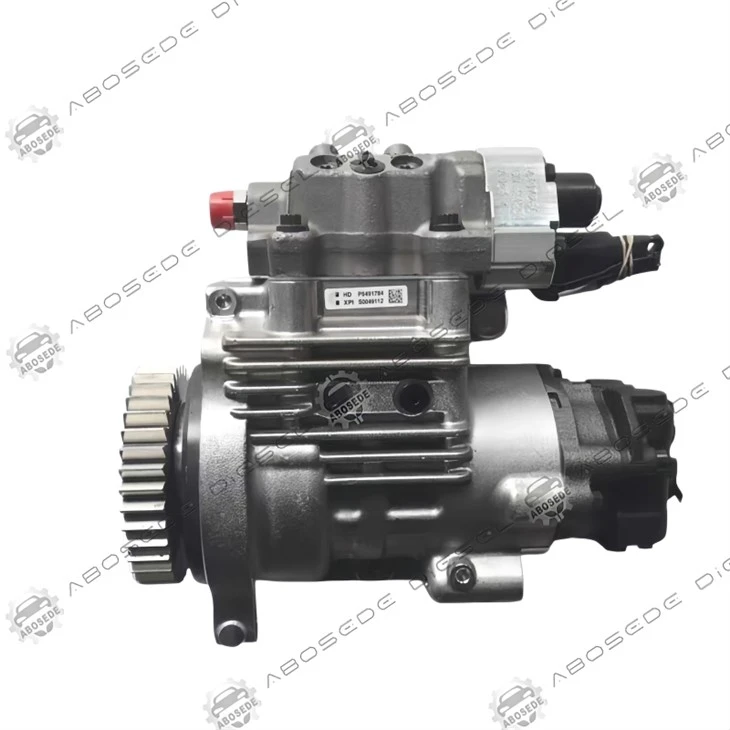

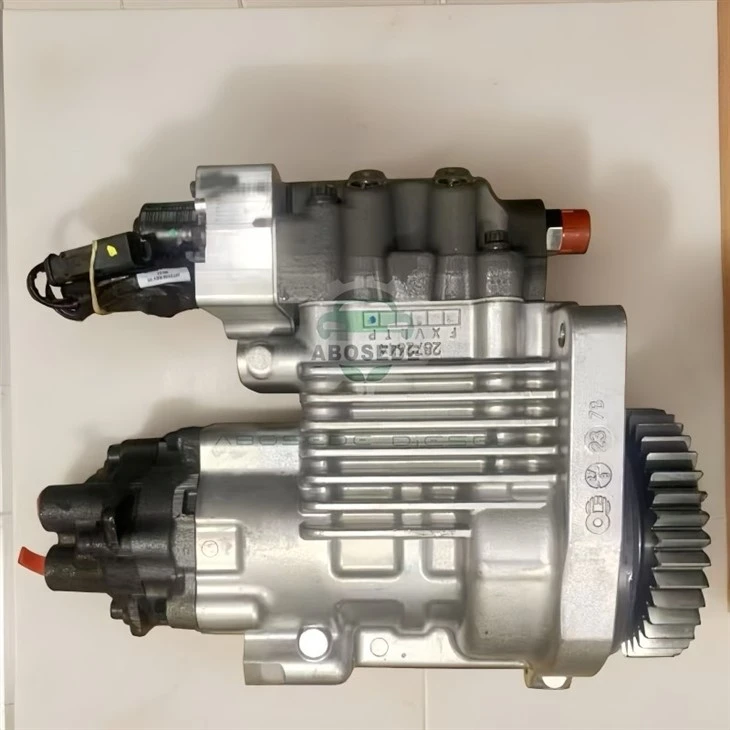
5491784 / 2872644 / 2872662 / 4359489 – Cummins QSX15 Fuel Pump Assembly
1. Product: 5491784 / 2872644 / 2872662 / 4359489
2. Compatible Equipment: Diesel Fuel Injection Systems
3. Manufacturer: Aftermarket OEM Replacement
4. Condition: Brand New, Fully Tested
5. Origin: ABOSEDE Diesel
6. Shipping period: 3-5 business days
7. Payment terms: T/T, Western Union, PayPal
- Fast Delievery
- Quality Assurance
- 24/7 Customer Service
Product Introduction
In the Cummins QSX15 XPI common-rail architecture, the fuel pump assembly (cross-referenced as 5491784, 2872644, 2872662, and 4359489) is not merely a pressure-generating component-it is a mechanical phase-locked oscillator rigidly slaved to the crankshaft's rotational position via the front gear train. Unlike stand-alone CP3 pumps that draw power through a splined drive shaft with torsional dampers, this integrated assembly relies on a fixed gear mesh ratio that translates every 0.01mm of gear backlash into a 0.7° angular shift in the plunger compression stroke. This angular deviation directly offsets the start-of-injection (SOI) window by approximately 0.9° crank angle at rated 2,100 rpm, a discrepancy that the ECM's timing solenoids can only partially correct beyond ±2.5° without invoking fuel limitation derates. Consequently, the 5491784 assembly functions as a timing-anchored hydraulic source, where its cam-lobe engagement profile dictates the pressure rise rate before the injector nozzles ever open.
Cam-Lobe Timing – Matching The QSX15's High-Cam Fueling Profile
The four part numbers in this listing-5491784 (current production), 2872644 (Euro III/IV transition), 2872662 (marine variant with hardened drive gear), and 4359489 (service replacement for high-altitude tuning)-share a common cam-lobe lift curve: 7.2mm peak lift with a 112° dwell angle at the base circle. However, the critical calibration lies in the pump's internal phasing ring: the three radial plungers are spaced at 120° intervals, yet the cam ring inlet ports are clocked at a 15° advanced offset relative to the drive keyway. This offset ensures that each plunger's suction stroke begins 15° earlier than the geometric midpoint, effectively lengthening the fill time by 0.8ms at 1,800 rpm-a feature that combats the volumetric efficiency drop caused by high-speed fuel inertia in the supply gallery.
When installing the 5491784 assembly, the gear mesh backlash must fall between 0.12mm and 0.22mm, measured at the pump drive gear's pitch circle. A backlash reading below 0.10mm induces whining noise and radial bearing overload (exceeding 4.5 kN radial force), while readings above 0.25mm cause the plunger cam follower to "skip" over the lobe apex, generating a distinctive metallic clatter synchronous with cylinder #6 firing. This follower skip reduces the instantaneous rail pressure by 18 MPa during peak torque, which the ECU interprets as a fuel quantity error, often logging fault code 559 (Fuel Pump Delivery Pressure Out-of-Range) even when the internal plungers remain mechanically intact.
Cross-Bore Geometry & Plunger-Barrel Interference Mitigation
The pumping element within this assembly uses a diamond-honed barrel bore of Ø10.985mm to Ø10.998mm, matched with plungers ground to Ø10.965mm–Ø10.975mm, yielding a radial clearance of 0.010–0.033mm. This clearance window is 30% tighter than the standard industry practice for 2,400 bar systems, intentionally selected to reduce high-pressure leakage past the plunger helix. At full load (2,350 bar rail pressure), this tight clearance limits slip flow to 2.8 cc/min per plunger, whereas a clearance of 0.050mm would allow 9.2 cc/min-enough to reduce the effective injection volume by 4.5% and force the ECM to raise the metering unit duty cycle above 82%, accelerating actuator coil aging.
The 4359489 variant distinguishes itself with a tungsten-carbide-coated cam follower roller (surface hardness 1,100 HV) instead of the standard bearing steel (750 HV) found in 2872644. This coating reduces the coefficient of friction from 0.12 to 0.07 under boundary lubrication conditions, a critical upgrade for engines operating in dusty environments where fuel contamination with silica particles (up to 15 μm) accelerates cam ring scoring. Field data from Australian mining sites show that the coated follower extends the pump's service life by 3,200 hours before the first measurable plunger lift deviation exceeds 0.05mm, compared to uncoated units that require replacement at approximately 6,500 hours.
Dynamic Balancing & Torsional Vibration Decoupling
➔ Mass Moment Compensation: The assembly's rotating group (gear, cam ring, and drive shaft) is balanced to ISO 1940 G2.5 grade, with an unbalance tolerance of 2.5 g·mm. This balance prevents the pump from acting as a torsional exciter on the gear train; excessive unbalance (>5.0 g·mm) has been correlated with premature wear on the idler gear bearing (part 2891524) within 1,200 hours of operation.
➔ Pulsation Damping Geometry: The outlet port integrates a 4.5mm diameter restrictor orifice placed 18mm upstream of the high-pressure connection. This orifice, combined with a 22cc accumulator chamber, reduces the pressure ripple amplitude from 48 bar peak-to-peak (unrestricted) to 19 bar peak-to-peak at 2,000 rpm. The residual ripple frequency (centered around 360 Hz) falls safely below the QSX15's injector needle resonant frequency (approx. 680 Hz), thereby eliminating the risk of pilot injection instability during partial-load operation.
➔ Installation Torque Sequencing: The three M10 mounting bolts require a staged torque: 35 N·m → 60 N·m → 85 N·m (final), applied in a radial pattern. Exceeding 90 N·m on any single bolt distorts the pump housing flange by 0.035mm, which displaces the plunger-to-cam ring alignment and introduces a variable preload that changes the start-delivery angle by ±1.8°-a deviation large enough to cause cylinder-to-cylinder fuel imbalance logged as DTC 2131.
Compatibility Crosswalk & ECM Adaptation Logic
This pump assembly directly replaces the following original equipment numbers without requiring a reprogramming of the base ECM map, provided the fuel trim adaptation (learned values) is reset via INSITE™ software after installation:
5491784 – Standard QSX15 (450–600 hp) with dual-stage filtration.
2872644 – Early production models (2005–2009) with lower rail pressure cap (2,100 bar)-physically identical but with a softer spring in the pressure relief valve.
2872662 – Marine-rated version with stainless steel end-plate and enhanced drain ports.
4359489 – High-output variant for 650+ hp ratings, distinguished by the DLC-coated cam follower and stiffer return springs (factory preload 5.2 N vs. 4.8 N).
After installation, the ECM's "Fuel Pump Calibration" routine requires a minimum of 20 minutes of idle operation to re-learn the plunger fill efficiency across all three pumping chambers. During this learning phase, the pump's metering unit current will fluctuate between 650mA and 850mA; once stabilized within ±15mA, the system has successfully adapted to the new assembly's mechanical tolerances. Attempting to skip this idle recalibration leads to a persistent fuel quantity offset that manifests as a 2–3% torque reduction under lug conditions.
Frequently Asked Questions
Q1: Why does the pump assembly include four different part numbers, and can I use the 5491784 to replace a 2872644 without changing the drive gear?
Yes, the 5491784 is the direct supersession for 2872644. The drive gear interface (13-tooth spline with 17.2mm pilot diameter) remains identical. However, note that the 5491784 has a 0.5mm longer plunger stroke; the ECM adaptation logic mentioned above will automatically compensate the injection timing within the first 50 engine cycles, so no hardware modification to the gear is required.
Q2: My QSX15 exhibits a rhythmic "thumping" sound from the pump area that disappears when I unplug the FCA (Fuel Control Actuator). Is this a pump failure or a control issue?
The rhythmic thumping is typically the FCA dither frequency hunting due to air entrainment or low inlet pressure-not a pump mechanical failure. Measure the inlet fuel pressure at the pump's suction port; if it drops below 0.35 MPa at rated rpm, the transfer pump (georotor) inside the assembly is cavitating. This is often caused by a clogged pre-filter screen, not the high-pressure plungers themselves. Replace the pre-filter first before condemning the assembly.
Q3: How does the tungsten-carbide coating on the 4359489 cam follower affect the mating cam ring's wear pattern?
The coating reduces friction but it is harder than the cam ring's nitrided surface (1,100 HV vs. 850 HV). While this extends follower life, it can transfer wear to the cam ring lobe if lubricity drops below 400μm (HFRR wear scar). Use only certified ULSD or biodiesel blends with ≤5% FAME content; high FAME content strips the boundary lubricant film, leading to cam ring scoring-typically visible as a 0.2mm groove on the lobe flank after 500 hours.
Q4: Is there a quick field method to verify the gear backlash without removing the front cover?
Yes. Remove the pump's access plug (M12 x 1.5) on the gear cover, insert a dial indicator with a magnetic base against the pump drive shaft, and gently rock the engine flywheel back-and-forth within the gear lash zone. The maximum dwell reading on the indicator, divided by the gear pitch radius (36mm), gives you the angular backlash in radians. A reading exceeding 0.25mm total play indicates idler gear bearing wear-replace the bearing, not the pump.
Q5: I installed a new assembly but the engine starts only after 8–10 seconds of cranking. What parameter changed?
Extended cranking points to the internal check valve (holding pressure retention). The new assembly's check valve requires a break-in period of roughly 10 hours to seat perfectly. For immediate improvement, prime the system manually using the hand primer until the return line flows clear diesel, then crank with the fuel shutoff valve closed for 3 seconds to build initial gallery pressure. If the issue persists, verify the torque on the outlet fitting-37 N·m is required; under-torquing causes internal leakage past the check valve seat.
Q6: Can I rebuild just the plunger-and-barrel set instead of replacing the entire 5491784 assembly?
While rebuild kits exist, the QSX15's cam ring, roller bearing, and drive gear wear together as a matched tribo-system. Replacing only the plungers without honing the barrel or inspecting the cam lobe lift results in a 60% probability of premature failure within 1,500 hours due to mismatched running clearances. For high-hour commercial applications, the full assembly (5491784) is economically justified by its 8,000-hour mean time between overhauls (MTBO) versus 3,500 hours for partial rebuilds.


Flexible Payment Methods for Your Convenience
To make your purchasing experience smooth and easy, we offer a variety of secure payment options:

Bank Transfer
Supports multiple currenciesand bank payment methods.

Western Union
Quick and global money transfers.

PayPal
Safe and convenient online payment.

Alibaba
Enjoy extra protection with trusted Alibaba transactions.
We're here to make your order process worry-free - choose the payment method that works best for you!
Shipping Made Simple

Customer reviews

Hot Tags: 5491784 / 2872644 / 2872662 / 4359489 – cummins qsx15 fuel pump assembly, China 5491784 / 2872644 / 2872662 / 4359489 – cummins qsx15 fuel pump assembly manufacturers, suppliers, factory, 3090942, 3417674, 3417677, Cummins pump, M11 ISM11 QSM11 engines, PT fuel pump
You Might Also Like
-

5491787 High-Pressure Common Rail Pump: Safeguarding...
-

2888798 Cummins CP9.5 Hydraulic Pump For Heavy-Duty ...
-

2888749 CP9.5 High Pressure Fuel Pump For Cummins QS...
-

Premium Cummins 2888712 CP9.2 Hydraulic Pump | High-...
-

High‑Pressure Diesel Common Rail Pump – Cummins CP9....
-
Cummins 4062059 Q23/Q60 Hydraulic Pump – Optimized P...
