


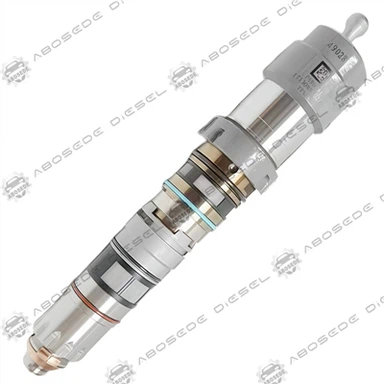
4954801 QSK60 MCR Injector: Solenoid Insulation Aging and Drive Current Waveform Distortion in High-Temperature Industrial Power
1. Product:4954801
2. Compatible Equipment: Diesel Fuel Injection Systems
3. Manufacturer: Aftermarket OEM Replacement
4. Condition: Brand New, Fully Tested
5. Origin: ABOSEDE Diesel
6. Shipping period: 3-5 business days
7. Payment terms: T/T, Western Union, PayPal
- Fast Delievery
- Quality Assurance
- 24/7 Customer Service
Product Introduction
In high-output industrial engines, the injector solenoid operates in a harsh thermal environment. Under-valve-cover temperatures can exceed 120°C. Over thousands of hours, that heat degrades the coil insulation. Insulation resistance drops. Inter-turn capacitance changes. The coil's effective resistance and inductance drift. The ECM drive stage still applies the same peak-and-hold current profile, but the current waveform changes. Rise time lengthens. Holding current ripple increases. The control valve opens later and closes less cleanly. Injection timing drifts. The ECM then spends adaptive range correcting an electrical-thermal interaction it cannot measure. The 4954801 QSK60 MCR injector is engineered around solenoid insulation stability, so drive current waveform distortion stays within the ECM's correction boundary across Tier 2 industrial power duty cycles.
⚙️ Why Solenoid Insulation Aging Defines Drive Current Waveform Distortion
In a common rail injector, the solenoid is a coil of copper wire coated with insulating enamel. At high temperature, the enamel undergoes gradual chemical change. Its dielectric strength decreases. Leakage current between turns increases. That leakage acts like a parallel resistor across the coil. It reduces effective inductance and changes the current rise time. The ECM calculates injection timing from a stored model that assumes a fixed rise time. If rise time increases, the control valve opens late. Injection timing retards. The ECM may then advance timing command to compensate. That correction consumes adaptive range. The 4954801 holds rise time variation within ±4% across −20°C to 120°C. A replacement injector with lower-grade insulation can vary by ±15%, causing injection timing drift and cylinder imbalance.
📊 4954801 Key Data and Thermal Thresholds
| Parameter | Specification |
|---|---|
| Product | 4954801 QSK60 MCR injector |
| Primary fitment | Cummins QSK60, QSK45 MCR |
| System type | High-pressure modular common rail |
| Peak rail pressure | 1,600+ bar |
| Coil resistance | 0.8–1.2 Ω at 20°C |
| Coil inductance | 0.8–1.2 mH |
| Insulation class | High-Tg, rated for 180°C continuous |
| Insulation resistance at 120°C | > 100 MΩ |
| Rise time variation | ±4% |
| Holding current ripple | < 5% |
| Injection timing drift | ±0.10° crank angle |
| Cycle-to-cycle quantity variation | 0.7% |
| Common rail relevance | Drive current waveform integrity |
These values matter because QSK60 engines often run at continuous high load. A small rise time drift accumulates into a large timing correction. That raises exhaust temperature and reduces fuel efficiency.
🔬 High-Tg Insulation and Thermal Cycling Endurance
Insulation aging starts at the enamel chemistry. The 4954801 uses a high-Tg (glass transition temperature) polyimide enamel. Tg is above 200°C. That means the enamel remains rigid and dimensionally stable even at peak under-valve-cover temperatures. Standard enamel with lower Tg softens and allows turn-to-turn movement. Movement causes abrasion and insulation failure. The 4954801 also uses a vacuum-pressure impregnation process. That process fills voids between turns and reduces partial discharge. Partial discharge erodes insulation over time. By eliminating voids, the 4954801 slows insulation aging. In a 1,000-hour thermal cycling test from −20°C to 120°C, insulation resistance stayed above 100 MΩ, while a standard replacement injector dropped below 10 MΩ.
🧪 Diagnostic Method: Current Waveform and Insulation Resistance
You can assess insulation aging without removing the injector. Monitor injector current waveform with an oscilloscope. During turn-on, measure rise time to peak current. A longer rise time than specification suggests increased inter-turn capacitance or leakage. During hold, measure current ripple. A ripple above 8% suggests insulation degradation or drive-stage interaction. Check injection timing correction during steady load. A steadily increasing correction indicates the ECM is compensating for rise time drift. Compare cylinder balance at idle and at 1,500 rpm. A spread above 3% suggests one or more injectors have different insulation aging. On a bench, measure insulation resistance at 20°C, 80°C, and 120°C over 1,000 cycles. A resistance below 50 MΩ at 120°C indicates a problem. Also measure rise time variation. A variation above ±8% indicates insulation aging.
❓ FAQ: 4954801 Injector and Solenoid Insulation Service
Q1: What is solenoid insulation aging in a common rail injector?
It is the gradual degradation of the enamel coating on the coil wire. Heat, vibration, and partial discharge reduce dielectric strength. That changes coil inductance and current rise time, shifting injection timing.
Q2: How can I tell if insulation aging is causing timing drift?
Monitor injector current waveform and injection timing correction. A longer rise time or higher holding ripple suggests insulation degradation. Bench testing insulation resistance confirms the issue.
Q3: Does the 4954801 require programming after installation?
Yes. QSK60 MCR injectors require trim code programming. Without coding, pilot quantity, balance rates, and drive current compensation will be incorrect.
Q4: Can I replace one 4954801 without replacing the set?
In an emergency, yes. But the new injector may have different insulation aging characteristics from aged ones. That creates cylinder-to-cylinder timing drift. For best results, replace the full bank or set.
Q5: What causes insulation to age faster?
High under-valve-cover temperature, high PWM frequency, and voltage spikes from poor grounding. The 4954801 uses high-Tg enamel and vacuum impregnation to slow aging.
Q6: Why must high-pressure fuel lines be replaced with the injector?
The line nose is a crush seal. It deforms after one torque cycle. Reusing it can cause leaks or release debris that damages the control valve and nozzle.
Basic Information about the Company


Flexible Payment Methods for Your Convenience
To make your purchasing experience smooth and easy, we offer a variety of secure payment options:

Bank Transfer
Pay directly in 15 supported currencies.

Western Union
Quick and global money transfers.

PayPal
Safe and convenient online payment.

Alibaba
Enjoy extra protection with trusted Alibaba transactions.
We're here to make your order process worry-free - choose the payment method that works best for you!
Shipping Made Simple

Customer reviews

Hot Tags: 4954801 QSK60 MCR Injector: Solenoid Insulation Aging and Drive Current Waveform Distortion in High-Temperature Industrial Power, China 4954801 QSK60 MCR Injector: Solenoid Insulation Aging and Drive Current Waveform Distortion in High-Temperature Industrial Power manufacturers, suppliers, factory, cummins injector
You Might Also Like
-
Cummins QSK23 Injector 4088431 | Heavy-Duty HPCR Fue...
-

The 15L Powerhouse Anchor: Reclaiming Torque With Th...
-

Elite Performance: Cummins M11 Diesel Injector 49033...
-

Ultra-Calibration Series: Cummins M11 Diesel Injecto...
-

Fuel Injector 2872765 2897414 Compatible For Cummins...
-

4327072 2897414 Cummins Fuel Injector For Cummins IS...
