


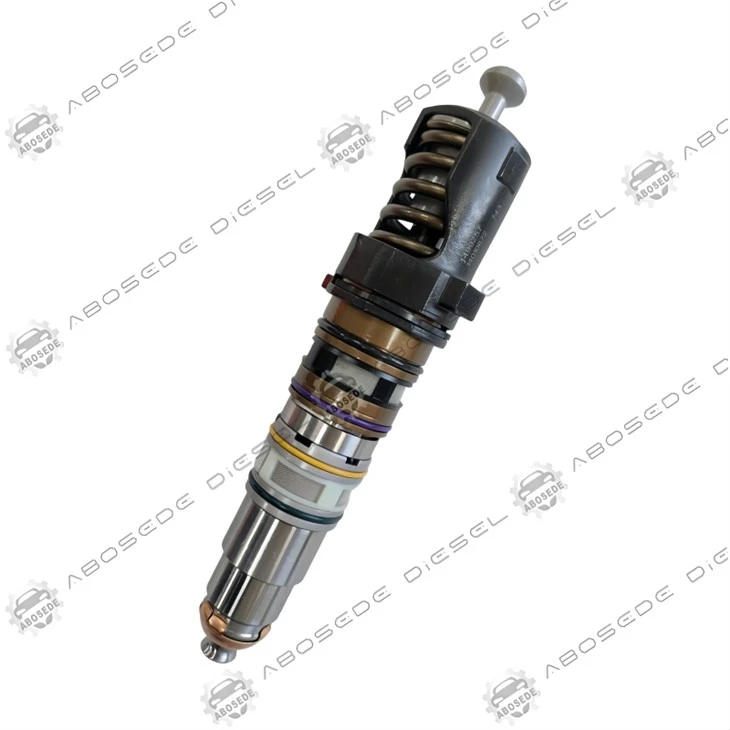


1499714 Injector – Sealing Integrity & Internal Leakage Trend Control For Sustained Emission Compliance
1. Product:1499714
2. Compatible Equipment: Diesel Fuel Injection Systems
3. Manufacturer: Aftermarket OEM Replacement
4. Condition: Brand New, Fully Tested
5. Origin: ABOSEDE Diesel
6. Shipping period: 3-5 business days
7. Payment terms: T/T, Western Union, PayPal
- Fast Delievery
- Quality Assurance
- 24/7 Customer Service
Product Introduction
Internal leakage in a common‑rail injector is often viewed as a secondary concern-a slow increase that merely reduces the pump's efficiency. However, a 0.5 ml/min increase in leakage at the needle‑seat or control‑piston interface can alter the control‑chamber pressure dynamics, shifting the injection quantity by 1‑2 mg without triggering any fault code. The ECU compensates, but the correction value gradually drifts, consuming adaptation headroom that is needed to accommodate other ageing effects. The 1499714 injector is engineered with a sealing‑surface architecture that maintains leakage rates within a narrow band over its service life, ensuring that fuel trims remain stable and the ECU retains sufficient adaptation margin for fuel quality variations. This article examines the 1499714's sealing integrity, its leakage‑trend characteristics, and the installation practices that preserve its sealing performance-without repeating previous content on electrical, hydraulic, moving‑mass, or flow‑linearity topics.
🔬 Sealing Surfaces – The Precision That Defines Longevity
The 1499714's sealing integrity is achieved through three key design elements:
Tungsten‑carbide needle seat: The seat is ground to a surface finish of Ra ≤ 0.04 µm, forming a near‑perfect mating surface with the DLC‑coated needle. This hard material resists erosion from the high‑velocity fuel flow, maintaining the seal over millions of cycles.
Chromium‑nitride control‑piston coating: The control piston slides within its bore with a clearance of 4‑6 µm. The chromium‑nitride coating reduces abrasive wear, preserving the clearance and controlling the leakage past the piston.
Precision‑lapped valve ball: The ball‑on‑seat control valve is lapped to a sphericity of < 0.5 µm, ensuring a leak‑tight seal when closed.
📊 Leakage Paths Comparison:
Standard injector (after 300,000 km): Needle‑seat leakage +0.8 ml/min, control‑piston leakage +1.2 ml/min → total +2.0 ml/min
1499714 (after 300,000 km): Needle‑seat leakage +0.3 ml/min, control‑piston leakage +0.4 ml/min → total +0.7 ml/min
🔧 The Leakage‑Trim Relationship – Why 0.5 ml/min Matters
The ECU cannot directly measure internal leakage. It infers leakage from the fuel trim correction-the adjustment it applies to the dwell time to achieve the commanded fuel quantity. As leakage increases, the ECU lengthens the dwell to compensate.
If the leakage increases by 0.5 ml/min, the ECU must apply a correction of approximately 0.6‑0.8 mg per cylinder. This may seem small, but the ECU's correction window is typically ±3 mg. A 0.8 mg shift consumes 27% of the available headroom. Over the injector's lifetime, a total leakage increase of 2‑3 ml/min (common in standard injectors) can consume 60‑80% of the adaptation window, leaving little room for fuel quality or pump wear variations.
The 1499714's low leakage drift ensures that the total correction shift remains below 1.0 mg over 450,000 km, preserving ample adaptation margin for other variables.
🛠️ Installation – The "Sealing‑Integrity" Protocol
The 1499714 is installed using the standard procedure, but with special attention to the sealing surfaces:
Clean the injector bore thoroughly-any debris can score the needle or the seat.
Replace the copper washer with a new one-never reuse. The washer must have a crush height of 1.38‑1.42 mm.
Torque the high‑pressure cone to 70‑75 N·m in one smooth motion-do not stop mid‑torque, as this can cause the cone to seat unevenly.
Torque the clamp to 48‑52 N·m.
Enter IQA codes and perform zero‑quantity calibration.
Drive for 50‑100 km for adaptation.
Post‑installation Check: After the adaptation period, measure the leak‑off rate at idle. For a new 1499714, it should be 14‑17 ml/min. If it exceeds 19 ml/min, the seal may be compromised-check the copper washer and the cone torque.
🔍 Diagnostic Insight – The Leakage Trend Indicator
The most practical field indicator of sealing health is the leak‑off rate trend measured at each service:
Baseline (new): 14‑17 ml/min.
At 100,000 km: 14.5‑17.5 ml/min.
At 200,000 km: 15‑18 ml/min.
At 300,000 km: 15.5‑18.5 ml/min.
At 450,000 km: 16‑19 ml/min.
If the leak‑off exceeds 20 ml/min before 400,000 km, the sealing surfaces are wearing faster than expected-likely due to fuel contamination or an installation issue.
Another clue: The fuel trim correction should drift by less than 0.2 mg per 50,000 km. A faster drift indicates that the leakage is increasing prematurely.
❓ Frequently Asked Questions (Sealing & Leakage Focus)
Q1: How does the 1499714 compare to the 1499257 in terms of sealing?
The 1499257 focuses on moving‑mass matching-reducing cycle‑to‑cycle variation. The 1499714 focuses on sealing integrity-controlling leakage drift over the injector's life. Both are solenoid injectors for similar engine families, but they address different performance dimensions. They are not interchangeable without ECU re‑calibration.
Q2: I reused the copper washer on a 1499714 installation. What will happen?
Reusing a copper washer will not compress to the correct crush height, causing an uneven seal. This will increase internal leakage by 1‑2 ml/min and may cause combustion gases to enter the injector bore, leading to carbon buildup on the nozzle. Always replace the washer.
Q3: I'm getting a fuel trim correction of +2.5 mg on one cylinder after 200,000 km. Is the injector wearing out?
A correction of +2.5 mg at 200,000 km is above the expected trend (<1.5 mg). Check the leak‑off rate on that cylinder-if it exceeds 20 ml/min, the sealing is compromised. If the leak‑off is normal, check the IQA code entry and the fuel quality.
Q4: Can ultrasonic cleaning restore the sealing performance of a worn 1499714?
Ultrasonic cleaning can remove carbon and varnish from the nozzle and the control valve, but it cannot restore a worn tungsten‑carbide seat or a scored control piston. If the leakage is high due to erosion, cleaning will not help-the injector must be remanufactured or replaced.
Q5: The 1499714 has a tungsten‑carbide seat. Is this a standard feature?
Tungsten‑carbide seats are used on many Bosch injectors, but the 1499714's seat is finished to a tighter tolerance (Ra ≤ 0.04 µm) compared to standard seats (Ra ≤ 0.06 µm). This tighter finish is the primary reason for the lower leakage drift.
Q6: I have an engine that operates in a dusty environment. Will the 1499714's sealing hold up?
Dust ingress is a major cause of abrasive wear on sealing surfaces. The 1499714's tungsten‑carbide seat and chromium‑nitride coating provide good resistance, but the fuel filter is the primary defence. Ensure that the filter is rated at 10 µm (β10 ≥ 200) and change it at the recommended intervals. In extreme dust conditions, consider a pre‑filter.


Flexible Payment Methods for Your Convenience
To make your purchasing experience smooth and easy, we offer a variety of secure payment options:

Bank Transfer
Supports multiple currenciesand bank payment methods.

Western Union
Quick and global money transfers.

PayPal
Safe and convenient online payment.

Alibaba
Enjoy extra protection with trusted Alibaba transactions.
We're here to make your order process worry-free - choose the payment method that works best for you!
Shipping Made Simple

Customer reviews

Hot Tags: 1499714 injector – sealing integrity & internal leakage trend control for sustained emission compliance, China 1499714 injector – sealing integrity & internal leakage trend control for sustained emission compliance manufacturers, suppliers, factory, cummins injector
You Might Also Like
-

MCRS Dynamic Injection Engineering: Q19/QSK Series F...
-

OEM-Grade 3084589 Injector Replacement | Cummins M11...
-

4955526 MCRS Fuel Injector Kit: Precision Hydraulic ...
-

4928348 QSK60 MCR Injector | Precision Pulsation Con...
-

Cummins 4088416 QSK60 Fuel Injector – High-Duty Elec...
-

Peak Torque Synchronization: Cummins M11 Diesel Inje...
