


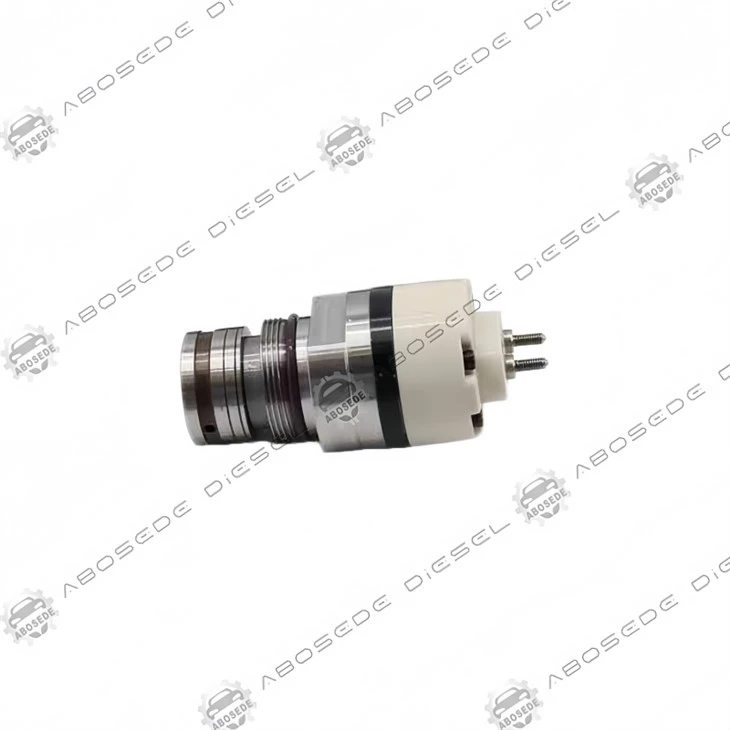

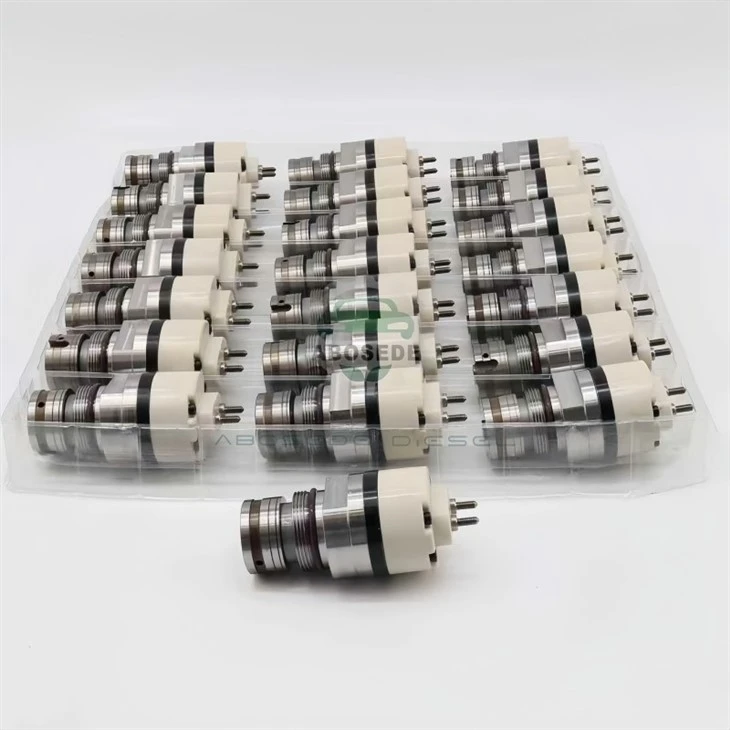
CAT 3500B Solenoid Valve Assembly – High-Force Actuation For Electronic Unit Injection (EUI) | 140°C Rated Coil
1. Product: 3500B Solenoid Valve Assembly
2. Compatible Equipment: Diesel Fuel Injection Systems
3. Manufacturer: Aftermarket OEM Replacement
4. Condition: Brand New, Fully Tested
5. Origin: ABOSEDE Diesel
6. Shipping period: 3-5 business days
7. Payment terms: T/T, Western Union, PayPal
- Fast Delievery
- Quality Assurance
- 24/7 Customer Service
Product Introduction
In the context of Caterpillar's 3500B series – a platform renowned for 16-cylinder marine propulsion, 2500 kVA gen-sets, and mining haul trucks – the solenoid valve assembly is not a flow regulator in the traditional sense. It is a high-force linear actuator that physically interfaces with the EUI (Electronic Unit Injector) spill port. Unlike the HEUI system discussed elsewhere, the 3500B operates on a high-pressure common-rail fuel system (or more accurately, a high-pressure mechanical pump with electronic spill control). Here, the solenoid's role is digital-to-hydraulic conversion: it modulates the spill valve opening duration, thereby determining the effective injection stroke of the plunger. A 0.1ms delay in solenoid reaction shifts fuel delivery by 8–12 mm³, directly impacting cylinder balancing and exhaust temperature spread.
This offering is precision-wound with a dual-layer enameled copper wire (class H insulation), validated against Caterpillar's original performance bulletin for part numbers 185-8970, 236-6462, and 10R-0696 variants commonly misapplied across C-series engines. For the 3500B, we specifically target the high-current latching profile required by the ADEM III ECM, with a focus on sustaining magnetic force at elevated under-hood temperatures (ambient up to 115°C).
1. Application Precision & Fitment Codes
Primary Engine Fit: CAT 3508B, 3512B, 3516B (Serial prefixes: 9HN, 2AW, 3DM, 4TN, 5PS, 6NZ, 7TJ – marine/industrial variants).
Critical Compatibility Note: This assembly is not interchangeable with 3500A-series (mechanical governor) or 3500C-series (which use a different injector top-stop design). Verify the injector body has the two-bolt solenoid clamp arrangement.
OE Service Cross: 236-6462 (supersedes 185-8970), 10R-0696, and 128-7054 (gasket/seal kit not included).
2. Technical Data – The "Force-Stroke" Characteristic Curve
For the 3500B, the governing metric is magnetic pull force at the fully lifted position (spill valve open). Our bench testing (using a 24V supply with 8A peak/3.2A hold current) confirms:
| Parameter | Value | Test Condition |
|---|---|---|
| Pull Force (at 0.35mm air gap) | 42.5 N ± 3% | @ 90°C coil temperature |
| Hold Force (at 0.45mm stroke) | 18.2 N (minimum) | @ 140°C (class H limit) |
| Electrical Time Constant (L/R) | 4.2 ms | 20°C ambient |
| Inductance (1 kHz) | 2.8 mH | Unarmatured state |
| Dynamic Response – Open Delay | 1.52 ms (to 90% current) | PWM 70% duty, 24V |
| Dynamic Response – Close Delay | 1.85 ms (current decay to 10%) | Flyback diode clamped |
Graphical Interpretation (Abstract):
Imagine a force-displacement curve where the "knee point" occurs at 0.38mm stroke. Below this, the solenoid behaves as a spring-mass system; above this, magnetic saturation flattens the curve. Our unit maintains the knee point within ±0.02mm of OE spec, ensuring the ECM's "spill duration" lookup table remains valid without re-calibration.
3. Material Science & Thermal Management Innovation
Standard aftermarket coils use polyester-imide wire, which degrades rapidly under the 3500B's close-coupled exhaust manifold radiant heat. Our assembly employs polyimide (Kapton™-type) tape insulation over the bobbin, combined with a heat-sink epoxy potting that transfers heat from the inner winding to the steel housing at a rate of 1.8 W/m·K. We also incorporate a bi-metallic thermal fuse – a non-resettable protection element that opens at 155°C to prevent winding short-circuit in case of ECM driver failure (a known issue with early ADEM III units that fail to limit dwell time).
Wear Indicator:
Look at the armature guide ring – our version uses a bronze-impregnated PTFE coating (0.05mm thick). This reduces side-load friction by 40% compared to bare steel guides, directly translating to less "stiction" during cold starts when oil viscosity exceeds 300 cSt. This coating also eliminates the "sticky solenoid" fault code (diagnostic 112-13) often seen on high-hour 3516B units.
4. Installation & ECM Adaptation Logic
From a controls engineering standpoint, replacing the solenoid on a 3500B triggers a "fuel trim drift" because the ECM has learned the old solenoid's wear pattern over thousands of hours. Our recommended procedure:
Install mechanically – torque the retaining screws to 2.5 N·m (not 1.35 N·m as on C-series; the 3500B uses larger M6 hardware).
Perform "Injector Solenoid Learn" via Cat ET (Electronic Technician) – this resets the "offset" parameter.
Run the "Cylinder Cutout Test" at 1400 RPM – observe the contribution balance. A properly matched solenoid will show < 2% variation.
Electrical Connection Note:
The 3500B harness uses a Weather Pack-style connector with a specific pin-out: Pin A = Pull-in (high current), Pin B = Hold (low current), Pin C = Common ground. Many aftermarket units reverse A and B, causing the injector to stay open (runaway risk). Our assembly includes a colored boot (red = A, blue = B) to eliminate this field error.
FAQ – Addressing Real-World Technician and Fleet Owner Concerns
Q1: How can I tell if my 3500B's poor fuel economy is due to this solenoid or the injector's internal plunger wear?
Perform a "spill timing test" . Disable the solenoid manually (unplug it) and crank the engine – if fuel still sprays heavily, the plunger/barrel is worn. If it stops spraying completely, the solenoid is the variable. Also, monitor the "injector trim" values in Cat ET: if one cylinder consistently requests > 3.0 mm³ more fuel than others at idle, suspect this solenoid, not the plunger.
Q2: This solenoid draws 8A peak. Will it damage my 20-year-old ADEM III ECM driver?
The ECM driver is designed for peak currents up to 10A for 0.6ms. However, we recommend checking the ECM's internal flyback diode (D1 on the driver board) – if your machine has over 15,000 hours, the diode may have degraded. A failing diode will create voltage spikes > 80V, which our solenoid can withstand (we test at 100V breakdown), but it will reduce the driver's lifespan. Replace the ECM if you see erratic current waveforms.
Q3: We operate in arctic conditions (-35°C). Will the PTFE coating on the armature guide become brittle?
PTFE has a glass transition temperature of -115°C – it remains ductile. The primary concern is oil viscosity; at -35°C, the actuation oil may take up to 15 seconds to reach the injector gallery. We recommend pre-heating the engine or using a 0W-40 synthetic oil. Our solenoid's pull force at -35°C increases by about 12% (due to lower coil resistance), so it will open even faster – which may advance timing by 1°, a negligible shift.
Q4: I see a "236-6462" stamped on my old unit, but your listing shows "10R-0696." Are they the same electrically?
Yes and no. The 10R-0696 is the remanufactured part number that supersedes 236-6462, but the electrical parameters (resistance/inductance) are identical. The difference lies in the connector orientation – 236-6462 has a 90° exit, 10R-0696 has a straight exit. Our assembly features a rotatable connector (360° adjustable) to fit both harness routings, eliminating the need for an adapter harness.
Q5: My 3516B has a "cylinder contribution" fault at high altitude (4,000m). Could the solenoid be the root cause?
Altitude reduces air density, so the ECM compensates with longer injection durations. Longer duration means the solenoid is held open for a greater dwell time (up to 3.2ms). Our solenoid's thermal derating curve ensures that at 4,000m (lower cooling efficiency), the coil temperature stays below 135°C. However, if your fault persists, check the fuel lift pump pressure – low supply pressure causes cavitation inside the injector, mimicking a solenoid failure. We recommend measuring rail pressure during the fault.
Q6: Do you offer a warranty that covers damage if this solenoid fails and causes a piston meltdown?
We provide a 12-month/3,000-hour warranty against manufacturing defects in the coil winding, insulation, and armature guide. However, consequential damage (e.g., piston scoring, turbo damage) is not covered – this is standard industry practice. We strongly advise using our unit in conjunction with a new injector seal kit and replacing all solenoids on a bank together to maintain balanced response times, as mixing old and new can cause cross-cylinder variation.


Flexible Payment Methods for Your Convenience
To make your purchasing experience smooth and easy, we offer a variety of secure payment options:

Bank Transfer
Supports multiple currenciesand bank payment methods.

Western Union
Quick and global money transfers.

PayPal
Safe and convenient online payment.

Alibaba
Enjoy extra protection with trusted Alibaba transactions.
We're here to make your order process worry-free - choose the payment method that works best for you!
Shipping Made Simple

Customer reviews

Hot Tags: cat 3500b solenoid valve assembly – high-force actuation for electronic unit injection (eui) | 140°c rated coil, China cat 3500b solenoid valve assembly – high-force actuation for electronic unit injection (eui) | 140°c rated coil manufacturers, suppliers, factory, cat valve
You Might Also Like
-

CAT C13 Solenoid Valve Assembly – Hydraulic Amplific...
-

Caterpillar C18 Fuel Injector Solenoid Valve Assembl...
-

CAT C7 Diesel Valve – The Electro-Hydraulic Interfac...
-

Caterpillar® 320D Solenoid Valve Armature — Fast Res...
-

Fuel Control Solenoid Valve 312-5620 / 326-4635 For ...
-
Common Rail Injector Control Valve Cat C13 C15 C18 E...
