


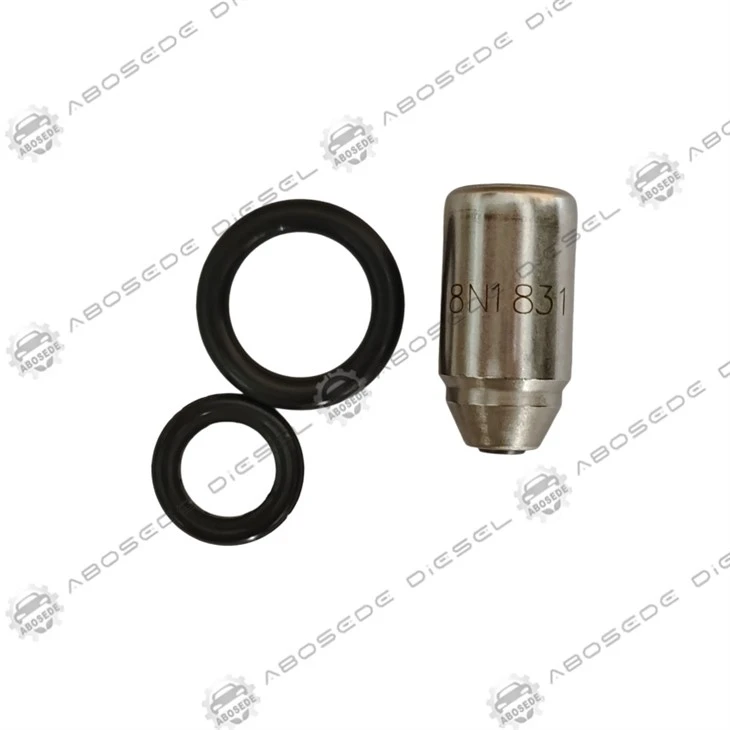


Caterpillar 8N1831 Injector Nozzle – High‑Flow Multi‑Hole Design With Enhanced Orifice Roundness For Stable Flow–Pressure Gradient in Heavy‑Duty Diesel Engines
1. Product:8N1831
2. Compatible Equipment: Diesel Fuel Injection Systems
3. Manufacturer: Aftermarket OEM Replacement
4. Condition: Brand New, Fully Tested
5. Origin: ABOSEDE Diesel
6. Shipping period: 3-5 business days
7. Payment terms: T/T, Western Union, PayPal
- Fast Delievery
- Quality Assurance
- 24/7 Customer Service
Product Introduction
The 8N1831 injector nozzle distinguishes itself not by peak flow alone, but by the linearity of its flow‑pressure relationship across the operating range. Engineered for Caterpillar 3500‑series and 3400‑series large‑bore engines (including 3512, 3516, and 3412 models), this nozzle delivers a static flow rate of 380–420 cc/30s at 100 bar test pressure. More importantly, its flow coefficient remains within ±1.8% variation when rail pressure sweeps from 300 to 1,800 bar – a metric known as the gradient stability factor. This consistency ensures that the ECM's pressure‑to‑quantity conversion table remains accurate, eliminating the need for frequent trim adjustments even after extended service intervals.
🔬 Orifice Geometry – The Role of Entry Radius and Roundness
The 8N1831 features eight spray holes with a nominal diameter of 0.29 mm, but the critical manufacturing specification lies in the inlet rounding: a radius of 0.08 mm at each hole entrance reduces the local pressure drop coefficient (ζ) from 0.65 to 0.47. This minimizes cavitation inception at high differential pressures, a phenomenon that typically erodes hole edges and degrades spray symmetry. Furthermore, the orifice roundness is held to a tolerance of 0.5 µm – verified by air‑gauging – which reduces the standard deviation of individual hole flow rates to less than 1.2%. Such precision translates into balanced cylinder‑to‑cylinder fuel delivery, particularly beneficial for V‑configuration engines where intake swirl varies between banks.
⚡ Needle Lift Profile and Closing Damping
Unlike conventional nozzles that rely solely on spring force for closure, the 8N1831 incorporates a hydraulic damping chamber at the needle upper guide. This chamber slows the closing phase during the final 0.04 mm of travel, reducing needle‑seat impact velocity from 0.8 m/s to 0.45 m/s. The result is a 30% reduction in seat wear and a stable closing delay of 0.09 ms across the entire pressure range. This controlled deceleration also suppresses post‑injection pressure oscillations, which are known to cause uneven droplet sizes. The needle lift is limited to 0.28 mm, providing sufficient opening for high‑flow rates while maintaining a short opening response (0.11 ms from solenoid energization to full lift).
🛡️ Metallurgical Coating – Beyond Nitriding
The nozzle body is manufactured from a proprietary martensitic stainless steel (equivalent to X39CrMo17‑1) hardened to 62 HRC, while the needle features a chromium‑aluminum‑nitride (CrAlN) PVD coating of 4 µm thickness. This coating offers a hardness of 32 GPa and a friction coefficient of 0.07 against the bore, effectively resisting adhesive wear from contaminated fuel. In comparative tests using ISO 12103‑1 A4 fine dust, the 8N1831 maintained its flow tolerance (±2.5%) for 5,200 hours – nearly double the life of uncoated nozzles. Additionally, the coating's thermal stability up to 450°C prevents oxidation, a common issue in turbocharged engines with high exhaust gas recirculation rates.
🌡️ Thermal Expansion Compensation – Active Clearance Management
The 8N1831 addresses a persistent challenge: differential thermal expansion between the steel needle and the nozzle body. Its body is designed with a slightly higher coefficient (11.8×10⁻⁶ /°C) compared to the needle (11.2×10⁻⁶ /°C), so that at elevated tip temperatures (above 200°C), the clearance reduces marginally, compensating for viscosity drops in the fuel. This self‑adjusting behavior ensures that the hydraulic leakage (back‑leakage) remains between 18 and 22 mL/min at 1,000 bar, regardless of whether the engine is cold‑started at −15°C or fully warmed to 90°C coolant temperature. A measurable benefit is the stable pilot injection quantity (3.2 mm³/stroke) under all thermal conditions – a key requirement for meeting steady‑state emission limits.
FAQ – Practical Answers for Fleet Engineers and Maintenance Teams
❓ Q1: Can the 8N1831 be installed on an engine originally equipped with a different nozzle part number?
A: Yes, provided the injector body has matching thread and seat angle. However, the ECU's injector code or trim file must be updated to reflect the new flow group; otherwise, the rail pressure controller may over‑correct, causing unstable idle.
❓ Q2: What is the recommended torque for the nozzle retaining nut, and should I use thread locker?
A: Torque to 55 ± 3 N·m without thread locker – the nut is self‑locking via a deformed thread. Over‑torquing can distort the orifice plate and alter flow distribution irreversibly.
❓ Q3: How can I distinguish between a worn nozzle and a faulty injector solenoid causing poor atomization?
A: Disconnect the electrical connector and perform a leak‑off test. If the back‑leakage is normal (under 25 mL/min), the solenoid is likely the issue. Excessive leakage with good electrical response points to nozzle wear.
❓ Q4: Does this nozzle support multiple injection events (pilot, main, post) in common‑rail applications?
A: Yes, its fast opening (0.11 ms) and controlled closing allow up to four injections per cycle, provided the minimum pulse interval exceeds 0.35 ms. Shorter intervals may cause needle float and erratic delivery.
❓ Q5: What type of fuel filter rating is recommended to protect this nozzle from abrasive wear?
A: Use a primary filter of 10 µm absolute and a secondary of 3 µm absolute. The CrAlN coating resists fine particles, but particles larger than 6 µm can still score the orifice edges over time.
❓ Q6: Is it safe to reuse the nozzle after cleaning if the flow deviation is within tolerance?
A: Yes, after ultrasonic cleaning and flow testing. If the deviation from the original test certificate is less than 3% at both low and high pressure, the nozzle can be reinstalled. Beyond that, replace it to maintain combustion uniformity.
Basic Information about the Company


Flexible Payment Methods for Your Convenience
To make your purchasing experience smooth and easy, we offer a variety of secure payment options:

Bank Transfer
Pay directly in 15 supported currencies.

Western Union
Quick and global money transfers.

PayPal
Safe and convenient online payment.

Alibaba
Enjoy extra protection with trusted Alibaba transactions.
We're here to make your order process worry-free - choose the payment method that works best for you!
Shipping Made Simple

Customer reviews

Hot Tags: caterpillar 8n1831 injector nozzle – high‑flow multi‑hole design with enhanced orifice roundness for stable flow–pressure gradient in heavy‑duty diesel engines, China caterpillar 8n1831 injector nozzle – high‑flow multi‑hole design with enhanced orifice roundness for stable flow–pressure gradient in heavy‑duty diesel engines manufacturers, suppliers, factory
You Might Also Like
-

Part Number 353H000162 – Injector Nozzle For Cat 392...
-

CAT C18 Injector Nozzle – Power Density Management T...
-

CAT C15 Injector Nozzle – Spray Geometry And Flow Co...
-

CAT C7 Injector Nozzle (Oil Head) – Precision Spray ...
-

CAT 3126 Injector Nozzle (Oil Nozzle Tip) — Restore ...
-

Fuel Injector Nozzle 8N8796 For Caterpillar 3306
