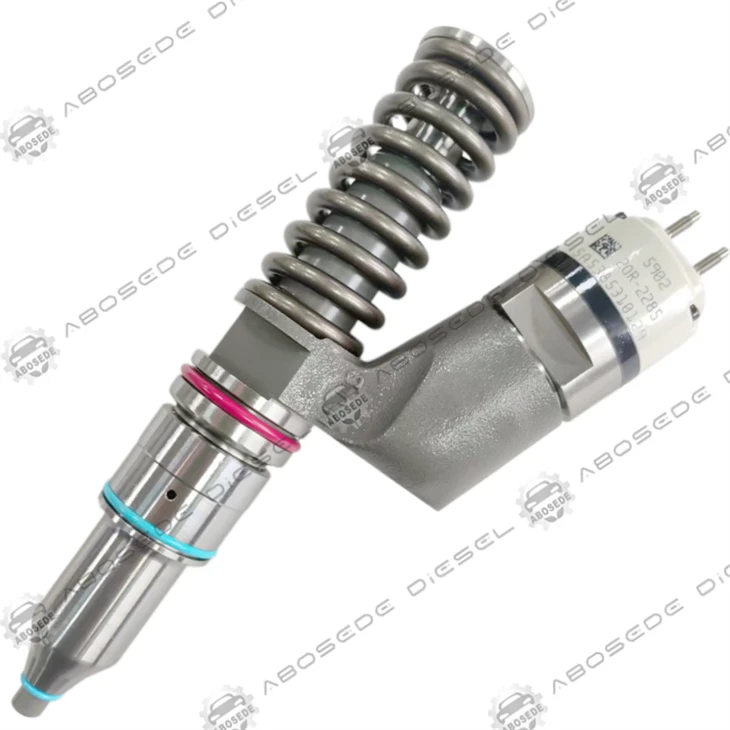
20R-2285 CAT Injector: Spray Cone Angle Stability as a Mechanical Determinant of Particulate Emissions in Common Rail and EUI Systems
video
20R-2285 CAT Injector: Spray Cone Angle Stability as a Mechanical Determinant of Particulate Emissions in Common Rail and EUI Systems

20R-2285 CAT Injector: Spray Cone Angle Stability as a Mechanical Determinant of Particulate Emissions in Common Rail and EUI Systems

1. Product: 20R-2285
2. Compatible Equipment: Diesel Fuel Injection Systems
3. Manufacturer: Aftermarket OEM Replacement
4. Condition: Brand New, Fully Tested
5. Origin: ABOSEDE Diesel
6. Shipping period: 3-5 business days
7. Payment terms: T/T, Western Union, PayPal

  • Fast Delievery
  • Quality Assurance
  • 24/7 Customer Service
Product Introduction


In a common rail system, the ECU can compensate for many injector variations. It reads rail pressure, commands multiple injection events, and trims pulse width per cylinder. One variable it cannot fully correct mechanically is spray cone angle. If the nozzle cone angle drifts, the fuel cloud misses the intended region of the piston bowl. Rich zones form, soot rises, and exhaust temperature spreads. The 20R-2285 CAT injector is engineered around spray cone angle stability. It holds cone angle within ±0.5° across the operating pressure range and resists the nozzle inlet erosion that widens the spray over time. This is not a flow-rate claim; it is a geometry-retention claim.


🔧 Why Spray Cone Angle Stability Defines Particulate Emissions

In a common rail system, pressure is held in a rail and metered electronically. The ECU can split injection into pilot, main, and post events. That flexibility can mask small spray variations. But if the cone angle drifts beyond a few degrees, the fuel cloud no longer matches the combustion bowl. The result is wall wetting, incomplete burn, and particulate matter. The 20R-2285 controls cone angle by holding nozzle inlet radius, orifice length-to-diameter ratio, and needle lift repeatability. It keeps the spray cone within ±0.5° of nominal across 400–1,800 bar and 20–100°C.


🌀 Nozzle Inlet Geometry and Cone Angle Retention

Spray cone angle is set by nozzle hole inlet radius, orifice taper, and needle lift. If the inlet radius erodes, flow separation moves, and the cone angle widens. The 20R-2285 uses a hydro-ground inlet with a controlled radius. That keeps the flow separation point stable across pressure and temperature. The orifice is abrasive-flow machined to maintain a consistent discharge coefficient. The needle guide is diamond-like carbon coated to reduce tilt, which would otherwise skew the spray pattern. In a 1-million-cycle wear test, cone angle drift stayed below 1.2°, while a standard nozzle drifted by more than 4°. The nozzle tip also uses a wear-resistant coating to resist carbon adhesion, which can distort spray symmetry.


💧 Matching Spray to Combustion Bowl Geometry

Cone angle stability matters only if the spray matches the bowl. In large-bore CAT engines, the piston bowl has a specific geometry. If the spray angle is too narrow, fuel does not reach the bowl lip. If it is too wide, fuel impinges on the cylinder wall. Both conditions increase particulate matter. The 20R-2285 is designed to match the original bowl geometry. Its spray penetration and cone angle are calibrated to deliver fuel into the bowl without wall wetting. That keeps combustion centered and reduces soot formation at both low and high load.


❓ FAQ: 20R-2285 CAT Injector and Common Rail Service Questions

Q1: Is the 20R-2285 a common rail injector?
It is a CAT diesel fuel injector used in common rail and EUI applications depending on engine platform. Verify fitment by engine serial number and ECM calibration before ordering.

Q2: Why does spray cone angle drift increase particulate emissions?
A drifted cone angle moves the fuel cloud away from the bowl center. That creates rich zones that burn incompletely, forming soot. The 20R-2285 holds cone angle within ±0.5°.

Q3: How can I test spray cone angle on a bench?
Measure cone angle at 30 mm downstream of the nozzle at 400, 1,200, and 1,800 bar, and at 20°C and 100°C. A total angle range above 2° indicates inlet erosion or needle guide wear.

Q4: Does the 20R-2285 require programming after installation?
Common rail applications require trim code programming. EUI applications generally do not, but the ECM must see correct injection response. Verify calibration and cylinder balance after installation.

Q5: What causes cone angle to widen over time?
Nozzle inlet cavitation erosion, needle guide clearance growth, and carbon adhesion on the tip. The 20R-2285 uses hydro-ground inlet geometry and a DLC-coated guide to resist these changes.

Q6: Can I replace one 20R-2285 without replacing the set?
In an emergency, yes. But the new injector will have different spray characteristics from aged ones. That creates cylinder-to-cylinder imbalance. For best results, replace the full set or bank.


202510091606539026


2

3

4


Flexible Payment Methods for Your Convenience


To make your purchasing experience smooth and easy, we offer a variety of secure payment options:

product-750-750

Bank Transfer

Pay directly in 15 supported currencies.

west union

Western Union

Quick and global money transfers.

PayPalLogo2014-1024x1014

PayPal

Safe and convenient online payment.

ae99cd49-2667-464e-b9db-b39cee0126e1

Alibaba

Enjoy extra protection with trusted Alibaba transactions.

We're here to make your order process worry-free - choose the payment method that works best for you!


Shipping Made Simple

6

Customer reviews


8

Hot Tags: 20R-2285 CAT Injector: Spray Cone Angle Stability as a Mechanical Determinant of Particulate Emissions in Common Rail and EUI Systems, China 20R-2285 CAT Injector: Spray Cone Angle Stability as a Mechanical Determinant of Particulate Emissions in Common Rail and EUI Systems manufacturers, suppliers, factory, 315-3020, 326-4635, C6 4 C6 6 engines, 361-4036, 292-3666, 618-0750

You Might Also Like

(0/10)

clearall