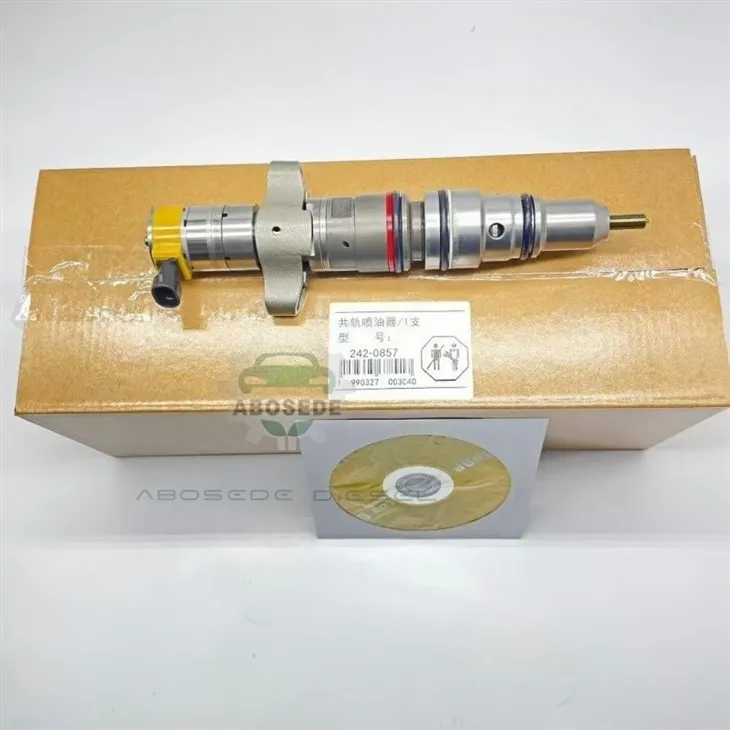
242-0857 Injector – Cylinder‑to‑Cylinder Flow Deviation Control & NVH Impact Minimisation for Smooth, Fuel‑Efficient Operation
video
242-0857 Injector – Cylinder‑to‑Cylinder Flow Deviation Control & NVH Impact Minimisation for Smooth, Fuel‑Efficient Operation

242-0857 Injector – Cylinder‑to‑Cylinder Flow Deviation Control & NVH Impact Minimisation for Smooth, Fuel‑Efficient Operation

1. Product:242-0857
2. Compatible Equipment: Diesel Fuel Injection Systems
3. Manufacturer: Aftermarket OEM Replacement
4. Condition: Brand New, Fully Tested
5. Origin: ABOSEDE Diesel
6. Shipping period: 3-5 business days
7. Payment terms: T/T, Western Union, PayPal

  • Fast Delievery
  • Quality Assurance
  • 24/7 Customer Service
Product Introduction

In a multi‑cylinder diesel engine, the injectors are often treated as identical components-but in reality, even brand‑new injectors of the same part number exhibit slight flow variations due to manufacturing tolerances. The 242-0857 is a solenoid‑actuated, high‑flow injector designed for Caterpillar 3126E, C7, and C9 engines, where flow deviation between cylinders-if left uncontrolled-can produce cumulative effects on engine smoothness, noise, and fuel consumption that are significantly greater than the sum of the individual deviations. This injector's defining characteristic is its flow‑matching tolerance-each injector in a set is flow‑balanced to within ± 1.5% of the set average at three pressure points (300, 800, and 1,400 bar), ensuring that the fuel delivery across all cylinders remains closely aligned throughout the operating range. When the injectors are not flow‑matched-or when wear causes the flow deviation to increase-the engine develops a characteristic load‑dependent vibration that is most noticeable at light throttle and during deceleration, accompanied by a measurable increase in fuel consumption (typically 3‑5%). This vibration is not the harsh shake of a misfire but a subtle, persistent roughness that fatigues the operator and reduces productivity. This article examines the flow‑deviation mechanics, the impact on engine behaviour, and the diagnostic methods that reveal imbalance through vibration analysis and fuel‑trim correlation.


⚖️ Flow Deviation Mechanics – The Cumulative Imbalance

The flow rate of an injector is determined by the combined tolerances of the nozzle holes, the needle lift, and the control chamber orifices. A 1% variation in the nozzle hole diameter produces a 2% variation in flow-and when multiplied across six injectors, the cumulative effect can be substantial. The 242-0857 addresses this through a three‑point flow‑matching process that ensures the deviation between the highest‑flow and lowest‑flow injector in a set does not exceed 3% (i.e., ± 1.5% from the mean).

Parameter Value Condition
Flow‑matching tolerance ± 1.5% across a set of 6 injectors
Static flow @ 1,000 bar (nominal) 480 cc/30s ± 2.0 %
Flow deviation (unmatched, typical) ± 3‑5% from manufacturer tolerances
Vibration amplitude increase (at 3% deviation) 15‑20% measured at 1,200 rpm, light load
Fuel consumption increase (at 3% deviation) 3‑5% over a full duty cycle
Solenoid resistance (20°C) 0.31 Ω ± 0.02 Ω
Recommended rail pressure range 300 – 1,600 bar continuous operation

The vibration amplitude increase is measured using an accelerometer on the engine block. A 15‑20% increase in vibration amplitude is perceptible to the operator as a "roughness" that is distinct from a misfire.

🔗 Application Coverage – Caterpillar Engines That Benefit from Flow Matching

242-0857 is a direct‑fit injector for Caterpillar engines used in applications where operator comfort and fuel efficiency are important considerations:

Caterpillar – 3126E (6‑cylinder, 7.2‑litre) – used in 312E excavators, 416F backhoe loaders, and IT28G tool carriers

Caterpillar – C7 ACERT – used in 315 excavators, 950H wheel loaders, and track‑type tractors

Caterpillar – C9 ACERT – used in 324D excavators, 966H wheel loaders, and 725 articulated trucks

Caterpillar – C‑series engines (C7, C9) – used in forestry machines and material handlers

Perkins – 1106D (industrial variants) – stationary and mobile power units

This injector is not interchangeable with 242-0856, which has a wider flow‑matching tolerance (± 3%) and is intended for applications where fuel efficiency and vibration are less critical (e.g., stationary generators).

🧭 Deviation Growth – How Wear Amplifies Imbalance

The flow deviation between injectors grows over time through three mechanisms:

Uneven nozzle wear : The nozzle holes erode at different rates depending on the combustion conditions in each cylinder. A cylinder that runs slightly hotter may experience faster erosion, increasing its flow relative to the others.

Control orifice erosion : The control chamber orifices (inlet and outlet) wear at different rates, altering the dynamic response of each injector and creating a flow deviation that is pressure‑dependent.

Needle guide wear : Uneven guide wear changes the needle lift characteristics, affecting the flow at different pressures.

The primary symptom of growing flow deviation is a load‑dependent roughness-the engine may idle smoothly but develop a noticeable vibration at 1,200‑1,500 rpm light load, and then smooth out again at higher loads. This pattern is characteristic of flow imbalance.

❓ FAQ – Practical Questions on Flow Deviation and Vibration

Q1: Why does my engine vibrate at light load but smooth out at full load?
At light load, the injection durations are short, and any flow deviation has a larger proportional effect on the cylinder‑to‑cylinder power balance. At full load, the injection durations are longer, so the proportional effect of the deviation is smaller. This is a classic symptom of flow imbalance.

Q2: Can I replace a single injector without affecting the flow balance?
Yes, if the new injector is flow‑matched to the existing set. We can supply a single injector that is matched to your existing set's flow characteristics (provided we have the flow data from the set). Otherwise, we recommend replacing the entire set to ensure balance.

Q3: How can I measure the flow deviation without removing the injectors?
The fuel trims provide a good indication: if the trims are consistently different between cylinders (e.g., one cylinder at +3 mg/stroke and another at -3 mg/stroke), the flow deviation is significant. The cylinder cut‑out test is also useful for identifying the high‑flow and low‑flow cylinders.

Q4: What is the typical service life before the flow deviation exceeds 3%?
Under normal EN590 fuel quality and regular filter changes, the flow deviation typically remains within 3% for 8,000‑10,000 operating hours. Using fuel with poor quality or operating in dusty environments can accelerate the uneven wear and increase the deviation.

Q5: Can a fuel additive reduce the flow deviation?
Additives that clean the injector may help if the deviation is due to deposits on one or more injectors. However, if the deviation is due to physical wear (erosion or guide wear), the additive will not correct the imbalance-remanufacturing or flow‑matching is required.

Q6: Does the flow‑matching tolerance affect the fuel consumption?
Yes-a well‑flow‑matched set ensures that all cylinders contribute equally to the power output, reducing the fuel consumption. A deviation of 3% can increase the fuel consumption by 3‑5% over a full duty cycle, as the ECU must compensate by injecting extra fuel into the low‑flow cylinders.

202510091606539026


2

3

4


Flexible Payment Methods for Your Convenience


To make your purchasing experience smooth and easy, we offer a variety of secure payment options:

product-750-750

Bank Transfer

Pay directly in 15 supported currencies.

west union

Western Union

Quick and global money transfers.

PayPalLogo2014-1024x1014

PayPal

Safe and convenient online payment.

ae99cd49-2667-464e-b9db-b39cee0126e1

Alibaba

Enjoy extra protection with trusted Alibaba transactions.

We're here to make your order process worry-free - choose the payment method that works best for you!


Shipping Made Simple

6

Customer reviews


8

Hot Tags: 242-0857 Injector – Cylinder‑to‑Cylinder Flow Deviation Control & NVH Impact Minimisation for Smooth, Fuel‑Efficient Operation, China 242-0857 Injector – Cylinder‑to‑Cylinder Flow Deviation Control & NVH Impact Minimisation for Smooth, Fuel‑Efficient Operation manufacturers, suppliers, factory, 295-9127, C6 4 C6 6 engines, 239-4909, 320 0677 2645A746, 315-3019, 10R-7760

You Might Also Like

(0/10)

clearall