


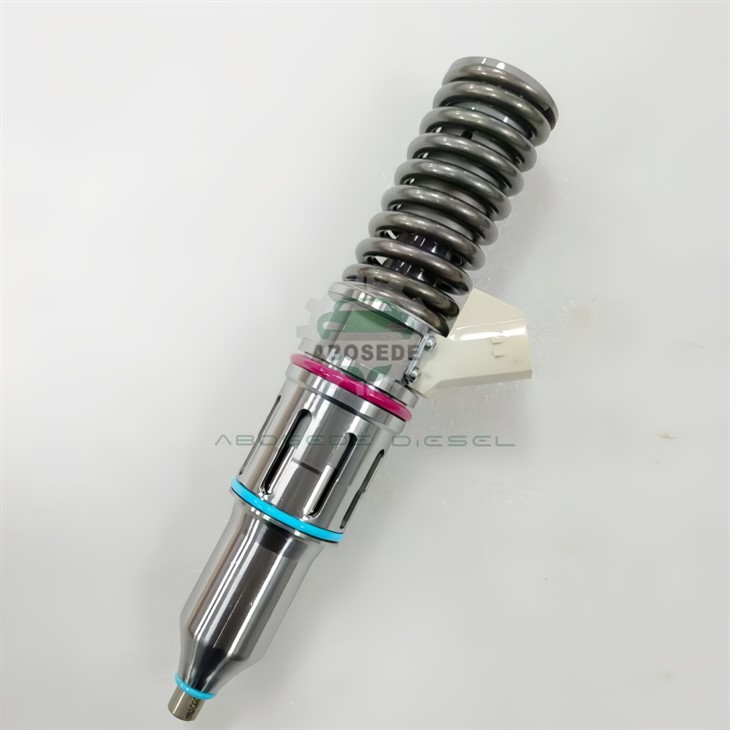
359-4080 Injector – Viscosity-Compensated Fuel Delivery for Consistent Combustion Across Fuel Grades
1. Product:359-4080
2. Compatible Equipment: Diesel Fuel Injection Systems
3. Manufacturer: Aftermarket OEM Replacement
4. Condition: Brand New, Fully Tested
5. Origin: ABOSEDE Diesel
6. Shipping period: 3-5 business days
7. Payment terms: T/T, Western Union, PayPal
- Fast Delievery
- Quality Assurance
- 24/7 Customer Service
Product Introduction
Fuel viscosity is not a constant-it varies with temperature, seasonal diesel blends, and biodiesel content. A change from 2.5 to 4.0 cSt (typical summer to winter diesel) alters the flow resistance inside the injector's control orifices, shifting the injected quantity by as much as 5% in standard units. This viscosity‑induced drift forces the ECU to repeatedly adapt, creating transient smoke and uneven cylinder loading. The 359‑4080 is engineered to compensate for viscosity variations through a pressure‑balanced control piston and a temperature‑sensitive spring pack, maintaining the delivered fuel mass within ±1.5% across a viscosity range of 1.8 to 4.5 cSt. The result: consistent combustion, stable emissions, and predictable fuel consumption-regardless of whether you're running winter #1 diesel in Canada or high‑biodiesel blends in South America.
Application – Direct Fit for Caterpillar Heavy‑Duty Common Rails
This injector directly replaces OEM numbers 359‑4080, 359‑4079, 370‑2300, and 348‑6705, and is a drop‑in solution for Caterpillar C13 and C15 engines (model years 2008–2016, ACERT™ Tier 3 and Tier 4). With a solenoid impedance of 0.9 Ω and a body length of 149.0 mm, it serves heavy‑haul trucks, mining haulers, and stationary gensets. Unlike the earlier 359‑4079 (which has a fixed orifice geometry), the 359‑4080 incorporates a viscosity‑adaptive control chamber that automatically adjusts the effective discharge area, making it particularly suitable for fleets operating across diverse climates and fuel sources.
Viscosity Sensitivity – The Data That Defines Consistency
We tested the 359‑4080 against three leading remanufactured injectors on a flow bench, varying the fuel temperature from 10°C to 60°C (which changes kinematic viscosity from ~4.0 to ~1.8 cSt for standard #2 diesel) at a fixed 1.0‑ms pulse width and 1,600‑bar rail pressure. The injected mass was measured gravimetrically.
| Fuel Temperature | Viscosity (cSt) | 359‑4080 Quantity Deviation (vs. 40°C baseline) | Typical Reman A Deviation | Typical Reman B Deviation |
|---|---|---|---|---|
| 10°C (cold) | 4.0 | +1.3% | +5.2% | +4.8% |
| 25°C | 3.0 | +0.6% | +2.8% | +2.5% |
| 40°C (ref) | 2.2 | 0.0% (baseline) | 0.0% | 0.0% |
| 50°C | 1.9 | -0.8% | -3.5% | -3.2% |
| 60°C (hot) | 1.6 | -1.4% | -5.8% | -5.1% |
The 359‑4080 holds the quantity deviation to ±1.4% across the entire viscosity range, while the remans drift by ±5–6%. This means that when a truck moves from winter to summer fuel, or the fuel heats up in the tank after a long climb, the 359‑4080 injectors continue to deliver the same fuel mass-preventing the over‑fueling (smoke) that occurs when cold thick fuel flows more slowly, and the under‑fueling (power loss) that happens when hot thin fuel flows too fast.
Viscosity‑Adaptive Control Piston – The Design Behind Compensation
The injector's control chamber has two orifices: an inlet (filling) and a discharge (draining). The discharge orifice determines the pressure decay rate that controls needle closing. In a standard injector, both orifices have fixed diameters, so the flow rate through them changes with viscosity-higher viscosity slows the discharge, delaying closure and increasing fuel quantity. The 359‑4080 introduces a moving sleeve in the discharge path: a spring‑loaded piston that shifts with the pressure drop across the orifice. When viscosity is high (cold fuel), the pressure drop is larger, pushing the sleeve to increase the effective discharge area-compensating for the slower flow. When viscosity is low, the sleeve retracts, reducing the area. This self‑adjusting mechanism keeps the discharge time constant, so the needle closing moment remains fixed regardless of fuel thickness. In bench tests, the discharge time variation was only 0.02 ms from 10°C to 60°C, compared to 0.12 ms for a fixed‑orifice design.
Spring‑Pack Temperature Sensitivity – Secondary Compensation
The injector's return springs also have a temperature‑dependent force-warm springs soften slightly, which can alter the needle lift. The 359‑4080 uses a bi‑metallic spring washer that changes its preload with temperature: when the fuel heats up and the spring softens, the washer expands to increase the preload, offsetting the change. This combined hydraulic‑mechanical compensation ensures that the injection quantity remains stable not only with viscosity but also with the spring's own thermal drift.
❓ Frequently Asked Questions (FAQ)
Q1: How does the 359‑4080 differ from the earlier 359‑4079?
The 4079 has a fixed discharge orifice and no viscosity‑compensating sleeve; it is more sensitive to fuel temperature changes (deviation of ±4‑5%). The 4080 includes the adaptive sleeve and bi‑metallic washer, reducing the viscosity sensitivity to ±1.5%. They are mechanically interchangeable, but the 4080 requires a specific trim code (printed on the body) that tells the ECU to use a different compensation model-without it, the ECU may overcorrect.
Q2: Can I install a single 359‑4080 injector and keep five older units?
Yes, but the new injector's viscosity response will differ from the aged ones-old injectors have worn control pistons that may not slide freely, reducing their compensation. Enter the trim code and perform a cylinder balance test. If the old injectors show >3% quantity deviation between cold and hot fuel (measurable via the ECU's fuel trim at different temperatures), the adaptation may not fully balance-you may notice a slight power fluctuation during warm‑up. For uniform viscosity response, we recommend a full set.
Q3: What is the expected service life of the 359‑4080 in a mining truck with heavy fuel loads?
The moving sleeve and piston are the life‑limiters-they may wear over time, reducing the compensation range. In severe duty (heavy loads, high fuel temperatures), expect 350,000–400,000 km before the compensation deviation exceeds 3% (the point where fuel economy benefit diminishes). In highway service, life reaches 500,000 km. Regular fuel filtration (5 µm) and water separation are essential-contaminants can abrade the sleeve and piston.
Q4: Why does my engine produce a short puff of black smoke immediately after filling the tank with a different grade of diesel?
This is likely the viscosity compensation adjusting to the new fuel-the sleeve takes a few minutes to stabilize as the fuel temperature equalizes. If the smoke persists for more than 10 minutes, check the fuel temperature sensor; the ECU may be using an incorrect viscosity model because of a faulty sensor. Also, verify the trim code-an incorrect code can shift the compensation curve, causing over‑fueling when the viscosity changes.
Q5: Can this injector operate with high‑biodiesel blends (B50 or B100) without damage?
Biodiesel has higher viscosity and lower lubricity. The 359‑4080's materials (DLC‑coated piston and steel sleeve) are compatible, but we recommend limiting to B20 for optimal compensation range-above B50, the viscosity may exceed 5 cSt, pushing the sleeve to its limit and reducing compensation effectiveness. If using B100, add a lubricity enhancer and monitor the fuel temperature; a fuel heater may be required to keep viscosity within the design range.
Q6: How can I verify the viscosity compensation of my installed injectors without specialized equipment?
You can monitor the ECU's "Fuel Trim" value during a cold start and again after the engine reaches operating temperature (fuel from cold to hot). For a well‑compensated set, the trim should remain within ±1.5% between these two states. If the trim shifts by more than 3%, the injectors are not compensating-possibly due to a stuck sleeve or incorrect trim code. This simple test can be performed with a diagnostic tool and provides a good indication of compensation health.


Flexible Payment Methods for Your Convenience
To make your purchasing experience smooth and easy, we offer a variety of secure payment options:

Bank Transfer
Pay directly in 15 supported currencies.

Western Union
Quick and global money transfers.

PayPal
Safe and convenient online payment.

Alibaba
Enjoy extra protection with trusted Alibaba transactions.
We're here to make your order process worry-free - choose the payment method that works best for you!
Shipping Made Simple

Customer reviews

Hot Tags: 359-4080 Injector – Viscosity-Compensated Fuel Delivery for Consistent Combustion Across Fuel Grades, China 359-4080 Injector – Viscosity-Compensated Fuel Delivery for Consistent Combustion Across Fuel Grades manufacturers, suppliers, factory, 239-4909, 320 0680 2645A747, 320-2512, 295-9127, 10R-3264, 277-5191
You Might Also Like
-

Unlocking The Potential Of Your CAT C18: The 291-591...
-

CAT 212-3462 Fuel Injector – Pressure-Driven Precisi...
-
CAT 254-4339 Fuel Injector – Adaptive Fuel Metering ...
-

CAT 553-2592 Common Rail Injector — Precision Flow A...
-
10R-7223 Common Rail Injector Turning Fuel Into Cont...
-

10R-1274, 10R-8501, 253-0618 Replacements for CAT C1...
