


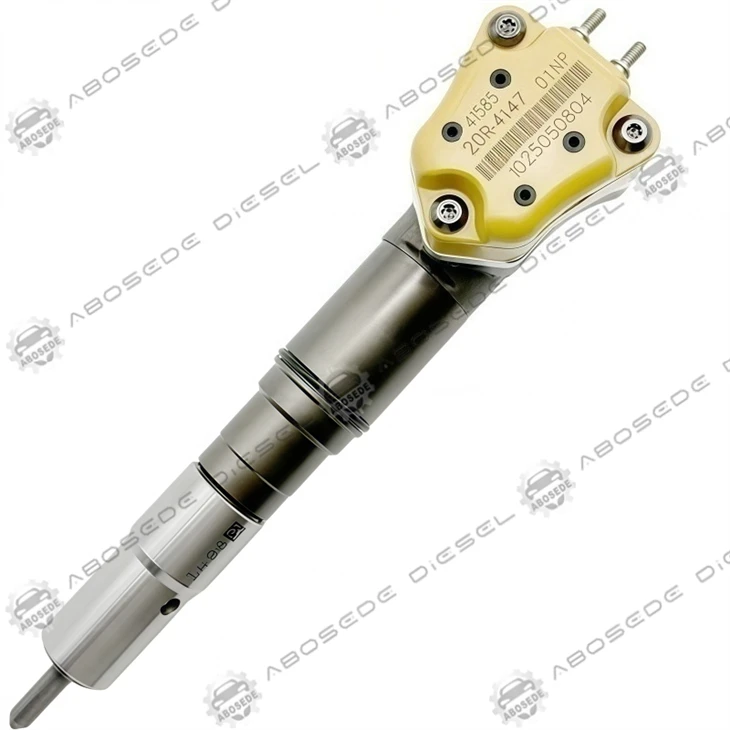


20R-4147 CAT Fuel Injector: Transient Response Stability in Common Rail Systems
1. Product: 20R-4147
2. Compatible Equipment: Diesel Fuel Injection Systems
3. Manufacturer: Aftermarket OEM Replacement
4. Condition: Brand New, Fully Tested
5. Origin: ABOSEDE Diesel
6. Shipping period: 3-5 business days
7. Payment terms: T/T, Western Union, PayPal
- Fast Delievery
- Quality Assurance
- 24/7 Customer Service
Product Introduction
Common rail engines rarely fail at steady state. They fail during transitions-when load changes suddenly, when the throttle moves faster than the fuel system can respond. The 20R-4147 CAT fuel injector is engineered for those moments. It targets transient response stability: the ability to deliver the commanded fuel quantity immediately after a change in rail pressure, engine load, or injection strategy. For Caterpillar common rail platforms, this injector reduces the lag between ECU command and actual needle response, keeping combustion phasing consistent when the engine is accelerating, lugging, or recovering from a load step.
⚡ Why Transient Response Defines Common Rail Drivability
In a common rail system, rail pressure is controlled by the high-pressure pump and a pressure control valve. When load changes, rail pressure fluctuates. If the injector cannot compensate quickly, the actual fuel quantity deviates from the commanded value. That deviation causes torque hesitation, smoke spikes, and unstable combustion. The 20R-4147 addresses this with a low-inertia armature and a high-response control valve that reaches full lift in 0.18 ms and returns to seat in 0.22 ms. This fast response allows the ECU to maintain injection timing during transient events, rather than waiting for rail pressure to stabilize.
🔧 Hydraulic Design for Fast Transient Response
The control valve uses a short-stroke spool with a low-mass armature. A permanent-magnet bias accelerates flux collapse, reducing closing delay. The control piston has a reduced dead volume, which shortens the hydraulic delay between solenoid energizing and needle lift. The nozzle uses conical orifice inlets to maintain discharge coefficient at 0.84, even when rail pressure drops during a transient. These design choices combine to keep injection quantity deviation below ±2% during a 500 bar/ms pressure ramp-a condition that occurs during hard acceleration or sudden load application.
🧪 Installation, Coding, and Diagnostic Verification
After replacing a 20R-4147, injector trim codes must be written to the ECM. Without coding, balance rates may drift, causing rough idle and transient hesitation. Diagnostic checks should include coil resistance, inductance, return flow, and minimum pulse response. A resistance outside 0.94 Ω ± 0.04 Ω indicates solenoid degradation. High return flow can signal control-valve leakage; low return flow may indicate internal blockage. Always verify rail pressure stability and cylinder balance after installation. For common rail systems, fuel cleanliness is critical: contamination that passes a basic filter can still erode nozzle seats and change transient response over time.
❓ FAQ: Common Rail Transient Response and 20R-4147 Service
Q1: Is the 20R-4147 a HEUI or common rail injector?
It is a common rail solenoid injector. It should not be interchanged with HEUI or mechanically actuated unit injectors. Verify fitment by engine serial number and ECM calibration.
Q2: How does transient response affect fuel economy?
Poor transient response causes the ECU to over-fuel or under-fuel during load changes. Over-fueling wastes fuel and increases soot; under-fueling reduces torque and may trigger fault codes. The 20R-4147 keeps delivery closer to command, improving efficiency.
Q3: What causes slow transient response in common rail injectors?
High armature mass, long control-valve stroke, and large control-piston dead volume all increase response time. Contamination and solenoid degradation also slow response.
Q4: Does the 20R-4147 require programming after installation?
Yes. Injector trim codes must be written to the ECM. Skipping this step affects pilot quantity, balance rates, and transient response, even if the injector is mechanically correct.
Q5: How can I test transient response on a bench?
Bench testing should include step-response tests at different rail pressures, measuring opening and closing delays. A response time greater than 0.25 ms indicates a problem.
Q6: What service life can be expected from the 20R-4147?
With clean fuel and correct rail pressure, service life can reach approximately 6,000 hours in continuous-duty applications. Contaminated fuel or excessive return flow can shorten that significantly.


Flexible Payment Methods for Your Convenience
To make your purchasing experience smooth and easy, we offer a variety of secure payment options:

Bank Transfer
Pay directly in 15 supported currencies.

Western Union
Quick and global money transfers.

PayPal
Safe and convenient online payment.

Alibaba
Enjoy extra protection with trusted Alibaba transactions.
We're here to make your order process worry-free - choose the payment method that works best for you!
Shipping Made Simple

Customer reviews

Hot Tags: 20R-4147 CAT Fuel Injector: Transient Response Stability in Common Rail Systems, China 20R-4147 CAT Fuel Injector: Transient Response Stability in Common Rail Systems manufacturers, suppliers, factory, 368-9171, 282 0490 2645A709, 20R-2284, 249-0709, 253-0614, C6 4 C6 6 engines
You Might Also Like
-

Caterpillar 3116 Injector 0R-3580: Optimizing Mechan...
-

CAT 3500A Fuel Injector 7C-4174 | High-Performance D...
-

249-0712 Fuel Injector – Precision Pulse Control For...
-

CAT 577-7633 Common Rail Injector — Synchronizing Pr...
-

20R-8061 Reman Injector Rebalancing Fuel Precision i...
-

20R-8057 CAT Common Rail Injector: Pressure-Response...
