


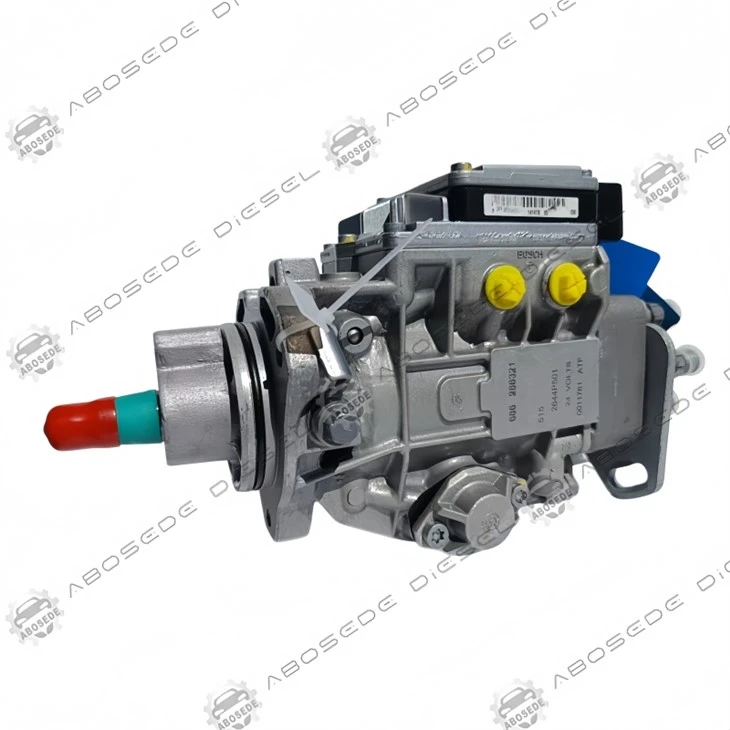


0470006010 VP29/30 Distributor Pump – Barometric Pressure Compensation For Altitude‑Adaptive Fuel Delivery in 1.9 TDI 90 PS
1. Product:0470006010
2. Compatible Equipment: Diesel Fuel Injection Systems
3. Manufacturer: Aftermarket OEM Replacement
4. Condition: Brand New, Fully Tested
5. Origin: ABOSEDE Diesel
6. Shipping period: 3-5 business days
7. Payment terms: T/T, Western Union, PayPal
- Fast Delievery
- Quality Assurance
- 24/7 Customer Service
Product Introduction
In naturally aspirated engines, the reduction in air density at high altitude is a well‑understood limitation. For turbocharged diesels, the turbocharger partially compensates by maintaining boost, but the compressor's ability to deliver mass airflow still diminishes with altitude-above 2,000 metres, even a turbocharged 1.9 TDI can lose 10‑15% of its air mass. If the fuel delivery remains unchanged, this results in an over‑fuelled mixture, producing black smoke, elevated exhaust temperatures, and a sluggish, sooty response. The 0470006010 VP29/30 distributor pump addresses this challenge through an integral barometric pressure compensator-a sealed aneroid capsule that senses ambient atmospheric pressure and mechanically adjusts the fuel rack position. As altitude increases and air pressure drops, the capsule expands, progressively reducing the maximum fuel delivery to match the available air mass. This mechanical adaptation ensures that the engine runs cleanly and responsively across altitudes from sea level to 3,000 metres, without requiring ECU intervention or sensor inputs.
◈ Barometric Compensation – How 0470006010 Adapts to Altitude
|
▪ Aneroid capsule operation ▪ Altitude‑matched fuel reduction ▪ Interaction with turbocharger |
🔄 Parallel with Common‑Rail Altitude Compensation
In common‑rail systems, altitude compensation is achieved through the ECU's atmospheric pressure sensor (built into the ECU or a separate sensor). The ECU reduces the injection quantity and adjusts the timing based on the measured pressure. The 0470006010's aneroid capsule performs the same function mechanically, without requiring electrical power or sensor inputs. While the common‑rail system offers more precise compensation (with resolution down to 1 mbar), the VP pump's solution is inherently reliable in electrical fault conditions-a significant advantage for older vehicles where sensor failure is a possibility.
🧰 Installation – Altitude Compensation Checks
Aneroid capsule inspection – The capsule must move freely; a seized capsule (often from corrosion or debris) will lock the compensation in a fixed position. If it's stuck in the expanded (high‑altitude) position, the engine will be under‑fuelled at sea level; if stuck in the compressed (sea‑level) position, the engine will over‑fuel at altitude. Check by pushing the capsule gently through the inspection port-it should compress and rebound smoothly.
Compensation lever link – The linkage between the capsule and the fuel rack must be free of play. Excessive play will cause a hysteresis effect, where the compensation engages at different pressures depending on whether the vehicle is ascending or descending.
Altitude‑specific calibration – The 0470006010 is calibrated for the standard 1.9 TDI 90 PS engine. If the engine has been modified (e.g., larger turbocharger, intercooler), the compensation may not match the new air‑flow characteristics. In such cases, a test‑bench recalibration is recommended.
Static timing – Set the plunger lift to 0.73 mm. The compensation does not affect timing, only quantity, so the static timing remains unchanged.
🆕 New vs. Remanufactured – The Barometric Compensation Factor
Remanufactured VP29/30 pumps often discard the aneroid capsule or replace it with a generic bellows that does not have the correct expansion characteristic. This is because the original capsule is a specialised component-its vacuum level and bellows spring rate are precisely matched to the fuel curve. Using a non‑calibrated capsule will result in either insufficient compensation (allowing smoke at altitude) or excessive compensation (causing power loss at moderate elevations). New 0470006010 units come with the factory‑sealed, calibrated aneroid capsule, guaranteeing the altitude performance specified.
❓ FAQ – Practical Questions from High‑Altitude Operators
Q1: How can I verify the barometric compensation is working without driving to high altitude?
Remove the pump and connect a vacuum pump to the capsule's pressure port (if accessible). Apply 700 mbar (simulating 3,000 metres) and observe the fuel rack position-it should retract by approximately 1.5‑2.0 mm compared to the sea‑level position. Alternatively, use a test bench with a pressure chamber to simulate altitude.
Q2: The engine smokes at 2,000 metres-could the compensation be insufficient?
Yes-if the capsule is sticking or the linkage is worn, the rack may not retract fully. First, check for mechanical binding. If the movement is free, the capsule may have lost its vacuum (due to a small leak), causing it to remain expanded at all altitudes, reducing fuel but also preventing full compensation. A capsule with a leak will not expand further as altitude increases.
Q3: Can I retrofit this pump to a vehicle that never had altitude compensation?
The pump will fit, and the compensation will work. However, the ECU's fuel maps are calibrated for a non‑compensated pump; the compensation may cause slight under‑fuelling at altitude, but this is generally beneficial-it prevents smoke. No ECU changes are required for basic operation, but for optimal performance, a remap can adjust the injector duration to match the pump's reduced delivery.
Q4: What is the effect of the compensation on fuel economy at sea level?
At sea level, the capsule is fully compressed, and the fuel rack is at its maximum position-there is no reduction in fuel delivery. Therefore, fuel economy at sea level is the same as a non‑compensated pump. Only at altitude is fuel delivery reduced, which actually improves fuel economy because the engine is not over‑fuelling.
Q5: How does the compensation interact with the governor's full‑load limiter?
The compensation acts as an override on the governor-it limits the maximum fuel rack regardless of the governor's position. The full‑load limiter (boost‑sensitive) still functions within the reduced envelope, ensuring smoke‑free acceleration even at altitude.
Q6: The capsule is damaged-can I replace it without rebuilding the entire pump?
The capsule is an integral part of the governor housing and is not a standard service part. Some specialist workshops can replace it, but it requires recalibrating the pump on a test bench. In most cases, replacing the entire pump with a new 0470006010 is more cost‑effective.


Flexible Payment Methods for Your Convenience
To make your purchasing experience smooth and easy, we offer a variety of secure payment options:

Bank Transfer
Supports multiple currenciesand bank payment methods.

Western Union
Quick and global money transfers.

PayPal
Safe and convenient online payment.

Alibaba
Enjoy extra protection with trusted Alibaba transactions.
We're here to make your order process worry-free - choose the payment method that works best for you!
Shipping Made Simple

Customer reviews

Hot Tags: 0470006010 vp29/30 distributor pump – barometric pressure compensation for altitude‑adaptive fuel delivery in 1.9 tdi 90 ps, China 0470006010 vp29/30 distributor pump – barometric pressure compensation for altitude‑adaptive fuel delivery in 1.9 tdi 90 ps manufacturers, suppliers, factory, 0445020530, 1042300FE010, Bosch for Mercedes, Diesel Fuel Injection Pump 0445020050 ME225083, Euro 6 Tier 4 Final, for Iveco Euro Cargo
You Might Also Like
-

0986437603 Common Rail Pump – Product Page
-

02113694 | High-Pressure Fuel Supply Pump For Common...
-

Volvo Penta 7421219977 – The Feed Pump With Controll...
-

Volvo Penta 0414750004 – The Fuel Feed Pump That Com...
-

Bosch 0445020203 High-Pressure Pump – CP3 Power For ...
-

Diesel Pump Common Rail Injection Pump 0445020546
