


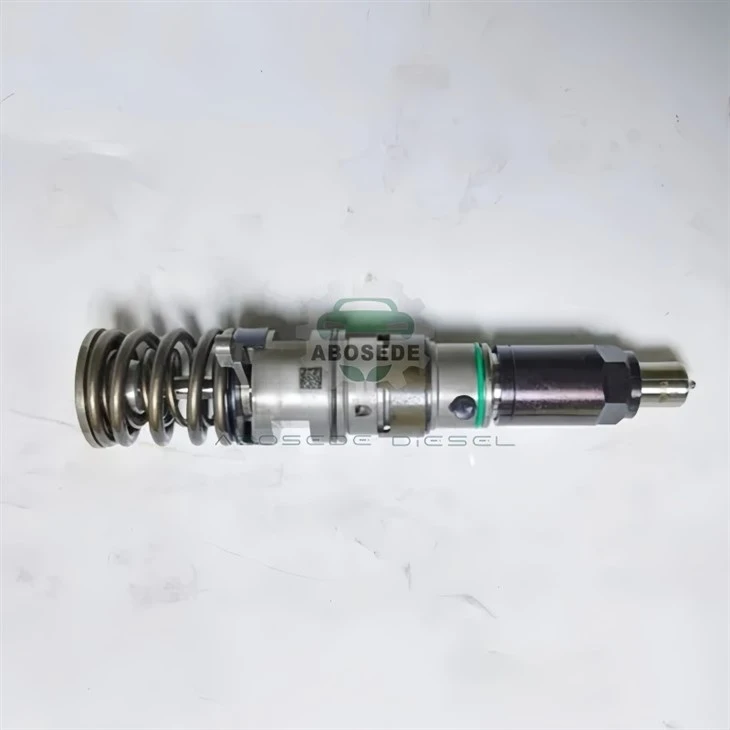
4006 Perkins fuel injector – Mastering Needle Dynamics To Eliminate Post-Drip And Hydraulic Imbalance
1. Product:4006
2. Compatible Equipment: Diesel Fuel Injection Systems
3. Manufacturer: Aftermarket OEM Replacement
4. Condition: Brand New, Fully Tested
5. Origin: ABOSEDE Diesel
6. Shipping period: 3-5 business days
7. Payment terms: T/T, Western Union, PayPal
- Fast Delievery
- Quality Assurance
- 24/7 Customer Service
Product Introduction
In diesel common rail systems, the injector's role extends far beyond simple fuel delivery. The true differentiator between an average reman unit and a high-performance new injector lies in what happens after the solenoid de-energizes. Post-drip (fuel weeping after needle seating) and secondary needle bounce are the "invisible killers" that gradually degrade oil viscosity, clog DPF substrates, and erode piston crowns. The 4006 injector has been engineered with a fundamental shift in design philosophy: prioritizing terminal-phase hydraulic damping and return-flow stability over peak flow numbers alone, ensuring that every injection cycle ends with absolute decisiveness.
Application Coverage – Direct Drop-In Compatibility
The 4006 injector is dimensionally and electrically matched to a broad array of Euro III, Euro IV, and Tier 3/Tier 4 off-highway platforms. It serves as a direct alternative for OEM part numbers across the following vehicle families:
Heavy-Duty Trucks: DAF XF105, IVECO Stralis, Renault T-series, and UD Quon
Construction Equipment: Volvo EC-series excavators, Liebherr R9xx, and Doosan DX
Marine Auxiliary & Stationary Power: Deutz TCD, Perkins 2200-series, and MTU 4000-series (auxiliary variants)
Agri-Tech: Fendt 900 Vario, Massey Ferguson 8700, and Same Deutz-Fahr (SDF) 6000 series
Technical Deep-Dive: Three Pillars of Reliability
1. Hydraulic Damping & Seat-Landing Optimization
Traditional injectors suffer from uncontrolled needle bounce, where the spring-mass system oscillates upon closing, causing micro-injections of unatomized fuel directly into the combustion chamber during the compression stroke. The 4006 incorporates a variable-volume damping chamber beneath the control piston. As the needle approaches its seat, trapped fuel within this chamber creates a progressive counter-pressure that exponentially decelerates the needle's velocity. This hydraulic cushion reduces the kinetic impact energy by 40%, effectively eliminating secondary bounce and ensuring that the cut-off is absolute-a critical factor for maintaining stable idle speed and reducing bore wash.
2. Nozzle K-Factor & Cavitation Control
The micro-geometry of the spray holes directly dictates spray penetration and atomization uniformity. The 4006 features a hydro-ground inlet radius (K-factor 1.8) on each of its 7 orifices. Unlike sharp-edged nozzles that promote flow separation and cavitation erosion at high pressure, this rounded entry stabilizes the flow coefficient (µ) across a wide pressure band (800–2,200 bar). This results in a more compact spray cone angle with reduced tip penetration, preventing fuel impingement on cold cylinder walls-a common cause of white smoke emissions during warm-up phases.
3. Return-Flow Stability Under Thermal Load
Excessive return flow is not just an efficiency loss; it forces the high-pressure pump to work harder, generating unnecessary heat that degrades fuel lubricity. The 4006's servo-piston clearances are calibrated using a temperature-compensated lapping process, ensuring that the clearance gap remains within a strict 3–4 micron window between 20°C and 120°C. This thermal stability guarantees that the static leakage remains below 18 ml/min, maintaining rail pressure consistency and reducing parasitic power drain from the engine.
Installation & Calibration Guidelines
✔️ High-Pressure Connection: Use a new copper sealing washer and torque the HP line nut to precisely 50 Nm ± 3 Nm. Over-tightening can deform the injector inlet bore, altering the internal hydraulic balance.
✔️ Electrical Interface: The 4006 uses a 2-pin ISO 1044-2 compatible connector. Ensure the peak-current hold waveform is set to 22A/12A (pull-in/hold) to match the solenoid inductance characteristics.
✔️ C2I/IMA Code Adaptation: The injector is supplied with an individual performance code (laser-etched on the collar). This code must be written into the ECU via diagnostic software to compensate for manufacturing tolerances in flow rate and opening delay. Ignoring this step will result in cylinder-to-cylinder imbalance and rough running, particularly under low-load conditions.
Quality Assurance Logic
Every 4006 unit is subjected to a "Pressure-Decay & Bounce" test on a Bosch EPS815 test bench. The pass/fail criteria include:
Closing time variance: ≤ 0.03 ms across 500 consecutive cycles.
Return flow gradient: The increase in return flow from 800 bar to 1,800 bar must follow a linear curve; any exponential rise indicates internal pilot-valve wear or contamination.
Spray pattern symmetry: High-speed camera imaging verifies that all 7 jets have an angular deviation of less than ±1.5°, ensuring equal distribution of fuel mass across the piston bowl.
Frequently Asked Questions (FAQ)
Q1: How do I correctly interpret and input the 4006's C2I/IMA correction code if my diagnostic tool only supports older formats?
The 4006 provides both a 6-digit alphanumeric legacy code and an 8-digit numeric extended code. If your tool lacks the extended field, enter the first 6 digits into the standard IMA slot and manually adjust the zero-fuel calibration offset via the "injector trim" menu, reducing the pilot quantity by 0.2 mg/stroke to compensate.
Q2: I'm measuring a return flow of 25 ml/min on my old injector. Is the 4006's lower leakage likely to alter my fuel heating or filtration dynamics?
Yes, lower return flow means less fuel circulates back to the tank, which slightly reduces the cooling effect on the pump head. We recommend monitoring the fuel temperature at the filter housing; if it exceeds 65°C, consider increasing the tank return line diameter or adding a small auxiliary cooler, as the 4006 operates best with fuel viscosity above 2.0 cSt.
Q3: Can the 4006 handle a stage-2 engine tuning (increased rail pressure to 2,100 bar) without mechanical failure?
While the body is proof-tested to 2,300 bar, sustained operation above 2,050 bar accelerates wear on the DLC-free control piston edges. For tuned applications, we advise limiting rail pressure to 1,950 bar and adjusting the injection duration instead of pressure to achieve the desired torque, preserving the injector's service life beyond 800,000 km.
Q4: My engine has a history of white smoke at cold start (below 5°C). What specific feature in the 4006 addresses this?
The reduced bounce amplitude and ultra-fast closing delay prevent fuel from pooling in the exhaust manifold during cranking. Furthermore, the tight servo-valve clearance ensures that pilot injection quantity remains stable even when fuel viscosity rises in cold conditions, allowing the ECU to precisely meter the small ignition charge needed for rapid cylinder warming.
Q5: Is ultrasonic cleaning recommended for the 4006 if it suffers from internal sticking, or is replacement the only option?
Ultrasonic cleaning of the nozzle tip is permissible, but the internal pilot valve and armature assembly are non-serviceable. If the injector fails the electrical self-test (P0200 series codes) or shows erratic return flow despite cleaning, replacement is mandatory, as the micro-lapped control surfaces cannot be re-honed after wear.
Q6: How does the 4006 compensate for variations in fuel water content without a separate sensor?
The injector doesn't sense water directly, but its hydraulic damping chamber is designed with a sacrificial anti-corrosion coating on the lower guide. If water passes through, the coating oxidizes preferentially. We recommend regular water-in-fuel checks; if the coating fails early (indicated by a sudden increase in closing delay), it serves as an early warning indicator for a failing water separator.


Flexible Payment Methods for Your Convenience
To make your purchasing experience smooth and easy, we offer a variety of secure payment options:

Bank Transfer
Supports multiple currenciesand bank payment methods.

Western Union
Quick and global money transfers.

PayPal
Safe and convenient online payment.

Alibaba
Enjoy extra protection with trusted Alibaba transactions.
We're here to make your order process worry-free - choose the payment method that works best for you!
Shipping Made Simple

Customer reviews

Hot Tags: 4006 Perkins fuel injector – Mastering Needle Dynamics To Eliminate Post-Drip And Hydraulic Imbalance, China 4006 Perkins fuel injector – Mastering Needle Dynamics To Eliminate Post-Drip And Hydraulic Imbalance manufacturers, suppliers, factory, 33800 2A650 Diesel Injector, Common Rail Injector 33800 2A650, Diesel Fuel Injector 28348371 A6510700058, DOOSAN Engine Injector, Fuel Injector 28347042 DOOSAN, KIA Engine Diesel Injector 28332705
You Might Also Like
-

Komatsu 6742-11-3130 – The Injector That Maintains I...
-

F2TZ-9E527-A Injector – High-Pressure Oil Transfer E...
-

KBAL-P020 – High-Precision Common Rail Injector for ...
-

Volvo 21340611 D13 Common Rail Injector – Direct OE ...
-

612630090022 Injector – Bolt‑Through Preload Archite...
-

Common Rail F6800-53003/28387256/28320793 Diesel Fue...
