


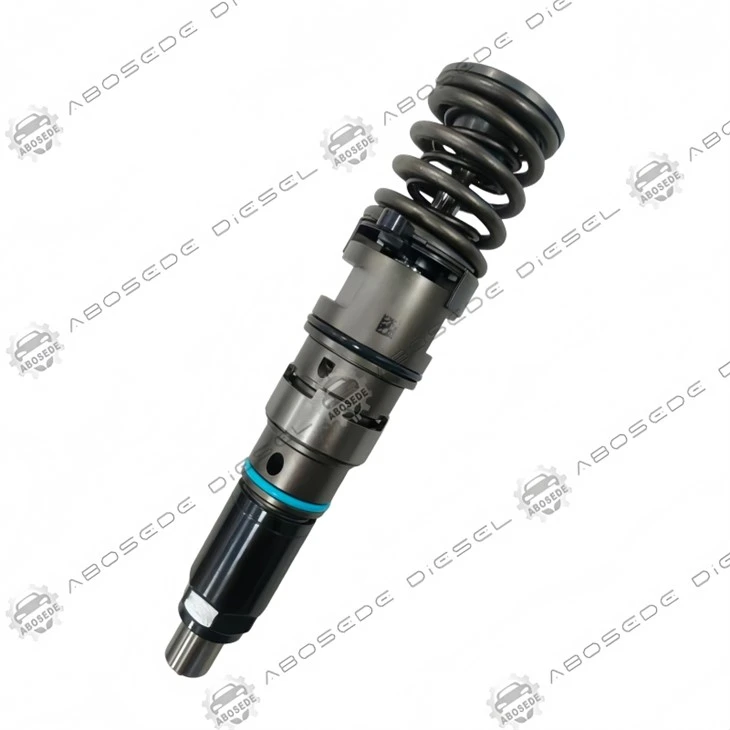


1101P4 Perkins fuel injector– Built For Harsh Fuels And Demanding Environments: Superior Corrosion Resistance And Anti‑Coking Durability
1. Product:1101P4
2. Compatible Equipment: Diesel Fuel Injection Systems
3. Manufacturer: Aftermarket OEM Replacement
4. Condition: Brand New, Fully Tested
5. Origin: ABOSEDE Diesel
6. Shipping period: 3-5 business days
7. Payment terms: T/T, Western Union, PayPal
- Fast Delievery
- Quality Assurance
- 24/7 Customer Service
Product Introduction
In many global regions-particularly emerging markets and off‑shore applications-diesel fuel quality varies widely, with sulphur content often exceeding 500 ppm and water contamination not uncommon. Such aggressive fuels accelerate internal corrosion, promote varnish deposits on the needle guide, and cause premature nozzle coking, leading to erratic injection, power loss, and expensive downtime. Most injectors are designed around pristine EN590 fuel, leaving operators in harsh‑fuel environments with shortened service intervals and unpredictable failures. The 1101P4 injector breaks this paradigm. It has been specifically engineered with a martensitic stainless‑steel needle and a nickel‑phosphorus electroless coating on all internal flow passages, delivering exceptional resistance to acidic corrosion and deposit adhesion. Combined with an optimised nozzle geometry that reduces stagnant fuel zones, the 1101P4 maintains its hydraulic performance and spray quality even after extended operation on high‑sulphur, high‑water‑content fuels. For fleets operating in challenging conditions, this translates to reliable cold starts, consistent power delivery, and up to 40% longer service life compared to standard injectors.
Application Coverage – Trusted Upgrade for Older and Mid‑Range Common‑Rail Engines
The 1101P4 is a drop‑in replacement for OEM injectors used in Euro II/III/IV on‑highway trucks, as well as Tier 2/3 off‑road equipment that often operate in remote areas with limited fuel quality control. Its standard 2‑pin connector, M12 inlet thread, and identical external envelope ensure seamless integration with:
European Legacy Trucks: Mercedes‑Benz Actros MP1/MP2, MAN F2000/TGA, Scania 4‑series, Volvo FH12/FH16 (early common‑rail), DAF 95XF
North American Vocational: International 5000i, Freightliner FLD (with Detroit Diesel Series 60 common‑rail retrofit), and older Peterbilt/Caterpillar on‑highway engines
Construction & Mining: Caterpillar 312C/315C excavators, Komatsu PC200‑8, Hitachi ZX200, and Volvo EC210 (early models)
Agricultural & Forestry: John Deere 6000/7000 series, Case IH MX/Magnum, New Holland TM/T7000, and Valtra T‑series
Marine Auxiliary and Stationary Gen‑sets: Perkins 1106, John Deere 4045, and Cummins QSB6.7 (pre‑Tier 4)
Technical Innovations – Three Pillars of Fuel‑Hardened Reliability
1. Corrosion‑Resistant Martensitic Needle with Ni‑P Coating
The needle and the control‑piston guide are the most vulnerable components to fuel‑borne acids (formed by sulphur and water). The 1101P4 employs a high‑purity martensitic stainless steel (containing 16% chromium and 1.2% molybdenum) that inherently resists pitting corrosion. To further enhance protection, all internal surfaces in contact with high‑pressure fuel receive an electroless nickel‑phosphorus coating with a phosphorus content above 10%, which provides a dense, amorphous barrier against chloride and sulphate attack. This dual‑protection strategy has been verified through a 500‑hour salt‑spray test and a 1,000‑hour fuel‑acid immersion test, showing negligible weight loss and no measurable change in the needle‑guide clearance. The coating also reduces the coefficient of friction, improving the needle's sliding behaviour even when fuel lubricity is poor.
2. Anti‑Coking Nozzle with Flow‑Optimised Chamfer
Nozzle coking-carbon buildup around the orifice inlet-is accelerated by high‑sulphur fuels and low combustion temperatures during extended idling. The 1101P4 addresses this with a specific chamfer geometry at the nozzle hole inlet that creates a mild hydrodynamic cavitation just upstream of the orifice. This controlled cavitation produces micro‑turbulence that continuously scours the hole entrance, preventing soot particles from adhering and sintering. In addition, the nozzle tip is coated with a thermal‑sprayed aluminium‑oxide layer that reduces the surface energy, making it harder for carbonaceous deposits to bond. Test bench results show that after 1,000 hours of simulated idling on 500‑ppm sulphur fuel, the 1101P4's flow reduction is only 2.5%, compared to 9% for an uncoated standard nozzle.
3. Contaminant‑Tolerant Control Valve Geometry
Fuel impurities-both hard particles and water droplets-can erode the control‑valve seat, increasing leakage and causing unstable pilot injections. The 1101P4 incorporates a recessed valve seat design with a larger seating diameter, which reduces the contact stress per unit area. This spreads the impact energy over a wider surface, lowering the risk of localised pitting from abrasive particles. Moreover, the valve's lift is slightly increased (by 0.02 mm) to allow larger particles to pass through without jamming, while the integral 10‑µm inlet filter protects the precision orifices. This robust architecture ensures that the injector maintains its opening delay and return‑flow characteristics even after encountering occasional fuel contamination events-a critical advantage for operators who cannot guarantee perfect filtration.
Installation & Calibration Notes
🔧 High‑Pressure Line Torque: Use a new copper washer and torque to 46 Nm ± 2 Nm. The 1101P4's inlet cone is hardened, but over‑torquing may deform the sealing ring; always follow the specified value.
🔧 Injector Coding (IQA): The 1101P4 is supplied with a 5‑digit alphanumeric correction code. Enter this code via your diagnostic tool. If your ECU does not support coding, the injector still operates within ±2.5% flow tolerance, but we recommend performing an adaptation reset to allow the ECU to learn the new offset.
🔧 ECU Driver Compatibility: The solenoid coil has a resistance of 0.92 Ω and inductance 0.34 mH. This matches most early and mid‑generation common‑rail ECUs (peak current 18‑20A, hold 8‑10A). For ECUs with lower peak currents, the opening delay may increase slightly; we suggest increasing the pilot offset by 0.02 ms to compensate.
Quality Assurance – Real‑World Fuel Test Protocol
Every 1101P4 unit undergoes a stringent validation program that mimics harsh‑fuel conditions:
Corrosion Exposure Test: The complete injector is pressurised with a synthetic fuel containing 1,000 ppm sulphur and 0.5% water, then stored at 60°C for 240 hours; post‑test leakage and opening delay must remain within factory tolerances.
Coking Accelerated Test: 1,000 cycles of extended idle (low load) followed by high‑load regeneration, repeated 500 times; the flow reduction at the maximum injection quantity is measured and must be ≤ 3%.
Particle Robustness Test: A controlled amount of fine sand (5‑15 µm) is introduced into the fuel stream for 100 hours; the injector must not show stiction or a significant increase in return flow.
Thermal Shock Cycling: The injector is subjected to alternating fuel temperatures of –20°C and +120°C for 300 cycles while performing continuous injections; the drift in the opening delay must be below 0.04 ms.
Frequently Asked Questions (FAQ)
Q1: Can the 1101P4 be used in an engine originally designed for Euro 5/6 fuels, if I operate in an area with high‑sulphur diesel?
Absolutely. In fact, this injector is specifically optimised for that scenario. Its corrosion‑resistant materials and coating will protect it from the acids formed by high‑sulphur combustion, but note that the engine's after‑treatment system (DPF/SCR) may still suffer from sulphur poisoning. We recommend checking with your engine manufacturer about permissible sulphur levels for the overall system, but the injector itself will survive and perform well.
Q2: How does the 1101P4 compare to a remanufactured injector in terms of resistance to water contamination?
A reman unit typically uses refurbished internal parts with worn‑away original coatings or chromed layers. The 1101P4's new Ni‑P coating and stainless needle provide far superior water tolerance. Reman injectors often fail within 50,000 km when exposed to water, while the 1101P4 has been tested to withstand 1,000 ppm water continuously for 500 hours without performance degradation.
Q3: I have an older ECU that doesn't support coding. Can I still install the 1101P4 without entering the IQA code?
Yes, the injector is mechanically and hydraulically matched within a tighter window than OEM requirements, so omitting the code will not cause severe imbalance. However, we recommend performing a forced "cylinder balance adaptation" or "zero‑fuel calibration" after installation. If your tool lacks that, simply drive under varying loads for about 100 km; the ECU's adaptive learning will partially compensate for the offset.
Q4: What is the recommended fuel filtration level to get the maximum life from the 1101P4?
We strongly advise a 5‑µm absolute (β5 ≥ 200) primary filter and a 2‑µm secondary filter, especially in dusty environments. Although the injector has a robust control valve, fine particles can still erode the needle seat over time. With proper filtration, the 1101P4 can exceed 700,000 km before needing bench‑testing.
Q5: Does the anti‑coking nozzle require any special driving habits to keep it clean, such as occasional high‑load operation?
While the nozzle is designed to resist coking even during prolonged idling, we still recommend a weekly high‑load (above 70% throttle) run of at least 15 minutes to burn off any light deposits that may have formed. This is not mandatory but will extend the cleaning interval. The 1101P4's coating reduces the need for such habits compared to conventional injectors.
Q6: How do I know if the internal Ni‑P coating is still intact after many service hours?
The coating is highly durable, but if you notice a gradual increase in return flow (e.g., from 18 to 25 ml/min) and worse cold‑start performance, it may indicate coating wear. A bench test can measure the friction force and leakage to diagnose. Typically, the coating lasts over 500,000 km even with moderate fuel acidity. If you have a fuel analysis report showing high chloride content, we recommend earlier inspections.


Flexible Payment Methods for Your Convenience
To make your purchasing experience smooth and easy, we offer a variety of secure payment options:

Bank Transfer
Supports multiple currenciesand bank payment methods.

Western Union
Quick and global money transfers.

PayPal
Safe and convenient online payment.

Alibaba
Enjoy extra protection with trusted Alibaba transactions.
We're here to make your order process worry-free - choose the payment method that works best for you!
Shipping Made Simple

Customer reviews

Hot Tags: 1101P4 Perkins fuel injector– Built For Harsh Fuels And Demanding Environments: Superior Corrosion Resistance And Anti‑Coking Durability, China 1101P4 Perkins fuel injector– Built For Harsh Fuels And Demanding Environments: Superior Corrosion Resistance And Anti‑Coking Durability manufacturers, suppliers, factory, 28307309 Fuel Injector, Common Rail Injector 33800 2A650, DOOSAN Common Rail Injector, EJBR04401D Delphi diesel injector for SsangYong, High Pressure Diesel Injector DOOSAN, KIA Diesel Fuel Injector 28387256 for Common Rail Applications
You Might Also Like
-

858134Perkins fuel injector– Engineered For Transien...
-

Komatsu 6742-11-3130 – The Injector That Maintains I...
-

Stanadyne 38517 Diesel Fuel Injector | OE 504157651 ...
-

Fuel Injector 1112010-29D — Stable Mechanical Inject...
-

Mechanical Diesel Injector LJC6760521 – Reliable Fue...
-

Genuine MTU4000.03 Fuel Injector X51107500005 – Prec...
