


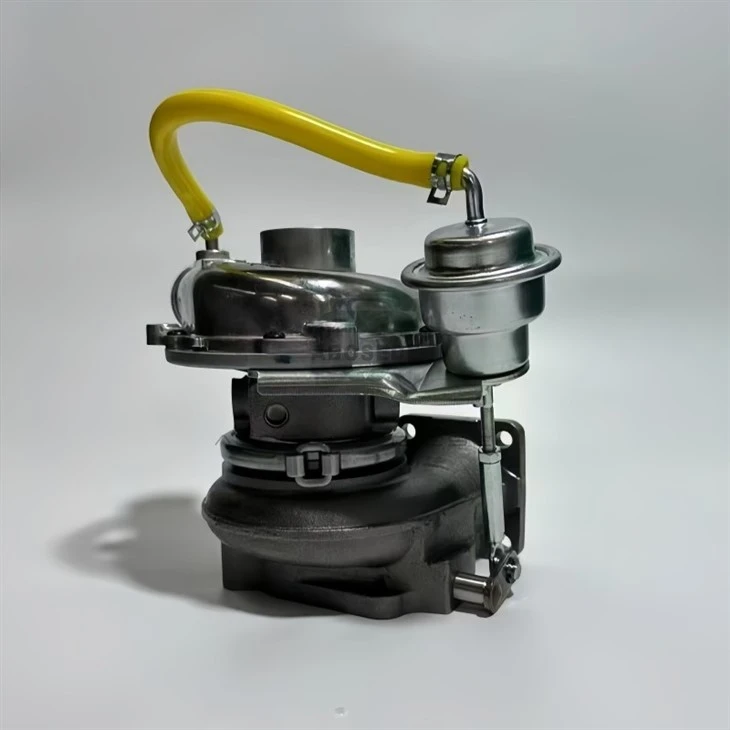
Toyota 129935-18010 – The CT16V Turbo That Matches Exhaust Energy To Boost Demand
1. Product:129935-18010
2. Compatible Equipment: Diesel Fuel Injection Systems
3. Manufacturer: Aftermarket OEM Replacement
4. Condition: Brand New, Fully Tested
5. Origin: ABOSEDE Diesel
6. Shipping period: 3-5 business days
7. Payment terms: T/T, Western Union, PayPal
- Fast Delievery
- Quality Assurance
- 24/7 Customer Service
Product Introduction
A turbocharger is fundamentally an energy conversion device – it captures exhaust gas enthalpy and converts it into compressed air. But the conversion is not instantaneous; there is a delay between the driver pressing the accelerator and the turbo delivering the required boost pressure. This delay, known as turbo lag, is determined by the inertia of the rotating assembly and the efficiency of the turbine housing in converting exhaust pulses into rotational energy. The 129935-18010, the original CT16V turbocharger used on Toyota's 1KD-FTV and 1GD-FTV diesel engines, is engineered with a rotor mass and turbine housing geometry that strike a balance between low-end response and top-end flow. It does not simply move air – it manages the energy contained in each exhaust pulse to deliver boost when the engine needs it most.
The Transient Response Challenge – Inertia vs. Power
Every turbocharger faces a fundamental trade-off: a lighter, smaller turbine wheel spins up faster but may restrict exhaust flow at high rpm, limiting peak power. A heavier, larger wheel flows more at high rpm but takes longer to accelerate, increasing lag. The 129935-18010 uses a turbine wheel with a carefully optimised inertia value – sufficient to provide the exhaust flow capacity required for the 1KD-FTV's 170 hp output, but light enough to reach 80 % of maximum boost within 1.8 seconds of a snap throttle from idle. This is achieved through a combination of a low-inertia inconel turbine wheel and a turbine housing with an A/R ratio of 0.78 – a value that balances pulse energy capture with flow capacity. The result is a turbo that feels responsive in city driving while still delivering the air volume required for sustained highway overtaking.
The Variable Geometry Angle – Adjusting the Nozzle Ring
The CT16V is a variable geometry turbocharger (VGT), meaning the turbine housing contains a ring of movable vanes that adjust the angle of the exhaust gas flow entering the turbine wheel. At low engine speeds, the vanes close to a narrow angle, accelerating the exhaust gas and increasing the energy available to the turbine – this spools the turbo faster. At high engine speeds, the vanes open to a wider angle, reducing the flow restriction and allowing the turbine to pass more exhaust gas. The 129935-18010 uses a control ring actuated by a vacuum actuator – the same type found on the original equipment. The nozzle ring is made from a high-temperature alloy that resists distortion at exhaust temperatures up to 800 °C, maintaining the vane positioning accuracy required for consistent boost control.
Failure Patterns – And How the 129935-18010 Resists Them
The most common failure in the CT16V is not a catastrophic turbine or compressor failure but a progressive loss of vane actuation performance caused by carbon build-up on the nozzle ring and the control ring. As carbon deposits accumulate, the vanes become stiff and may not close fully, resulting in a boost pressure that drops at low rpm and a noticeable lag. The 129935-18010 uses a nozzle ring with a specialised anti-carbon coating that reduces deposit adhesion, and the control ring has a revised clearance specification that allows for a small amount of carbon accumulation without binding. The bearing housing also features an improved oil drain port that reduces oil coking, a common cause of bearing failure in earlier CT16V revisions.
Installation – The Oil Prime Procedure That Protects Bearings
The most critical step in installing the 129935-18010 is the oil prime procedure. The turbocharger bearing system relies on a thin film of oil to separate the shaft from the bearing surfaces – if the turbo is started without oil, the bearing damage occurs within seconds. Before connecting the oil feed line, add approximately 50 ml of clean engine oil through the oil inlet port, rotate the compressor wheel by hand to distribute the oil, and then crank the engine with the fuel shut off (or the starter disabled) until the oil pressure warning light goes out. This ensures that the bearing housing is full of oil before the engine fires. The correct torque for the oil feed line banjo bolt is 25 Nm – over-tightening can crush the sealing washers and restrict oil flow.
Frequently Asked Questions
Q1: How can I tell if my CT16V turbo is losing vane actuation performance without removing it?
→ Monitor the "actual boost pressure" and "commanded boost pressure" live data during a full-throttle acceleration from 1,500 to 3,000 rpm. If the actual boost lags behind the commanded boost by more than 0.3 bar for more than 2 seconds, the nozzle ring may be sticking due to carbon build-up.
Q2: Can the nozzle ring and vanes be cleaned to restore performance, or is replacement necessary?
→ In some cases, the nozzle ring can be removed and cleaned ultrasonically to remove carbon deposits. However, the cleaning process is labor-intensive, and the vane clearance may be altered if the cleaning is too aggressive. The 129935-18010 is a replacement turbo – if cleaning fails, replacement is the only option.
Q3: What is the typical service life of the CT16V turbo in a Hilux used for heavy towing?
→ Under heavy towing conditions, we recommend inspection at 150,000 km and replacement at 200,000 km. The higher exhaust temperatures from sustained load accelerate carbon formation on the nozzle ring and increase bearing wear.
Q4: Why does my boost pressure fluctuate at steady highway speeds in my Land Cruiser Prado?
→ This is often caused by a vacuum actuator leak or a sticking control ring. The variable geometry system relies on a stable vacuum signal – if the actuator diaphragm is leaking, the vanes will not maintain a consistent position. The 129935-18010 includes a new actuator, so replacement often resolves this issue.
Q5: Can I use a boost controller to increase the boost pressure beyond the factory setting with this turbo?
→ The CT16V is capable of approximately 2.8 bar absolute boost, but exceeding the factory boost setting (2.5 bar) requires ECU remapping and may reduce the turbo's service life. The turbine wheel speed limit is approximately 180,000 rpm – exceeding this limit can cause turbine wheel burst, which is a catastrophic failure.
Q6: Does the 129935-18010 require specific engine oil or filter for optimal life?
→ Toyota recommends a high-quality diesel engine oil meeting API CJ-4 or ACEA E7/E9 specification, with a viscosity of 5W-30 or 5W-40. The oil filter must be changed at the same interval as the oil – the bypass valve in the filter protects the turbo during cold starts, and a clogged filter can restrict oil flow to the turbocharger.


Flexible Payment Methods for Your Convenience
To make your purchasing experience smooth and easy, we offer a variety of secure payment options:

Bank Transfer
Supports multiple currenciesand bank payment methods.

Western Union
Quick and global money transfers.

PayPal
Safe and convenient online payment.

Alibaba
Enjoy extra protection with trusted Alibaba transactions.
We're here to make your order process worry-free - choose the payment method that works best for you!
Shipping Made Simple

Customer reviews

Hot Tags: toyota 129935-18010 – the ct16v turbo that matches exhaust energy to boost demand, China toyota 129935-18010 – the ct16v turbo that matches exhaust energy to boost demand manufacturers, suppliers, factory
You Might Also Like
-

Garrett 797862-0049 Electronic VNT Actuator – The 19...
-

Garrett 797862-0031 VNT Turbo Actuator – The Electro...
-

CAT C3500 Diesel Fuel Injector 11R-1874 | Round Head...
-

Original Turbocharger 8976787981 — Precision Airflow...
-

Mercedes‑Benz K31 Turbocharger – 53311013065 / 53319...
-

320D Fuel Injectors for CAT – High-Precision Diesel ...
