


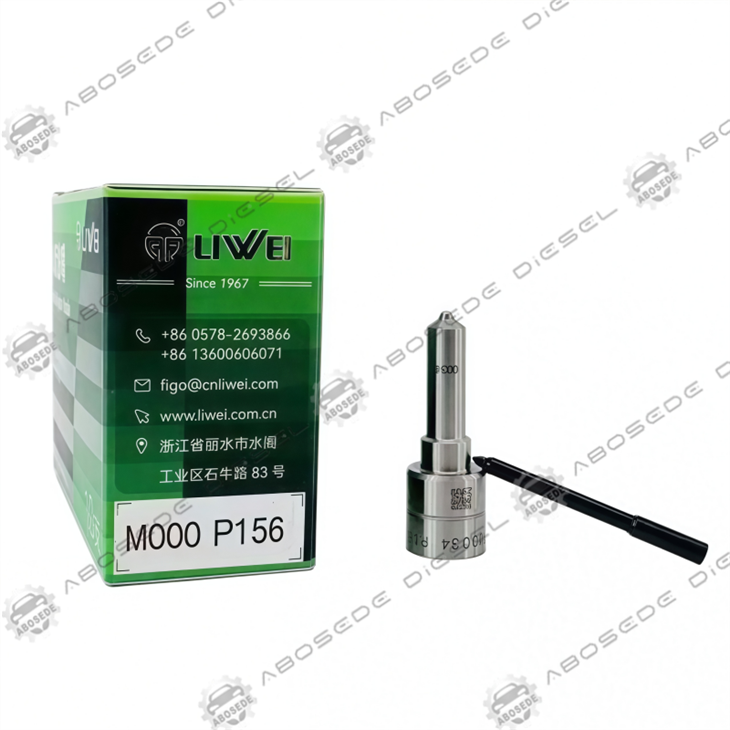

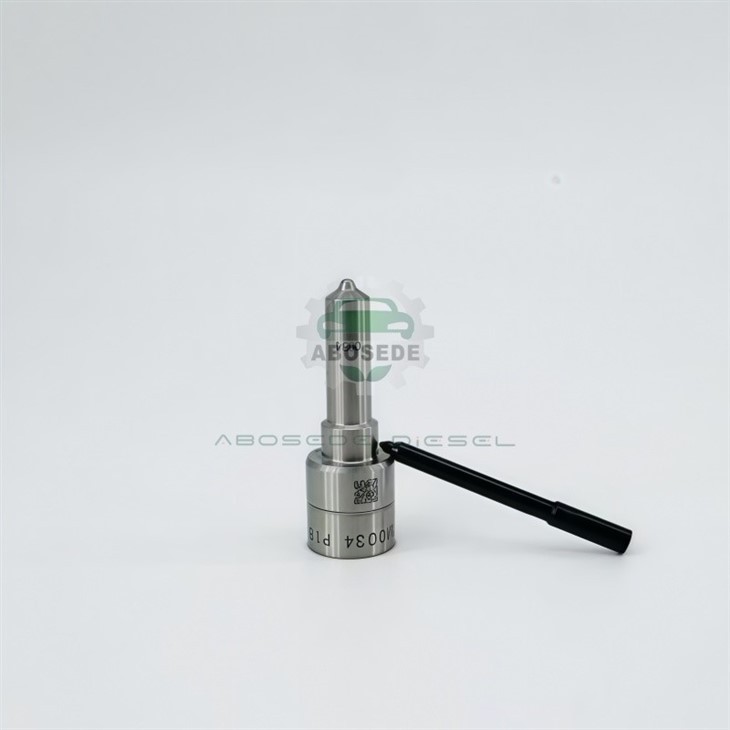
Liwei M000P156 Diesel Injector Nozzle: Needle Guide Clearance Hysteresis, Cold-Start Hydraulic Lock & Return-Flow/Friction Trade-Off
1. Product:M000P156
2. Compatible Equipment: Diesel Fuel Injection Systems
3. Manufacturer: Aftermarket OEM Replacement
4. Condition: Brand New, Fully Tested
5. Origin: ABOSEDE Diesel
6. Shipping period: 3-5 business days
7. Payment terms: T/T, Western Union, PayPal
- Fast Delievery
- Quality Assurance
- 24/7 Customer Service
Product Introduction
The Liwei M000P156 is a seven-hole, 150° diesel injector nozzle referenced for Bosch CRI and Denso common-rail injectors. It is a bare nozzle, not a complete injector. Its 7 × 0.190 mm geometry, 870 cc/min static flow and 4–6 µm needle-to-nozzle clearance are common in 2.0L–3.0L engines. The critical service variable is not static flow. It is guide clearance hysteresis. A clearance that is too tight can cause cold-start stiction, slow needle lift and hydraulic lock. A clearance that is too loose increases return flow, needle tilt and spray asymmetry. The ECM can correct fuel mass with IQA/trim and cylinder balance. It cannot correct needle hysteresis or cold-start lock. This guide focuses on clearance hysteresis, cold-start hydraulic lock, return-flow/friction trade-off and installation verification.
📌 Fitment & Nozzle Identity
The M000P156 must be matched to the correct injector body, needle, control valve, seat angle, opening pressure and needle lift. Confirm injector part number, nozzle number, needle diameter, seat angle, lapping requirement and copper washer specification before ordering. Do not install a bare nozzle without checking injector body wear and sleeve condition. Also confirm the combustion system. A 150° cone with 7 × 0.190 mm holes is common, but bowl depth and swirl ratio still affect spray landing. A mismatched bowl changes soot, idle stability and oil dilution.
📊 Clearance Hysteresis & Flow Data
| Parameter | Service target | Diagnostic meaning |
|---|---|---|
| Nozzle type | Inward-opening, differential pressure | Common-rail nozzle family |
| Number of holes | 7 | Flow area and plume count |
| Orifice diameter | ≈ 0.190 mm | Atomization and flow rate |
| Spray angle | 150° | Standard bowl matching |
| Static flow @ 100 bar | ≈ 870 cc/min | Hydraulic baseline |
| Droplet SMD | ≈ 22 µm | Evaporation and cold-start stability |
| Needle guide diameter | ≈ 4.2 mm | Concentricity and side loading |
| Needle-to-nozzle clearance | ≈ 4–6 µm | Hysteresis vs leakage trade-off |
| Opening pressure | ≈ 225 ± 10 bar | Start of injection |
| Seat angle | ≈ 60° conical | Sealing and after-dribble control |
| Seat diameter | ≈ 3.8 mm | Seat contact and flow transition |
| Needle lift | ≈ 0.23 mm | Partial-lift and pilot stability |
| DLC coating | ≈ 1.5 µm on guide | Friction and cold-start stiction |
| Max rail pressure | ≈ 1,800 bar | Pressure compatibility |
⚙️ Needle Guide Clearance Hysteresis
Clearance between needle and guide is a trade-off. A larger clearance reduces friction but increases fuel leakage past the guide. A smaller clearance reduces leakage but increases friction and side-load sensitivity. Hysteresis is the difference between the commanded needle position and the actual needle position during opening and closing. Tight clearance increases hysteresis because the needle sticks, then releases. Loose clearance increases hysteresis because the needle tilts and the flow area becomes asymmetric. In both cases, the ECM sees a fuel-mass error it cannot explain from rail pressure alone. Opening delay increases, pilot quantity becomes unstable and cylinder balance drifts.