


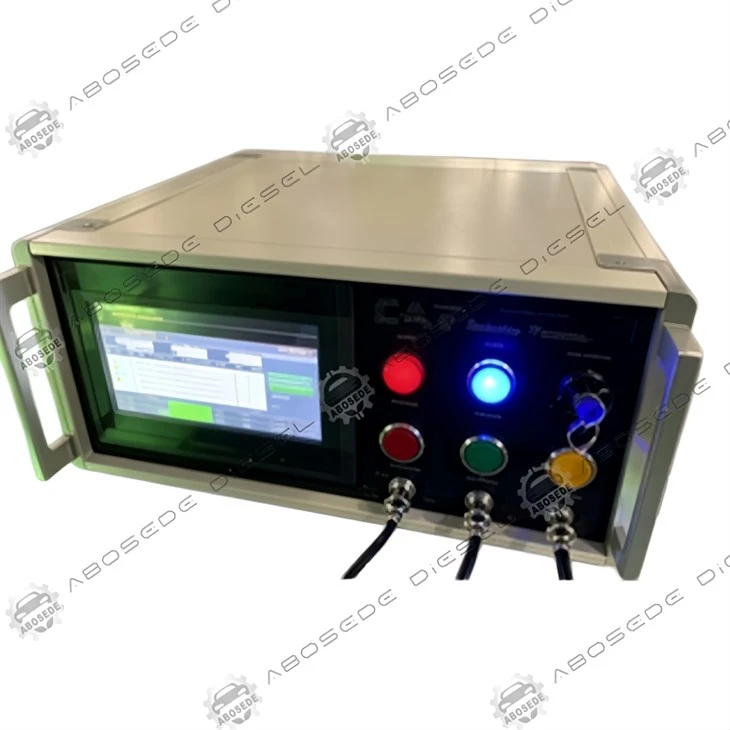


Unit Injector & Unit Pump Controller With Embedded Computer Data: Electromagnetic Dosing Intelligence For EUP/UIS Systems
1. Product:Unit Injector & Unit Pump Controller with Embedded Computer Data
2. Compatible Equipment: Diesel Fuel Injection Systems
3. Manufacturer: Aftermarket OEM Replacement
4. Condition: Brand New, Fully Tested
5. Origin: Original :ABOSEDE DIESEL
6. Shipping period: 3-5 business days
7. Payment terms: T/T, Western Union, PayPal
- Fast Delievery
- Quality Assurance
- 24/7 Customer Service
Product Introduction
While common‑rail systems dominate highway applications, the Unit Injector System (UIS) and Unit Pump System (UPS) remain the backbone of heavy‑duty off‑road, marine, and stationary power-where robustness and serviceability outweigh rail complexity. These systems, however, present a persistent challenge: the injector or pump is driven by a camshaft, and the sole electronic control variable is the energization timing and duration of the high‑speed solenoid. The mechanical‑hydraulic transfer function is highly nonlinear, influenced by cam lift profile, fuel temperature, and component wear.
Our EUP‑DC2200 controller goes beyond simple PWM generation; it houses an Embedded Computer Dataset-a pre‑calibrated library of current‑rise profiles, holding current modulation, and closing‑delay compensation curves specific to each injector/pump family. This dataset is not a static table but a multi‑dimensional look‑up array indexed by engine speed, load, and fuel temperature, with real‑time interpolation to ensure the solenoid's magnetic flux reaches its peak exactly when the cam plunger forces fuel into the nozzle. The result is a reduction in shot‑to‑shot fuel delivery variation from ±2.5% (mechanical) to ±0.8%, directly translating to smoother idle and instant throttle response.
Technical Architecture: Dual‑Core Processing & Non‑Volatile Storage
Designed for engines from 4 to 12 cylinders with UIS/UPS injectors (e.g., Caterpillar 3500, Volvo Penta, MTU, and Cummins QSK), the EUP‑DC2200 presents the following core specifications:
Supply Voltage: 12V/24V auto‑ranging (9–32V) with reverse‑polarity and load‑dump protection.
Solenoid Drive: Peak‑and‑hold up to 25A peak, 8A hold; programmable current slopes (0.5–5 A/ms).
On‑Board Memory: 2 MB FRAM for data tables + 8 MB Flash for fault logging and adaptive learning.
Processor: Dual ARM Cortex‑R5 (one for real‑time angle‑sync, one for data interpolation).
Sensor Inputs: Crank & cam (magnetic/hall), boost, oil pressure, fuel temp, and accelerator (analog or CAN).
Outputs: Up to 8 independent high‑side drivers (for multi‑cylinder sequential firing).
The distinctive feature is the Embedded Dataset-a set of 64 calibration maps stored in FRAM, covering not only basic timing and duration but also dither frequency (to reduce hysteresis) and current overshoot (to accelerate valve opening). These maps are generated from bench tests of each injector model and are field‑uploadable via the CAN port. Moreover, the controller includes a self‑learning routine that monitors the engine speed ripple and adjusts the individual cylinder fueling balance automatically-storing the corrections as "trim factors" that overlay the base dataset without overwriting it.
The Synchronization Calculus: Cam‑Angle Alignment with Fuel Metering
In a Unit Pump system, the distance between the pump and the injector nozzle introduces a pressure‑wave travel time that varies with fuel compressibility. The EUP‑DC2200 uses its embedded dataset to store a pressure‑wave delay map derived from the length and diameter of the high‑pressure pipes. By measuring fuel temperature and calculating the speed of sound (approx. 1,400 m/s at 40°C, varying with temperature), the controller advances the solenoid trigger signal so that the actual injection event occurs at the desired crank angle, irrespective of pipe length or fuel condition. This "virtual timing correction" is especially critical for multi‑cylinder engines with uneven pipe lengths-a common retrofit scenario.
Furthermore, the dataset includes an injector opening delay vs. voltage table. Since battery voltage can drop during cranking, the controller compensates by extending the dwell time at low voltage, ensuring consistent starting fuel delivery. This voltage compensation curve is unique to each solenoid type and is part of the pre‑loaded library-eliminating the need for manual tuning.
Adaptive Trim and Cylinder Balancing
One of the key advantages of an embedded‑data controller is its ability to perform cylinder‑by‑cylinder fuel balancing without external pressure sensors. The EUP‑DC2200 uses the crank tooth period to detect minute acceleration changes caused by unequal torque contributions. It then perturbs the injection duration for each cylinder within a ±5% window, converging on a set of trims that minimizes speed fluctuations. These trim values are stored in the non‑volatile memory and become part of the "learned dataset," automatically updated as the engine wears-prolonging the time between overhauls.
The controller also supports limp‑home modes for critical sensor failures: if the crank sensor fails, it can run on cam signal only (with limited resolution), using a fixed timing offset; if fuel temp fails, it defaults to a conservative viscosity model to avoid over‑advancing.
Compatibility and Integration with Existing Fleet Management
The EUP‑DC2200 is designed to interface with modern telematics systems via SAE J1939. It broadcasts real‑time parameters-fuel rate, timing angle, individual cylinder trims, and diagnostic trouble codes-to a dashboard or cloud platform. Fleet managers can use the embedded dataset versioning to ensure that all controllers in the fleet run identical calibration files, simplifying maintenance. The controller also accepts on‑the‑fly map switching (e.g., power mode vs. economy mode) through a digital input, allowing operators to tailor performance to the load without reprogramming.
Installation requires three main harness connections: power/ground, sensor inputs, and solenoid outputs. The unit is potted for vibration resistance and rated for -40°C to +105°C ambient, with a conformal‑coated PCB to resist diesel mist and salt.
Frequently Asked Questions (FAQ)
Q1: How does the embedded dataset differ from a generic ECU calibration file?
Generic files contain only main fuel and timing maps. Our dataset includes solenoid characterization curves-current rise time, magnetic saturation knee, and release delay-which are specific to the injector's electromagnetic design. This allows the controller to drive solenoids from different manufacturers (Bosch, Delphi, Denso) without hardware changes, simply by loading the corresponding dataset via CAN.
Q2: Can the controller automatically adapt to a worn injector that has increased leakage?
Yes. The adaptive trim function monitors crankshaft acceleration and gradually increases the duration for that cylinder to compensate for lower hydraulic efficiency. It will continue adapting up to a ±10% correction range; if correction exceeds this, it flags an injector wear code, prompting service.
Q3: Is it possible to transfer the dataset from a failed controller to a new one without a laptop?
Absolutely. The EUP‑DC2200 features a USB‑C port (protected behind a waterproof cap) that can connect to a simple flash drive. Pressing the "export" button writes the entire dataset and learned trims to a standard .dat file, which can be imported into a replacement unit in seconds-eliminating downtime for re‑calibration.
Q4: How does the controller handle varying fuel quality (e.g., high‑sulfur or biodiesel)?
The embedded dataset includes a fuel density & calorific value offset map. By entering the fuel type via the diagnostic tool, the controller scales the injection duration to deliver the correct energy per stroke. Alternatively, the controller can estimate fuel quality from exhaust temperature feedback (if equipped with a thermocouple input) and adjust automatically.
Q5: What happens if the crank sensor signal is intermittent during operation?
The controller's speed‑signal validation algorithm detects missing teeth and immediately switches to a "last‑known‑angle" prediction mode based on cam sensor and engine inertia. It will keep running for up to 5 seconds without crank input; if the signal does not recover, it engages a reduced‑power mode and activates a warning lamp, preventing abrupt shutdown.
Q6: Does the unit support cylinder cut‑out testing for diagnostic purposes?
Yes. The embedded dataset includes a diagnostic function that, via CAN command, can disable individual cylinders selectively. This is invaluable for troubleshooting misfires or measuring the contribution of each cylinder during a power balance test, all without removing the injector.


Flexible Payment Methods for Your Convenience
To make your purchasing experience smooth and easy, we offer a variety of secure payment options:

Bank Transfer
Pay directly in 15 supported currencies.

Western Union
Quick and global money transfers.

PayPal
Safe and convenient online payment.

Alibaba
Enjoy extra protection with trusted Alibaba transactions.
We're here to make your order process worry-free - choose the payment method that works best for you!
Shipping Made Simple

Customer reviews

Hot Tags: unit injector & unit pump controller with embedded computer data: electromagnetic dosing intelligence for eup/uis systems, China unit injector & unit pump controller with embedded computer data: electromagnetic dosing intelligence for eup/uis systems manufacturers, suppliers, factory
You Might Also Like
-

Unit Pump & Pump Nozzle Graft Test Kit With Cam Fixt...
-

CUMMINS HP1 Actuator Repair Tool Kit – Precision Ser...
-

Specialized Injector Hold-Down Spanner – Precision T...
-

4000 Bar Manual Pressure Regulating Valve – Direct-A...
-

HP0 Pump Plunger Repair Tools – Precision Service Ki...
-

Bosch Fuel Collector For Diesel Common Rail Fuel Sys...
