


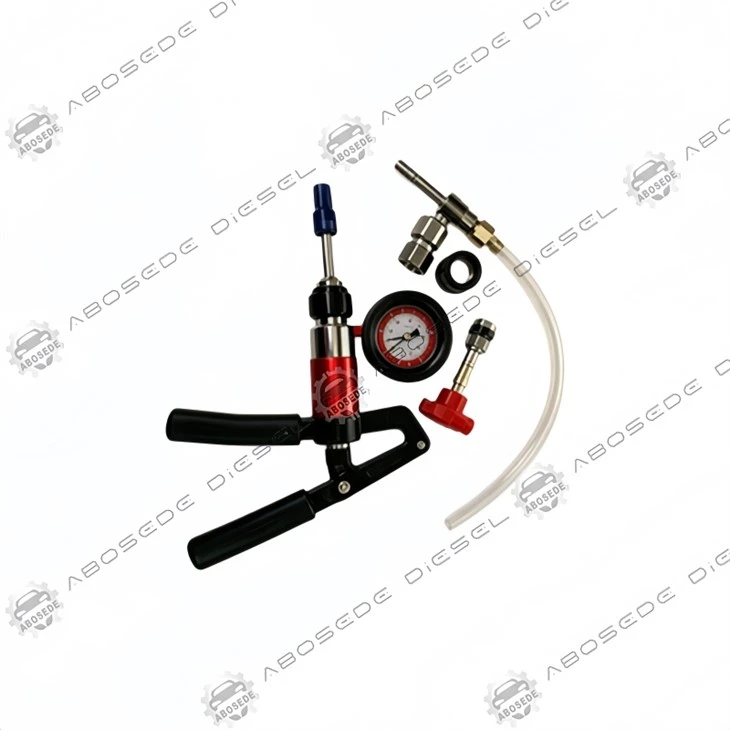


Scania / Bosch Unit Pump Control Valve Seal Tester — Dynamic Leak‑Rate Quantification For High‑Pressure Fuel Gates
1. Product:Scania / Bosch Unit Pump Control Valve Seal Tester
2. Compatible Equipment: Diesel Fuel Injection Systems
3. Manufacturer: Aftermarket OEM Replacement
4. Condition: Brand New, Fully Tested
5. Origin: Original :ABOSEDE DIESEL
6. Shipping period: 3-5 business days
7. Payment terms: T/T, Western Union, PayPal
- Fast Delievery
- Quality Assurance
- 24/7 Customer Service
Product Introduction
In Scania's DC13/DC16 engines and Bosch's heavy‑duty unit pump systems (P‑pumps, PE‑pumps), the control valve-often a solenoid‑actuated poppet or a spring‑loaded spill valve-meters the fuel volume delivered to the pumping element. This valve's sealing face, a precision‑ground metal cone or flat seat, must maintain a leak rate below 0.5 ml/min at 1,200 bar to ensure consistent fuel delivery across all cylinders. A leak rate exceeding this threshold causes the pump to lose prime, reduces the effective stroke, and introduces cylinder‑to‑cylinder delivery variations that show up as rough running, increased smoke, and reduced power. Traditional "bubble test" (submerging the valve in test oil and observing gas bubbles) is subjective and cannot quantify the leak rate; a simple pressure‑hold test indicates only gross leakage. This Scania / Bosch Unit Pump Control Valve Seal Tester applies a precise, controlled pressure and measures the pressure decay rate over a fixed time, converting the decay into a volumetric leak rate (ml/min). The tester provides a quantitative pass/fail result, enabling technicians to reliably determine whether the control valve can be reused, re‑lapped, or must be replaced.
🧪 Measurement Principle - Pressure Decay Quantification
The tester comprises a hand‑operated hydraulic pump (0‑2,000 bar), a precision pressure transducer (accuracy ±0.25% FS), and a microprocessor‑based controller with a 3.5‑inch LCD display. The test sequence is fully automated:
Connection - The control valve is installed in a dedicated test fixture (supplied with the kit) that seals against the valve's inlet and outlet ports. The fixture includes a quick‑connect high‑pressure hose (rated 2,500 bar) that connects to the pump.
Pressurisation - The technician operates the pump to raise the pressure to the test value (typically 1,200 bar for Scania, 1,000 bar for Bosch, as per the manufacturer's specification). The controller monitors the pressure rise and stops the pump automatically when the target is reached.
Stabilisation - The system holds the pressure for 5 seconds to allow the valve's internal seals to settle; any initial pressure drop is discarded.
Measurement - The controller measures the pressure decay over a 30‑second period. The decay rate (bar/min) is converted to a volumetric leak rate using the system's known dead volume (the trapped fuel volume between the valve, the fixture, and the transducer). The controller's algorithm accounts for the temperature and the fuel's compressibility (based on the selected fuel type: diesel, test oil, or biodiesel).
Result - The display shows the leak rate in ml/min, and a PASS/FAIL indicator (green LED for PASS, red for FAIL) is illuminated. The controller also stores the test result (with date and time) in its internal memory (up to 1,000 tests).
📊 Test Data - Specifications and Tolerances
| Parameter | Scania Unit Pump (DC13) | Bosch P‑pump | Bosch PE‑pump |
|---|---|---|---|
| Test pressure | 1,200 bar | 1,000 bar | 800 bar |
| Stabilisation time | 5 s | 5 s | 5 s |
| Measurement time | 30 s | 30 s | 30 s |
| Pass leak rate (new) | ≤ 0.5 ml/min | ≤ 0.4 ml/min | ≤ 0.3 ml/min |
| Pass leak rate (service limit) | ≤ 1.0 ml/min | ≤ 0.8 ml/min | ≤ 0.6 ml/min |
| Fail leak rate | > 1.0 ml/min | > 0.8 ml/min | > 0.6 ml/min |
| Dead volume (system) | 2.8 cm³ | 2.5 cm³ | 2.2 cm³ |
| Temperature compensation | Reference 40°C | Reference 40°C | Reference 40°C |
The tester includes a temperature sensor (Pt100) that measures the fuel temperature at the fixture. The controller automatically compensates the leak rate calculation for temperatures between 20°C and 60°C, ensuring consistent results regardless of the workshop's ambient conditions.
🔄 Operational Workflow - Integrated into the Rebuild Process
Valve removal - The control valve is removed from the pump (or from the unit injector, depending on the system) and cleaned of any external debris.
Insert selection - The correct fixture insert is chosen based on the valve type. The insert is installed into the tester's fixture.
Valve installation - The valve is placed into the insert, aligned with its sealing faces. The fixture's clamp is closed, applying a controlled, repeatable sealing force (set by a torque‑limiting knob).
Priming and venting - The pump is operated to fill the system with test oil (supplied, ISO 4113 or equivalent). A bleed valve is opened to purge any air from the system.
Test execution - The technician presses the "START" button on the controller. The system pressurises automatically, stabilises, measures, and displays the result. The entire cycle takes under 90 seconds.
Decision - If the result is PASS, the valve is cleaned and either stored for future use or installed into a rebuilt pump. If FAIL, the valve is marked for re‑lapping (using the optional seat lapping tool) or replacement.
Record - The technician can print a test label (via the optional thermal printer) or export the result via USB to a workshop management system.
🧪 Diagnostic Value - Beyond Pass/Fail
The tester's pressure decay curve-the rate of decay over the 30‑second measurement period-provides diagnostic insights beyond the final PASS/FAIL result:
Steady decay (linear, consistent slope) - Indicates a uniform leak, typically from the valve's main sealing face. The valve can often be re‑lapped and retested.
Rapid initial decay followed by a stable plateau - Suggests a large particle trapped on the sealing face (which may be dislodged by lapping) or a deformed seal (which requires replacement).
Stair‑step decay (sudden drops in pressure at irregular intervals) - Indicates a sticking poppet or a damaged spring-the valve must be replaced.
Decay rate trending - By testing the same valve after lapping or seal replacement, the technician can verify that the repair has reduced the leak rate to the acceptable level.
The controller's display shows a graphical trace of the pressure decay, making these patterns immediately visible.
❓ FAQ
Q1: Can this tester be used on control valves from engines other than Scania and Bosch (e.g., Delphi, Denso)?
The tester's hydraulic and electronic modules are universal-only the fixture inserts are valve‑specific. We offer inserts for Delphi, Denso, and other brands as separate accessory packs. The controller's valve‑type selector allows the user to choose the correct test pressure and leak‑rate threshold for each valve type.
Q2: What is the difference between testing a control valve with this pressure‑decay method and the traditional bubble test?
The bubble test is qualitative (bubbles present or not) and operator‑dependent. It cannot quantify the leak rate, and it cannot distinguish between a small acceptable leak and a large rejection‑worthy leak. The pressure‑decay tester provides a quantitative, repeatable result that correlates directly with the valve's performance in the engine.
Q3: Can the tester be used to test valves that have been previously lapped (i.e., had material removed from the sealing face)?
Yes. Lapping changes the valve's geometry slightly, but the tester measures the leak rate-the only parameter that matters for performance. However, if a valve has been lapped more than twice (resulting in a significant reduction in poppet length), the tester may not be able to accurately assess the seal because the valve's stroke will have changed. We recommend testing the valve after each lapping operation and comparing the results.
Q4: What test oil should be used, and is it supplied?
We recommend using ISO 4113 test oil (available as an optional accessory). The tester is calibrated with this oil's compressibility and viscosity characteristics. If you use a different oil (e.g., diesel), the tester's controller has a selectable fuel type-choose the appropriate setting to ensure accurate results.
Q5: How long does a test cycle take, and how many valves can be tested in an hour?
A single test cycle (pressurisation + stabilisation + measurement) takes approximately 90 seconds. With valve installation and removal, a technician can test 30–35 valves per hour. For high‑volume workshops, we offer an optional multiple‑fixture expander that allows simultaneous testing of up to six valves.
Q6: Is the tester suitable for valves with a damaged or scored sealing face?
The tester will still measure the leak rate accurately. If the leak rate exceeds the PASS limit, the technician can decide whether to lap the valve (using the optional seat lapping tool) or replace it. If the sealing face is deeply scored, lapping may not recover the seal-the tester will show that the leak rate remains high after lapping, confirming that replacement is necessary.


Flexible Payment Methods for Your Convenience
To make your purchasing experience smooth and easy, we offer a variety of secure payment options:

Bank Transfer
Pay directly in 15 supported currencies.

Western Union
Quick and global money transfers.

PayPal
Safe and convenient online payment.

Alibaba
Enjoy extra protection with trusted Alibaba transactions.
We're here to make your order process worry-free - choose the payment method that works best for you!
Shipping Made Simple

Customer reviews

Hot Tags: scania / bosch unit pump control valve seal tester — dynamic leak‑rate quantification for high‑pressure fuel gates, China scania / bosch unit pump control valve seal tester — dynamic leak‑rate quantification for high‑pressure fuel gates manufacturers, suppliers, factory
You Might Also Like
-

Premium Pneumatic Injector Puller — 24‑Piece Master ...
-

Volvo E3/E1 Complete Shim Assortment — Stack‑Up Engi...
-

CAT HEUI 3126, C7/C9 Tools – Master Diagnostic & Ser...
-

Common Rail Pressure Limiting Valve Seat Lapping Too...
-

DENSO G3 Common Rail Injector – Precision Fuel Deliv...
-

Common Rail Injector Valve Testing Tools – Precision...
