


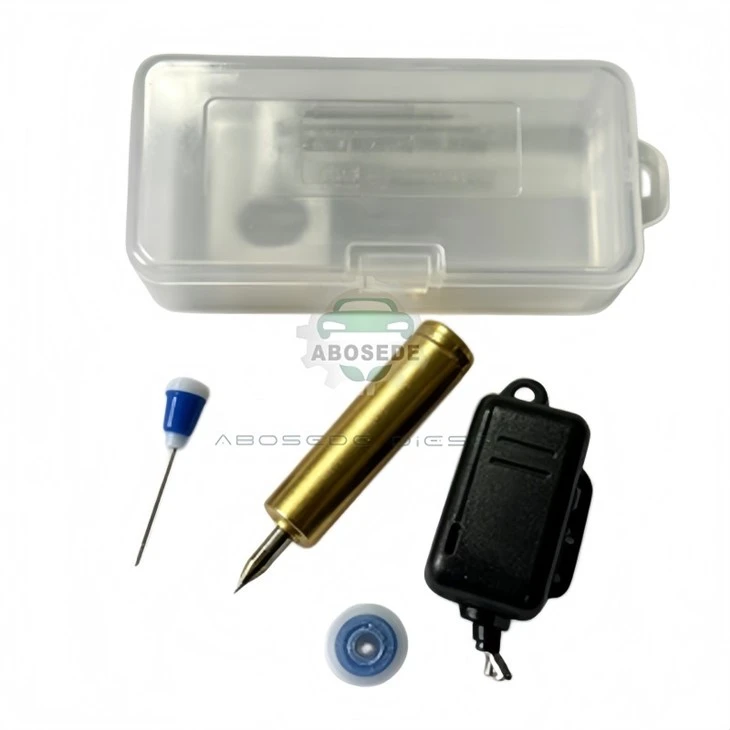
Injector Nozzle Orifice Cleaning Tool – Micro‑Needle System For Controlled Deposit Removal
1. Product:Injector Nozzle Orifice Cleaning Tool
2. Compatible Equipment: Diesel Fuel Injection Systems
3. Manufacturer: Aftermarket OEM Replacement
4. Condition: Brand New, Fully Tested
5. Origin: Original :ABOSEDE DIESEL
6. Shipping period: 3-5 business days
7. Payment terms: T/T, Western Union, PayPal
- Fast Delievery
- Quality Assurance
- 24/7 Customer Service
Product Introduction
The orifices in a common rail injector nozzle are minute-typically 0.08–0.20 mm in diameter-and their cross‑sectional area directly determines the fuel flow rate and spray penetration. Over time, carbonaceous deposits from combustion blow‑by and fuel degradation accumulate at the orifice inlet, progressively reducing the effective flow area. A 20% reduction in orifice diameter reduces the flow rate by approximately 36% (since flow is proportional to the fourth power of the radius), leading to a measurable power loss and increased smoke. However, aggressive cleaning methods-such as wire brushing or ultrasonic cleaning with strong solvents-can erode the orifice edges, altering the spray angle and droplet size. This Injector Nozzle Orifice Cleaning Tool provides a controlled method for removing deposits without damaging the delicate orifice geometry. The tool comprises a set of precision‑ground micro‑needles, each matched to a specific orifice diameter, and a guide fixture that ensures the needle enters the orifice axially, preventing side‑wall contact that could enlarge the hole.
Matched Needle Set – Sizing for Common Orifice Diameters
The cleaning tool is supplied with a set of 12 micro‑needles, manufactured from 440C stainless steel and ground to a cylindrical profile with a hemispherical tip. The needle diameters range from 0.08 mm to 0.20 mm in 0.01 mm increments-covering the full spectrum of common rail injector orifice sizes. Each needle is laser‑etched with its diameter and is colour‑coded (red for 0.08–0.12 mm, blue for 0.13–0.16 mm, green for 0.17–0.20 mm) for rapid identification. A reference card lists the nominal orifice diameters for over 100 injector models (Bosch, Delphi, Denso, Siemens), allowing the technician to select the correct needle without measuring the orifice. The needle's hemispherical tip is designed to push deposits out of the orifice, not to cut or scrape the wall-reducing the risk of enlarging the hole. The needles are supplied in a protective block with a numbered position for each size.
Guide Fixture – Ensuring Axial Alignment
The guide fixture is a cylindrical block machined from 6061‑T6 aluminium, hard‑anodised, with a central bore that accepts the needle. The block is placed over the nozzle's tip, centring the bore over the orifice to be cleaned. A spring‑loaded plunger inside the fixture applies a gentle, consistent pressure (approximately 0.5 N) to the needle as it is advanced, ensuring that the needle enters the orifice axially. This prevents the common problem of the needle entering at an angle, which can enlarge the orifice or scratch the internal surface. The fixture also has a depth stop, limiting the insertion to the length of the orifice (typically 0.5–1.0 mm), preventing the needle from reaching the nozzle's internal cavity, where it could damage the needle valve. The guide fixture is sized to fit the most common nozzle tip diameters (18 mm, 20 mm, 22 mm), with interchangeable collets included.
Application Coverage – Injectors from Leading Manufacturers
This cleaning tool is compatible with the following injector families, which use a single‑orifice or multi‑orifice nozzle design:
Bosch CRIN 2/3/4 – all common rail injectors, with orifice diameters ranging from 0.10 mm to 0.18 mm (depending on the power rating)
Delphi DFI 1.1/1.2/1.3 – orifice sizes typically 0.12–0.16 mm
Denso G3/G4/G5 – orifice sizes 0.10–0.15 mm
Siemens/Continental piezo injectors – orifice sizes 0.08–0.14 mm
Caterpillar HEUI and MEUI – orifice sizes 0.14–0.20 mm
The tool is also suitable for mechanical injectors (e.g., Bosch P‑line, Delphi) that use similar orifice geometries. A separate needle set for large‑bore nozzles (0.22–0.30 mm) is available.
Material and Mechanical Design – Minimising Contamination
The needles are manufactured from 440C stainless steel, hardened to 58 HRC, and ground to a surface finish of Ra 0.1 µm to prevent the needle from scratching the orifice wall. The hemispherical tip is polished to a mirror finish, reducing the risk of embedding particles into the orifice surface. The guide fixture is made from 6061‑T6 aluminium, hard‑anodised, with a non‑stick surface that repels fuel and deposit residues. The needles are stored in a protective block made from a polymer that does not absorb solvents, preventing contamination of the needles when stored in a workshop environment.
Frequently Asked Questions
Q1: Can I reuse the needles after cleaning multiple injectors?
Yes, but the needles are wear items. Each needle is rated for approximately 500 insertions before the tip geometry is compromised. Clean the needles with a solvent‑soaked cloth after each use to remove deposits.
Q2: What if I don't know the nominal orifice diameter for my injector?
The reference card lists over 100 injector models with their orifice sizes. If your injector is not listed, you can measure the orifice diameter using a pin gauge or, failing that, use the smallest needle (0.08 mm) and work up until you find one that passes freely without resistance-this is a safe method to determine the size.
Q3: Can this tool remove hard carbon deposits that ultrasonic cleaning doesn't affect?
Yes-ultrasonic cleaning can remove soft deposits, but hard, baked‑on carbon often requires mechanical removal. The needle's hemispherical tip is designed to push these deposits out, not cut them, reducing the risk of damaging the orifice.
Q4: Is there any risk of breaking the needle inside the orifice?
The needles are manufactured from hardened stainless steel and are designed to withstand a bending force of up to 2 N. The guide fixture ensures axial alignment, so the risk of bending is minimal. However, do not force the needle-if resistance is felt, withdraw and check for debris.
Q5: Does this tool work on nozzles with a painted or coated surface?
The tool is designed to clean the orifice only-it does not contact the external surface of the nozzle. The guide fixture is placed over the tip, but the cleaning operation is confined to the orifice bore. It will not damage the coating.
Q6: How does this tool compare to laser cleaning or abrasive methods?
Laser cleaning can be effective but requires specialised equipment and can generate heat that may affect the nozzle's material properties. Abrasive methods (e.g., walnut shell blasting) can erode the orifice edges. This needle‑based method provides a low‑cost, controlled alternative that, when used correctly, preserves the orifice geometry.


Flexible Payment Methods for Your Convenience
To make your purchasing experience smooth and easy, we offer a variety of secure payment options:

Bank Transfer
Pay directly in 15 supported currencies.

Western Union
Quick and global money transfers.

PayPal
Safe and convenient online payment.

Alibaba
Enjoy extra protection with trusted Alibaba transactions.
We're here to make your order process worry-free - choose the payment method that works best for you!
Shipping Made Simple

Customer reviews

Hot Tags: injector nozzle orifice cleaning tool – micro‑needle system for controlled deposit removal, China injector nozzle orifice cleaning tool – micro‑needle system for controlled deposit removal manufacturers, suppliers, factory
You Might Also Like
-

TQ-Series Preset Torque Wrench – Precision Fastening...
-

Bosch 818 Pump Valve Puller – Precision Extraction T...
-

Bosch Pump Valve Puller – Professional Removal Tool ...
-

Bosch P‑Pump Delivery Valve Spline Sleeve – Precisio...
-

CT-INJ-CMS01 – The Injector Service Tool That Mainta...
-

Fuel Injector Flow Tools – Accurate Flow Testing For...
