


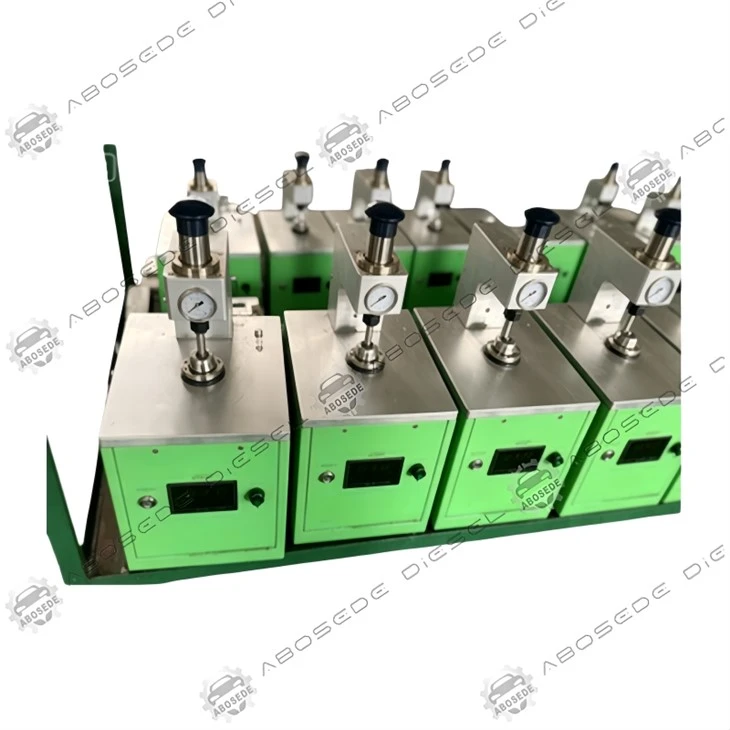


Common-Rail Valve Assembly Lapping Machine: Sub-Micron Seat Conformity For Piezo Injectors
1. Product:Common-Rail Valve Assembly Lapping Machine
2. Compatible Equipment: Diesel Fuel Injection Systems
3. Manufacturer: Aftermarket OEM Replacement
4. Condition: Brand New, Fully Tested
5. Origin: Original :ABOSEDE DIESEL
6. Shipping period: 3-5 business days
7. Payment terms: T/T, Western Union, PayPal
- Fast Delievery
- Quality Assurance
- 24/7 Customer Service
Product Introduction
In a common-rail injector, the valve assembly (comprising the control valve piston and its mating seat) governs the fuel quantity deviation-often referred to as the Q-dev parameter. A wear-induced gap of just 0.5 microns on this seat can increase leakage flow by 12%, directly causing rail pressure droop during pilot injections. Traditional manual lapping introduces erratic cross-hatch patterns; this VLM-2000 lapping machine replaces human touch with controlled harmonic oscillation.
The machine operates on a dual-phase cycle: a high-frequency (120 Hz) micro-stroke for surface roughness reduction, followed by a low-frequency (10 Hz) waviness correction stroke. By maintaining a constant lapping pressure of 1.2 N/mm², it ensures the valve seat achieves a Ra < 0.04 µm and a roundness deviation below 0.8 µm. This precision translates to a leakage reduction from 2.5 ml/min (worn) to under 0.3 ml/min-directly recovering the fuel economy loss seen in high-mileage injectors.
Technical Architecture & Kinematic Data
Engineered for Bosch, Denso, and Delphi common-rail valve assemblies (including the 2.0L, 4.5L, and 6.7L platforms), the VLM-2000 provides the following critical specifications:
Stroke Amplitude: 0.5 – 2.5 mm (adjustable via stepper motor, resolution 0.01 mm).
Oscillation Frequency Range: 20 – 150 Hz (optimized for valve materials like X46Cr13 hardened steel).
Normal Load Force: 0.5 – 5.0 N (servo-controlled with ±0.05 N accuracy).
Lapping Medium: Diamond paste (3 µm and 1 µm grain sizes) suspended in a non-polar carrier fluid.
Cycle Time: Standard seat restoration completed in 180 seconds (three 60-second phases).
The machine employs a piezoelectric force transducer to monitor the real-time contact stiffness. As lapping progresses, the force-displacement curve flattens, indicating the seat has achieved full 360° contact. This closed-loop feedback is displayed on a 7" HMI as a convergence factor (Γ)-a novel metric that drops from 0.8 (initial) to below 0.1 (finished), providing a graphical go/no-go criterion without relying on visual inspection alone.
Dynamic Balancing: The Anti-Chatter Algorithm
A common failure in valve grinding is the generation of polygonal wear-a lobed pattern caused by synchronous motion. The VLM-2000 breaks this synchrony by introducing a 15° phase shift between the rotational and oscillatory axes. This produces a Lissajous-like trajectory on the seat surface, ensuring that no single grain path is repeated. The resulting abrasive action creates an isotropic surface texture, which improves the oil film retention during the injector's opening delay, reducing the pilot injection variation from ±0.5 mm³/stroke to ±0.1 mm³/stroke.
Additionally, the machine integrates an adaptive damping system. As the valve seat material removes (typically 5–8 µm of stock), the resonant frequency changes. The VLM-2000's DSP (Digital Signal Processor) recalculates the optimal frequency every 5 seconds, maintaining a constant G-force of 2.5G at the lapping tip-preventing micro-cracking that often leads to field failures after 1,000 hours of operation.
Repeatability and Gauge R&R Performance
For a diesel common-rail workshop, the ability to produce identical results across multiple operators is paramount. The VLM-2000 boasts a GR&R (Gauge Repeatability & Reproducibility) of less than 10% for seat diameter and concentricity measurements. This is achieved through a quick-change collet system with a runout of < 2 µm at the spindle nose. The machine automatically stores lapping profiles for up to 50 different valve part numbers, ensuring that the stroke, force, and duration are recipe-controlled, removing human error from the equation.
Furthermore, the lapping spindle's thermal growth is compensated via an integrated thermistor; as the spindle warms up after 10 cycles, the controller adjusts the stroke length to maintain the same material removal rate (MRR)-a feature critical for high-throughput re-manufacturing environments where ambient temperatures fluctuate.
Operational Protocol & Diamond Paste Selection
The recommended lapping process follows a two-grit sequence:
Rough Lapping (60 sec): 3 µm diamond paste, frequency 80 Hz, force 3.0 N – removes the fatigue layer and restores the seat profile.
Finish Lapping (120 sec): 1 µm diamond paste, frequency 120 Hz, force 1.5 N – achieves the mirror finish required for zero static leakage.
The machine includes an automated cleaning cycle: after each lapping phase, a pressurized air blast removes residual paste from the valve seat, preventing cross-contamination. For operators, the HMI displays a profile cloud-a color map (red-to-green) indicating the remaining high spots, allowing a visual confirmation that the green zone (contact area > 95%) is achieved before ejection.
Frequently Asked Questions (FAQ)
Q1: How does this lapping machine specifically address the common-rail "ball and seat" wear pattern?
The common-rail control valve often exhibits "Brinelling" indentation from high-frequency impact. The VLM-2000's asymmetric oscillation generates a tangential shear force that smears the surface, effectively raising the material's yield strength locally (work-hardening). This restores the seat's hardness gradient, making it more resistant to the micro-welding that occurs during injection dwell times.
Q2: Can the machine detect if the valve is beyond reclaimable limits before lapping?
Yes. The initial contact stiffness test (performed at 10 N force) measures the deformation depth. If the deformation exceeds 50 µm, the seat is considered undersized and lapping is halted to prevent valve breakage. The machine issues a "Reject" code, saving consumables and time.
Q3: What is the allowable stock removal limit for maintaining the injector's hydraulic flow rating?
We recommend a maximum material removal of 12 µm total. Beyond this, the valve's hydraulic tappet clearance exceeds the injector's calibration tolerance, altering the opening delay. The VLM-2000's feedback system stops lapping once 10 µm of stock is removed, preserving the fuel quantity (IQ) balance within ±1.5% of OEM spec.
Q4: How do different diamond paste carriers affect the surface finish?
Oil-based carriers provide better lubrication and reduce heat, but require thorough cleaning. Our non-polar carrier fluid is designed for easy evaporation, leaving no residue that could interfere with the injector's internal clearances. For high-volume shops, we recommend paste with a 15% solid concentration for optimal material removal vs. particle breakdown.
Q5: Is the lapping pressure sensitive to the valve size (e.g., 5mm vs. 7mm piston)?
Absolutely. The servo system uses a pressure-per-area algorithm; for smaller pistons, the force reduces proportionally to prevent edge collapse. The machine automatically reads the valve diameter from the barcode scan and adjusts the force setpoint in 0.1 N increments, ensuring consistent seat stress regardless of valve geometry.
Q6: What periodic calibration is required to maintain the GR&R below 10%?
We recommend a monthly calibration using the included master gauge block set. The spindle runout should be verified with a dial indicator; if it exceeds 3 µm, the collet needs cleaning. The software also prompts a force sensor zero-check every 50 cycles, ensuring long-term repeatability for your workshop's ISO 9001 compliance.


Flexible Payment Methods for Your Convenience
To make your purchasing experience smooth and easy, we offer a variety of secure payment options:

Bank Transfer
Pay directly in 15 supported currencies.

Western Union
Quick and global money transfers.

PayPal
Safe and convenient online payment.

Alibaba
Enjoy extra protection with trusted Alibaba transactions.
We're here to make your order process worry-free - choose the payment method that works best for you!
Shipping Made Simple

Customer reviews

Hot Tags: common-rail valve assembly lapping machine: sub-micron seat conformity for piezo injectors, China common-rail valve assembly lapping machine: sub-micron seat conformity for piezo injectors manufacturers, suppliers, factory
You Might Also Like
-

Denso G2 (1211) Injector Service Tool Suite – Extrac...
-

Caterpillar HEUI Actuator Pump Disassembly Fixture K...
-

CAT Pump Lift Valve Disassembly & Debugging Tool
-

Work Bench-A TYPE – Professional Common Rail Injecto...
-

CAT 320D Tools – Professional Diesel Common Rail Ser...
-

BFA-1211 Back Flow Adaptor – Precision Return Flow D...
