


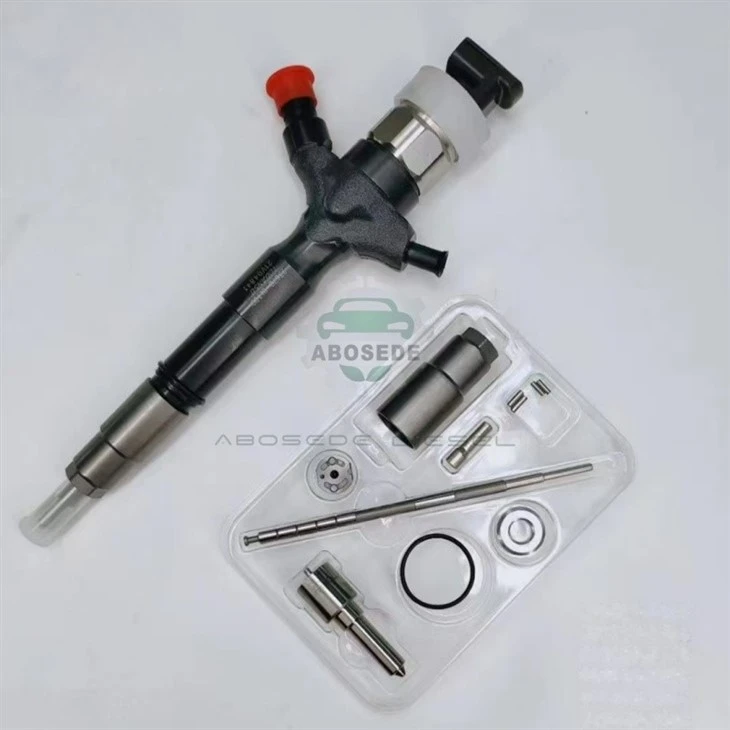
DENSO 095000-8470 / 23670-E0410 Common Rail Injector Overhaul Kit
1. Product:095000-8470 / 23670
2. Compatible Equipment: Diesel Fuel Injection Systems
3. Manufacturer: Aftermarket OEM Replacement
4. Condition: Brand New, Fully Tested
5. Origin: ABOSEDE Diesel
6. Shipping period: 3-5 business days
7. Payment terms: T/T, Western Union, PayPal
- Fast Delievery
- Quality Assurance
- 24/7 Customer Service
Product Introduction
That Hilux on the hoist has been there since yesterday morning. Driver is pacing, dispatcher is calling, and the diagnostic screen is showing cylinder contribution codes again. You know the drill-one weak injector pulling rail pressure down, raising soot output, and killing fuel economy. The customer approves the repair, but the real question is bay occupancy. Waiting two days for a complete new injector versus two hours for a rebuild with the DENSO 095000-8470 kit is not about convenience; it is about whether that bay turns a profit this week or sits idle. Cross-referenced with OE 23670-E0410, this service set puts the essential wear components back into the injector body without forcing you to stock a dozen pre-built exchange units. It gives you control over scheduling, quality verification, and cost per job-cutting the external supplier dependency that strangles your workshop rhythm.
⚙️What the Kit Delivers and Where Its Limits Are
Inside the box you get the high-failure elements that typically determine whether an injector returns to service. The control valve assembly-ball and seat-is the primary piece, because that interface suffers the most from pressure oscillation and microscopic particle erosion. The O-ring set and backup rings use FKM compounds rated for thermal cycling up to 200°C, but they will not rescue a nozzle with visible erosion or a plunger/barrel pair showing scoring. The spacer shims let you restore needle lift geometry, affecting pilot and main injection timing. What this kit does not do is turn a mechanically destroyed injector into a new one. It is intended for units where the hydraulic body and servo system remain within factory tolerance. For the service manager, this means fewer comebacks caused by mismatched aftermarket components, because the dimensional tolerances match DENSO's original production prints. You still need a test bench to confirm opening pressure and spray pattern post-assembly, but the kit removes the guesswork from parts matching-provided your technician understands that bench validation is non-negotiable, not optional.
🚛Application Scope That Matches Workshop Traffic
If your daily bay workload includes Toyota D-4D models-Hilux, Land Cruiser Prado, 1KD-FTV, 2KD-FTV, and the Lexus IS220d-then the 23670-E0410 reference should be in your parts lookup history weekly. Beyond Toyota, this injector platform appears in certain Mitsubishi commercial vehicles and Isuzu N-series trucks sharing the same DENSO HP0/HP3 architecture. For the parts counter, stocking a few 095000-8470 kits covers a high percentage of the diesel jobs that walk in with rough idle, white smoke on cold starts, or persistent fuel trim DTCs that do not clear after filter changes. Fewer unique SKUs tied up on the shelf means less cash locked in slow-moving inventory, fewer lookup errors, and faster response when a fleet operator needs a same-day turnaround. Knowing the exact boundaries of this kit also protects you from ordering it for engines where it does not belong-saving return shipping hassles and customer disappointment.
🔩Installation Pitfalls That Drive Rework Rates
No kit performs if assembly ignores the physical realities of common-rail systems. The first rule is contamination control-absolute, obsessive cleanliness. The new control valve assembly has lapped surfaces that seal at micron-level precision, and any particle introduced during assembly becomes a stress point that accelerates internal leakage. You are not replacing rubber seals only; you are handling parts that govern fuel metering down to fractions of a cubic millimeter per stroke. The retaining nut torque is another frequent source of rework. Over-tightening distorts the seat geometry, causing the ball valve to seat unevenly, which leads to erratic needle lift and a return of the original symptoms. Under-tightening invites secondary injection and unstable rail pressure behavior. Your lead tech should use a calibrated torque driver-no "feel" method-and the assembly bench must be isolated from grinding dust or brake-lathe residue. After reassembly, every unit must go on a test bench measuring flow rate across idle, mid-load, and high-speed ranges. Skipping this step is the primary cause of repeat repairs with the same kit. One comeback consumes the labor profit from three successful rebuilds, so that bench test is your workshop's rework insurance.
📊Why Rebuilding Beats Replacing on the Workshop P&L
For the owner tracking monthly margins, the repair-kit decision is about cash flow and bay utilization. A new DENSO injector can cost three to four times this kit, and when a six-cylinder engine needs two or three, that difference becomes a real obstacle for price-sensitive fleets. The kit lets you offer a mid-tier solution: the customer pays significantly less than full replacement, and you still earn a healthy margin on both parts and labor. The trade-off is transparent-you are restoring the hydraulic circuit to functional tolerance, but you are not extending the life of a worn nozzle or a scored plunger. For your shop, this creates an additional revenue stream without tying up capital in bulk reman inventory. You can keep a small batch on the shelf and rotate stock based on average monthly injector jobs. Your internal metric is cost per repair hour-and rebuilds typically occupy a bay for under two hours including bench testing, compared to ordering and waiting for a new unit. More importantly, offering in-house rebuilding positions your business as technically competent, not just a parts exchanger. Owner-operators appreciate a clear explanation of what failed and why, and that transparency builds repeat visits.
❓FAQ: Commercial Garage Procurement Inquiries
Q1: We currently buy pre-remanufactured injectors in volume. Why would we shift to in-house rebuilds with this kit?
Lead-time control. External reman suppliers impose their production schedules, shipping windows, and core-return terms. In-house rebuilds let you return a vehicle the same day, improving bay throughput and reducing loaner-vehicle costs or storage space for waiting trucks.
Q2: What stock level makes sense for a shop doing 10–15 diesel injector jobs per month?
Keep five to seven kits as a baseline. Monitor your rolling four-week usage-if you consistently exceed three kits per week, increase your buffer to ten. Elastomer shelf life spans several years, so you are not risking obsolescence, but rotate oldest stock first to ensure fresh seals.
Q3: Can we reuse old spacer shims instead of the new ones supplied?
Not recommended. The factory thickness is calibrated to each injector's wear state, and old shims have settled. Using them with a fresh control valve assembly often results in incorrect needle lift and failed spray-pattern readings on the bench, costing you an extra hour of diagnosis.
Q4: What real-world service life can fleets expect from a rebuilt unit versus a new OE injector?
Fleet data shows 85–92% of new-unit life, assuming fuel filtration meets EN 590 or ASTM D975 standards. The eventual failure point is usually nozzle erosion, not the control valve-so the kit addresses the first major wear mode but does not make the nozzle permanent. Most trucks log 180,000–220,000 km post-rebuild.
Q5: What documentation should we keep for each rebuild to protect against warranty disputes?
Record pre- and post-repair test-bench readings: opening pressure, return-flow rate, and spray-pattern notes. Log the kit batch number and injector serial number. This data supports your warranty position and helps you spot procedure drift-for example, consistently low post-repair pressure may point to torque technique rather than kit quality.
Q6: Does the ECU require any special relearn after installing rebuilt injectors?
No special scanner update is needed, but you must re-enter the original IQA (Injector Quantity Adjustment) codes if the ECU relies on them. The kit does not supply new codes, so re-enter the values stored on the old injector body or in the ECU. Have a second tech double-check entry to avoid coding mismatches that cause rough running and a repeat visit.


Flexible Payment Methods for Your Convenience
To make your purchasing experience smooth and easy, we offer a variety of secure payment options:

Bank Transfer
Supports multiple currenciesand bank payment methods.

Western Union
Quick and global money transfers.

PayPal
Safe and convenient online payment.

Alibaba
Enjoy extra protection with trusted Alibaba transactions.
We're here to make your order process worry-free - choose the payment method that works best for you!
Shipping Made Simple

Customer reviews

Hot Tags: denso 095000-8470 / 23670-e0410 common rail injector overhaul kit, China denso 095000-8470 / 23670-e0410 common rail injector overhaul kit manufacturers, suppliers, factory
You Might Also Like
-

The Cost Of Ignoring Injector Drift: Why The 095000-...
-

Denso 095000-7380 / 23670-30240 Diesel Injector Over...
-

DENSO 095000-6952 / 23670-E0330 Overhaul Kit – Profe...
-

Denso 295050-2510 Overhaul Set (8-97622035-1) – Prec...
-

Denso Injector Restoration Cassette | Ref 095000-658...
-

Diesel Injector Rebuild Set: DENSO 095000-8092 / 236...
