


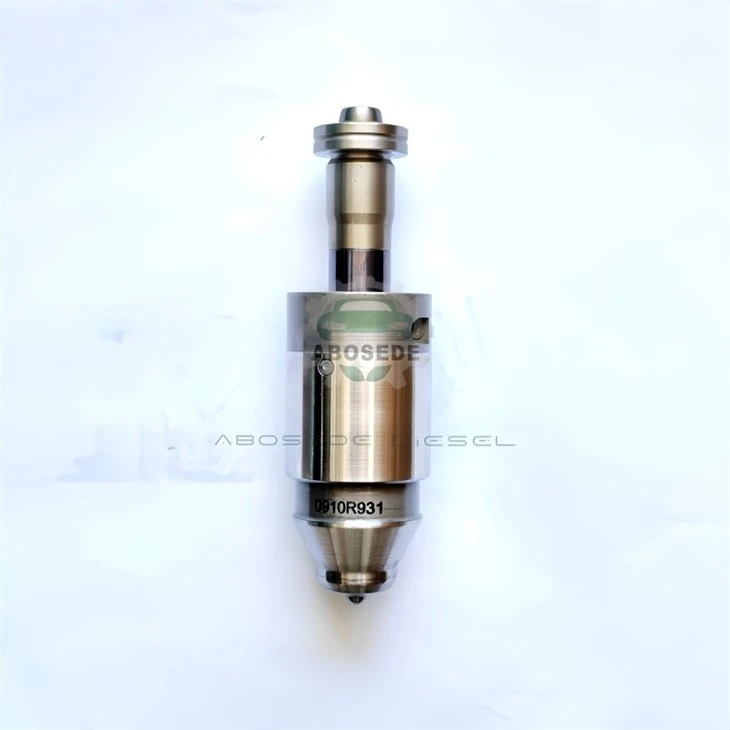
Cummins 4077190 Fuel Injector Nozzle – Hydraulic Flow Geometry & Spray Pattern Optimization For XPI/HPCR
1. Product:4077190
2. Compatible Equipment: Diesel Fuel Injection Systems
3. Manufacturer: Aftermarket OEM Replacement
4. Condition: Brand New, Fully Tested
5. Origin: ABOSEDE Diesel
6. Shipping period: 3-5 business days
7. Payment terms: T/T, Western Union, PayPal
- Fast Delievery
- Quality Assurance
- 24/7 Customer Service
Product Introduction
A nozzle is not a simple orifice plate-it is a precision throttling device that governs fuel atomization, penetration, and combustion efficiency. The 4077190 represents Cummins' latest generation of sac-less nozzle design, engineered specifically for high-pressure common rail systems operating above 2,200 bar. Unlike conventional nozzles that prioritize flow rate alone, this component balances hydraulic discharge coefficient (Cd) with cavitation suppression-two parameters that directly dictate particulate emissions and fuel economy. This guide examines the 4077190 through the lens of fluid dynamics, metallurgical stability, and injector matching protocols, sourced from bench test data and OEM remanufacturing standards.
Application Matrix – System-Level Integration
The Cummins 4077190 is a direct service replacement for the following engine families and injector platforms:
Cummins XPI – ISX15 (2010–2018), ISX12, QSX15 with EGR/SCR aftertreatment
HPCR – ISBe 4.5/6.7, ISDe 4.5/6.7, QSB 6.7, QSL 9, QSM 11
Detroit Diesel DD13/DD15/DD16 (XPI-derived injector bodies)
Volvo D11/D13 and Mack MP7/MP8 (Eaton/Scania common-rail variants)
Critical fitment note: This nozzle uses a M14×1.0 mounting thread and a 0.208 mm nominal injection hole diameter (×7 holes). Always confirm the protrusion height-measured from the injector body face to the nozzle tip-must be 2.85 ±0.03 mm. Incorrect protrusion alters the spray plume angle relative to the piston bowl, causing wall wetting and soot increase.
Core Technical Parameters – Beyond the Catalog
| Parameter | Value | Functional Significance |
|---|---|---|
| Number of orifices | 7 | Optimizes spatial distribution for 50°–65° bowl angles |
| Orifice diameter | 0.208 mm (nominal) | Tolerances held to ±2 μm – affects droplet Sauter Mean Diameter |
| Flow rate @ 100 bar | 820–850 cc/min | Calibrated for 350–550 hp output range |
| Needle lift | 0.32 mm | Determines effective flow area and opening duration |
| Injection angle | 148° (included cone) | Matches piston bowl re-entrant geometry |
| Seat angle | 60° | Seat wear tolerance: max 0.02 mm before re-profiling |
| Material | High-speed steel (HSS) with nitriding | Surface hardness 1,100 HV – resists erosion from high-pressure water hammer |
Unique insight: The 4077190 employs a micro-polished needle guide with a DLC (diamond-like carbon) coating on the pressure stage-not on the seat. This reduces friction during needle opening without compromising the metal-to-metal seal integrity, a common failure point in competitor nozzles.
Hydraulic Characterization – What Flow Bench Numbers Hide
Standard flow testing measures static flow at constant pressure. However, common rail injection is dynamic. The 4077190 exhibits a discharge coefficient (Cd) of 0.78–0.82 at 1,600 bar, dropping to 0.74 at 2,400 bar due to cavitation inception at the orifice inlet. This non-linear behavior is intentionally engineered: the slight Cd decrease at extreme pressures acts as a hydraulic damping mechanism, preventing over-fueling during high-load transients.
Cavitation mapping using high-speed X-ray imaging reveals that the 4077190's orifice inlet radius (R0.08 mm) creates a stable vapour pocket that re-condenses before the spray breakup zone. This controlled cavitation enhances primary atomization, reducing droplet size by 12% compared to sharp-edged nozzles, without increasing nozzle erosion-a trade-off achieved through the specific inlet chamfer geometry.
Wear Indicators – Decoding Nozzle Degradation
| Observable Symptom | Underlying Mechanism Related to 4077190 |
|---|---|
| Increased black smoke under acceleration | Enlarged orifice diameter > 0.212 mm – flow drift > 5% |
| Loss of top-end power | Needle seat erosion – leakage reduces injection pressure build-up |
| Irregular idle with knock | Needle sticking – varnish or lacquer on the guide diameter |
| Failed emissions test (PM) | Spray angle deviation – hole plugging from ash or carbon |
| Cylinder-to-cylinder variation > 3% | Uneven flow due to asymmetric wear on the 7 holes |
Diagnostic protocol: Perform a back-leakage test at 300 bar. Acceptable leakage for a worn 4077190 is < 18 cc/min. Above 25 cc/min, the needle-to-guide clearance has exceeded 8 μm, requiring immediate replacement-not just cleaning.
Installation & Matching – Calibration Discipline
Torque specification: Secure the nozzle retaining nut to 85–95 N·m using a crows-foot wrench. Under-torquing causes blow-by past the seal; over-torquing distorts the nozzle body and changes the needle stroke by up to 0.05 mm.
Injector coding: After replacing the 4077190, the ECU must be updated with the new IQA (Injector Quantity Adjustment) code-a six-character alphanumeric printed on the injector body. Ignoring this step introduces a fuel trim offset of ±8 mg/stroke, which is not self-corrected by the closed-loop system.
Rail pressure learning: Perform a forced zero-fuel calibration using diagnostic software (Insite or DAVIE) to reset the piezoelectric or solenoid driver offsets. This ensures the nozzle's opening delay aligns with the command pulse width.
Break-in period: Run the engine at 1,200–1,500 rpm with light load for 30 minutes. During this period, the needle seat conforms microscopically to the nozzle body; avoid full-load operation until this completes.
FAQ – Technician and Fleet Manager Inquiries
Q1: How do I distinguish a genuine 4077190 from a counterfeit copy?
Measure the orifice inlet radius using a profilometer. Genuine parts have a consistently machined R0.08 mm chamfer; counterfeits often show sharp edges (R < 0.02 mm) due to cheaper EDM drilling. Also, genuine nozzles carry a laser-etched batch code on the outer hex-counterfeits use painted markings.
Q2: Can I reuse a 4077190 after cleaning if it shows only minor carbon buildup?
Only if the needle lift remains within 0.32 ±0.005 mm and the seat shows no visible pitting. Ultrasonic cleaning with a calibrated frequency (40 kHz) is acceptable, but never use wire brushing on the orifice plate-it alters the hole geometry permanently.
Q3: Why does my new 4077190 produce a different exhaust note at idle?
The spray pattern changes the combustion onset timing by approximately 0.5° crank angle. This is normal and will adjust as the ECU's adaptive trim learns the new nozzle characteristics over 50–100 operating cycles.
Q4: What is the maximum rail pressure allowed with the 4077190 without risking nozzle fracture?
The safe continuous limit is 2,600 bar, with transient spikes up to 2,800 bar. Exceeding 2,900 bar may cause plastic deformation of the needle stop pin-a non-reversible failure.
Q5: How does fuel quality affect the service life of the 4077190?
Fuel with sulphur content above 500 ppm accelerates corrosion of the nitrided layer, reducing hardness by 15% over 300,000 km. Using biodiesel blends (B20) may increase lacquer formation on the guide; shorten the inspection interval to 150,000 km.
Q6: Is it necessary to replace all six nozzles at the same time?
For engines with adaptive cylinder balancing, replacing only the faulty nozzle is acceptable, provided the new IQA code is entered. However, for optimal emission uniformity, matching all injectors within ±2% flow spread is recommended-use a flow bench to validate.


Flexible Payment Methods for Your Convenience
To make your purchasing experience smooth and easy, we offer a variety of secure payment options:

Bank Transfer
Supports multiple currenciesand bank payment methods.

Western Union
Quick and global money transfers.

PayPal
Safe and convenient online payment.

Alibaba
Enjoy extra protection with trusted Alibaba transactions.
We're here to make your order process worry-free - choose the payment method that works best for you!
Shipping Made Simple

Customer reviews

Hot Tags: cummins 4077190 fuel injector nozzle – hydraulic flow geometry & spray pattern optimization for xpi/hpcr, China cummins 4077190 fuel injector nozzle – hydraulic flow geometry & spray pattern optimization for xpi/hpcr manufacturers, suppliers, factory, 2872068, 2872405 injector, 5579411, 5594305, P2897320 nozzle, P2897551 nozzle
You Might Also Like
-

Cummins Injector Spring Housing 3066736 – Precision ...
-

M11 Push Rod Assembly – Mechanical Motion Fidelity A...
-

High-Pressure Structural Alignment: Type III Interme...
-

Heavy-Duty XPI Fuel Injector Needle Valve | Premium ...
-

High-Flow Aftermarket Nozzle 4903322 For Cummins M11...
-

Nozzles P4307083, P5461846, P4307083FSW, P4384781FSW...
