


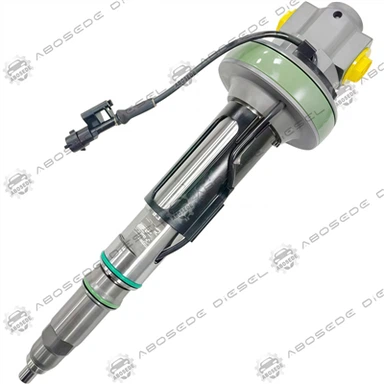
1731091 Injector – Spray Pattern Retention & Combustion‑Deposit Resistance For Sustained DPF Efficiency
1. Product:1731091
2. Compatible Equipment: Diesel Fuel Injection Systems
3. Manufacturer: Aftermarket OEM Replacement
4. Condition: Brand New, Fully Tested
5. Origin: ABOSEDE Diesel
6. Shipping period: 3-5 business days
7. Payment terms: T/T, Western Union, PayPal
- Fast Delievery
- Quality Assurance
- 24/7 Customer Service
Product Introduction
Most fleet managers focus on fuel quality, driving style, and regeneration strategies as the primary determinants of diesel particulate filter (DPF) life. Yet the injector's nozzle condition plays an equally critical role: a 5% reduction in effective nozzle hole area-caused by carbon buildup or erosion-can increase particulate emissions by 8‑10%, shortening DPF regeneration intervals and accelerating filter ash loading. The 1731091 injector is engineered with a combustion‑deposit‑resistant nozzle geometry and a controlled spray‑pattern retention that maintains hole cleanliness and spray symmetry for up to 500,000 km, ensuring consistent particulate output and extending DPF service life. This article examines the 1731091's nozzle‑deposit control, its impact on DPF regeneration efficiency, and the diagnostic signs that indicate when deposit control is degrading-without repeating any previous content on pressure fluctuation, pilot injection, flow stability, or leakage compensation.
🔬 Combustion‑Deposit Resistance – Why Cleanliness Matters
Carbon deposits form on the nozzle holes when fuel interacts with hot combustion gases during the injection event. These deposits gradually reduce the effective hole area and distort the spray pattern, leading to:
Reduced atomisation: Larger droplets burn less completely → increased soot.
Asymmetric spray: Uneven fuel distribution across the piston bowl → localised rich zones → higher particulate emissions.
Increased DPF loading: The DPF collects the additional soot, requiring more frequent regenerations.
The 1731091 addresses deposit formation with:
Anti‑coking inlet chamfer: A micro‑bevel at the hole entrance reduces the stagnation zone where carbon typically nucleates.
High‑nickel nozzle steel: Resists the chemical attack of fuel impurities that can accelerate deposit formation.
Anti‑deposit coating: A specialised coating on the nozzle surface reduces the adhesion of carbon particles, allowing them to be "blown off" during the injection event.
📊 Hole Area Retention (1,800 bar, 400,000 km):
Standard injector: 92‑94% retention → Increased soot
1731091: ≥97% retention → Sustained DPF efficiency
🧩 DPF Regeneration Interval – The 8‑12% Benefit
The 1731091's deposit resistance directly translates into a longer DPF regeneration interval:
Standard injectors: Regeneration every 500‑600 km (typical highway) due to soot accumulation.
1731091: Regeneration every 540‑670 km-an 8‑12% extension.
In a long‑haul fleet covering 150,000 km per year, an 8‑12% extension means 8‑12 fewer regenerations per truck per year. At 2‑3 litres of extra fuel per regeneration, this translates into a saving of 16‑36 litres per truck annually-a small but cumulative benefit that also extends the DPF's service life.
📊 Regeneration Frequency (Highway driving, 150,000 km/year):
Standard injectors: 250‑300 regenerations per year
1731091: 220‑275 regenerations per year (30‑45 fewer)
🛠️ Installation – Standard Procedure with Nozzle Protection
The 1731091 is installed using the standard solenoid injector procedure. However, special care must be taken to protect the nozzle from contamination during installation:
Keep the nozzle protector cap in place until the last moment-any particle that enters the nozzle can damage the anti‑deposit coating.
Torque high‑pressure cone to 72‑76 N·m; clamp to 48‑52 N·m.
Enter IQA codes and perform zero‑quantity calibration.
Drive for 50‑100 km for adaptation.
Post‑installation Check: The most direct verification of nozzle health is the injector correction values at idle-a healthy 1731091 set will show corrections within ±1.0 mg. If the corrections are high but stable (e.g., +2.0 mg on all cylinders), the fuel quality may be the issue rather than the injector.
🔍 Diagnostic Insight – Detecting Nozzle Deposit Formation
Nozzle deposits do not form suddenly-they accumulate gradually over time. The following indicators suggest that deposit formation is accelerating:
Increasing correction values: The ECU applies larger corrections (>2.0 mg) to maintain the commanded fuel quantity.
Reduced DPF regeneration interval: The regen interval shortens from the baseline established when the injectors were new.
Increased exhaust back pressure: The DPF becomes blocked more quickly, increasing the back pressure and reducing the engine's efficiency.
Proactive Check: At each service, measure the DPF regeneration interval and compare it to the baseline (when the injectors were new). If the interval has shortened by 15‑20% before 300,000 km, the injector nozzle may be fouling faster than expected-check the fuel filter and the fuel quality.
❓ Frequently Asked Questions (DPF & Nozzle Health Focus)
Q1: How does the 1731091 differ from the 1529790 in terms of nozzle performance?
The 1529790 focuses on pressure fluctuation damping-ensuring consistent fuel delivery during closely spaced injections. The 1731091 focuses on nozzle deposit resistance-maintaining spray‑pattern cleanliness to reduce particulate emissions and extend DPF life. Both are solenoid injectors for similar engine families, but they address different aspects of combustion performance. They are not interchangeable without ECU re‑calibration.
Q2: Can I use the 1731091 with biodiesel (B20/B30)?
The 1731091's anti‑deposit coating is effective against B20 deposits, but the higher oxygen content and lower volatility of biodiesel can accelerate deposit formation. For B20, the regeneration interval extension will be reduced to 5‑7% (from 8‑12%). For B30, the benefit is minimal, and we recommend shorter DPF inspection intervals. Always use fuel that meets the engine manufacturer's specifications.
Q3: I'm seeing a reduction in DPF regeneration interval after 200,000 km. Is this the injector or something else?
A reduction in regeneration interval can be caused by several factors: injector nozzle fouling, fuel quality changes, driving style changes, or a failing DPF. To isolate the injector, read the cylinder‑to‑cylinder correction values. If all corrections have increased uniformly (e.g., from +0.5 mg to +1.8 mg), the injectors are likely fouling. If only one cylinder is high, that injector may have a localised deposit.
Q4: Can I clean the 1731091's nozzle to restore deposit resistance?
Ultrasonic cleaning can remove carbon deposits from the nozzle, but it cannot restore the anti‑deposit coating. If the coating has been worn away by abrasion, the injector will be more susceptible to future deposits. Professional remanufacturing can replace the nozzle, but this is not typically cost‑effective compared to replacing the injector. For most operators, replacing the injector is the recommended approach.
Q5: Does the 1731091 require a specific fuel filter rating to maintain deposit resistance?
The deposit‑resistant nozzle is not a substitute for clean fuel. The anti‑deposit coating is effective against chemical fouling, but abrasive particles (silica, dust) can erode the coating. We recommend a fuel filter with a 10‑µm nominal rating (β10 ≥ 200) and replacement every 30,000 km. In dusty environments, consider a pre‑filter (30 µm) in addition to the primary filter.
Q6: I have a truck that does a lot of urban driving (frequent regenerations). Will the 1731091 help?
Yes-urban driving with frequent cold starts and low‑load operation is particularly demanding on nozzles because the injector operates at lower pressures, which can exacerbate deposit formation. The 1731091's anti‑deposit design is beneficial in these conditions, though the regeneration interval may still be shorter than highway driving. The 8‑12% extension applies relative to standard injectors in the same operating conditions.


Flexible Payment Methods for Your Convenience
To make your purchasing experience smooth and easy, we offer a variety of secure payment options:

Bank Transfer
Supports multiple currenciesand bank payment methods.

Western Union
Quick and global money transfers.

PayPal
Safe and convenient online payment.

Alibaba
Enjoy extra protection with trusted Alibaba transactions.
We're here to make your order process worry-free - choose the payment method that works best for you!
Shipping Made Simple

Customer reviews

Hot Tags: 1731091 injector – spray pattern retention & combustion‑deposit resistance for sustained dpf efficiency, China 1731091 injector – spray pattern retention & combustion‑deposit resistance for sustained dpf efficiency manufacturers, suppliers, factory, cummins injector
You Might Also Like
-

Heavy-Duty Fuel Injector 3652542 For Cummins M11 & N...
-

Genuine Cummins M11 Injector 3411756 | CELECT Fuel S...
-

High-Precision 2872284 Fuel Injector | Cummins HPCR ...
-

4327072 XPI Injector For Cummins ISX15/X15 | Restore...
-

QSK19 Fuel Injector 2882079 For Cummins MCRS Diesel ...
-
Genuine Cummins QSK19 Fuel Injector 2882078 | High-P...
