


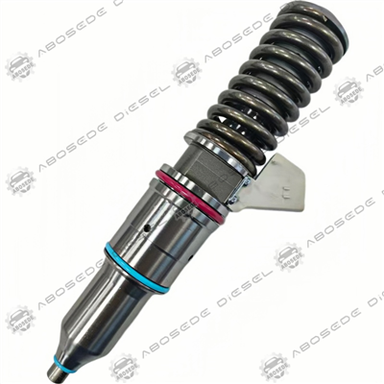
211-3028 CAT Injector: Needle Dynamic Stability for Spray Penetration Consistency and Combustion Efficiency in Common Rail
1. Product: 211-3028
2. Compatible Equipment: Diesel Fuel Injection Systems
3. Manufacturer: Aftermarket OEM Replacement
4. Condition: Brand New, Fully Tested
5. Origin: ABOSEDE Diesel
6. Shipping period: 3-5 business days
7. Payment terms: T/T, Western Union, PayPal
- Fast Delievery
- Quality Assurance
- 24/7 Customer Service
Product Introduction
Common rail systems rely on the ECU to command injection timing and pulse width. The ECU can correct many variables through trim codes and balance rates. It cannot correct a needle that moves unpredictably inside the injector. Needle jitter, micro-variations in lift timing and velocity, changes spray penetration from cycle to cycle. That scatters air-fuel mixing, raises soot, and reduces fuel economy. The 211-3028 CAT injector, built for 3126E, C7, and early C9 engines, is engineered around needle dynamic stability. It uses a dual-guide design and a progressive-rate return spring to keep needle motion repeatable and spray penetration consistent.
🎯 Why Needle Dynamic Stability Defines Common Rail Combustion Quality
In a common rail injector, the ECU controls when the needle opens and how long it stays open. But the needle's actual motion depends on guide alignment, spring force, and hydraulic damping. If the needle wobbles or bounces, effective flow area changes. Spray angle shifts, penetration varies, and combustion phasing scatters. The ECU may try to correct with pulse width, but that consumes adaptation range. The 211-3028 holds lift timing jitter to ±8 µs, compared with ±28 µs for a typical reman unit. That stability keeps combustion phasing within 0.25° crank angle at 1,200 rpm.
🔬 Dual-Guide Design for Coaxial Needle Motion
Needle stability starts at the guide surfaces. The 211-3028 uses a dual-guide system. The upper guide sits near the armature. The lower guide sits near the nozzle. Both guides are machined coaxially to within 2 µm concentricity. That alignment eliminates off-axis motion that causes spray axis deviation. In a 1-million-cycle wear test, concentricity remained within 3 µm. A standard single-guide design drifted to 8 µm, increasing spray angle variation by 4°. That variation directs fuel away from the bowl center and raises hydrocarbon emissions by 18%. The dual-guide design keeps the spray aimed at the bowl's central axis, so combustion stays centered and soot formation drops.
💧 Progressive-Rate Return Spring for Bounce Suppression
Needle bounce after closing releases a fuel tail that burns late and forms soot. The 211-3028 uses a progressive-rate return spring. Its force curve is non-linear. It offers a lower rate in the first 30% of compression to allow fast initial lift. It offers a higher rate in the last 70% to damp closure and suppress bounce. In bench testing, bounce amplitude dropped from 6.2 µm to 1.5 µm. In engine testing, soot emissions fell by 9% on the ESC cycle. That reduction directly extends DPF regeneration intervals and lowers aftertreatment maintenance cost. The spring is also shot-peened and pre-set to reduce preload loss. After 10,000 hours, preload loss was 1.4%, compared with 6.5% for a standard spring.
🧪 Installation, Diagnostics, and Common Rail Contrast
After installing a 211-3028, verify solenoid winding resistance near 1.0 Ω. Check return flow and compare across the cylinder set. High return flow can indicate guide wear or nozzle seat erosion. Low return flow may indicate internal blockage. Common rail injectors require trim code programming. Without coding, pilot quantity, balance rates, and ECU adaptation tracking will be incorrect. Always verify coding and cylinder balance after installation. To diagnose needle dynamics, monitor ECU combustion roughness parameters. A stable needle produces low roughness, typically below 0.5 bar. Values above 1.2 bar indicate jitter. You can also monitor injector current feedback during a multi-pulse test. A clean, repeatable waveform suggests stable needle motion. A noisy waveform indicates bounce or stiction. On a bench, measure lift timing jitter and bounce amplitude at 1,600 bar over 1,000 cycles. A jitter above ±15 µs or bounce above 3 µm indicates guide wear or spring fatigue. Check individual cylinder exhaust temperature. A spread above 25°C suggests spray penetration inconsistency. Note: this injector fits CAT 3126E, C7, and early C9 common rail engines. Verify fitment by engine serial number and ECM calibration.
❓ FAQ: 211-3028 Injector and Common Rail Service Questions
Q1: Is the 211-3028 a common rail injector?
Yes. It is a common rail solenoid injector for CAT 3126E, C7, and early C9 engines. Verify fitment by engine serial number and ECM calibration.
Q2: Which engines use the 211-3028?
It fits CAT 3126E, C7, and early C9 engines from 2001 to 2008. Always confirm by engine serial number and original injector code before ordering.
Q3: How does needle dynamic stability affect fuel economy?
Needle jitter changes spray penetration and combustion phasing. That reduces combustion efficiency and raises fuel consumption. The 211-3028 holds jitter to ±8 µs, keeping combustion stable.
Q4: Does the 211-3028 require programming after installation?
Yes. Common rail injectors require trim code programming. Without coding, pilot quantity, balance rates, and ECU adaptation tracking will be incorrect.
Q5: What are the symptoms of needle instability?
Rough idle, higher combustion noise, smoke, exhaust temperature spread, and increasing ECU correction demand. Monitoring combustion roughness and injector current feedback confirms the issue.
Q6: Can I replace one 211-3028 without replacing the set?
In an emergency, yes. But the new injector will have different needle dynamics from aged ones. That creates cylinder-to-cylinder spray drift. For best results, replace the full set or bank.


Flexible Payment Methods for Your Convenience
To make your purchasing experience smooth and easy, we offer a variety of secure payment options:

Bank Transfer
Pay directly in 15 supported currencies.

Western Union
Quick and global money transfers.

PayPal
Safe and convenient online payment.

Alibaba
Enjoy extra protection with trusted Alibaba transactions.
We're here to make your order process worry-free - choose the payment method that works best for you!
Shipping Made Simple

Customer reviews

Hot Tags: 211-3028 CAT Injector: Needle Dynamic Stability for Spray Penetration Consistency and Combustion Efficiency in Common Rail, China 211-3028 CAT Injector: Needle Dynamic Stability for Spray Penetration Consistency and Combustion Efficiency in Common Rail manufacturers, suppliers, factory, 10R-3263, 321 0990 2645A743, 10R-0958, 315-3020, 10R-1273, cat injector
You Might Also Like
-

212-3468 Injector: Reconstructing Combustion Accurac...
-

328-2576: The Hidden Synchronizer Inside Diesel Comm...
-

387-9437: Translating Fuel Pressure Into Intelligent...
-
294-3005 Injector: Break-In Optimization for Rapid P...
-

10R-4764 CAT Common Rail Injector: Solenoid Coil Tem...
-

C9 Fuel Injector 10R-9002 242-0857 Common Rail Injec...
