


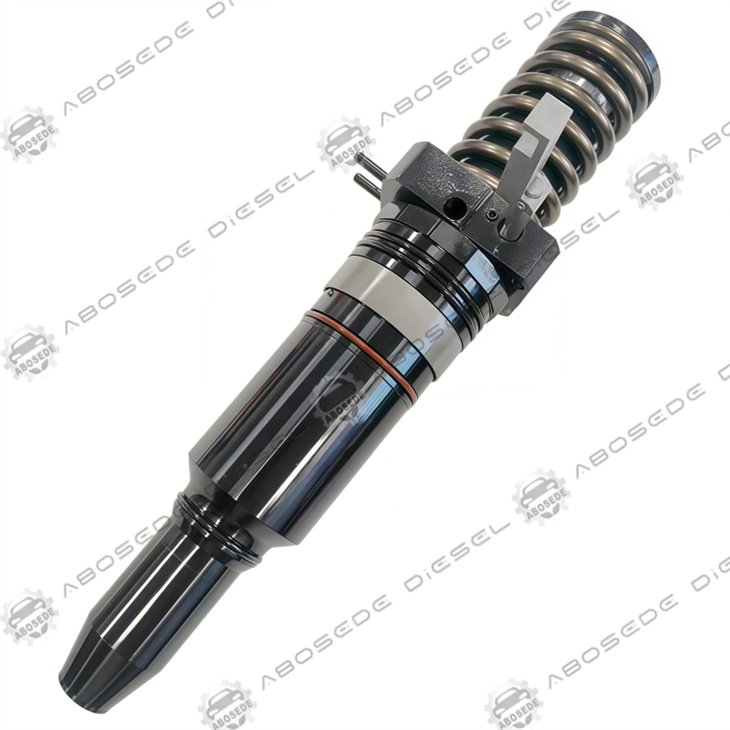


418-8820 CAT Common Rail Injector – Microsecond-Precision Fuel Metering for C13/C15 Acert Engines | Direct OEM Replacement
1. Product:418-8820
2. Compatible Equipment: Diesel Fuel Injection Systems
3. Manufacturer: Aftermarket OEM Replacement
4. Condition: Brand New, Fully Tested
5. Origin: ABOSEDE Diesel
6. Shipping period: 3-5 business days
7. Payment terms: T/T, Western Union, PayPal
- Fast Delievery
- Quality Assurance
- 24/7 Customer Service
Product Introduction
In modern common‑rail architectures, the injector is where digital calculation meets mechanical reality-its opening duration and needle lift determine not only peak power but also soot formation, NOₓ levels, and fuel consumption. The 418‑8820 is Caterpillar's specified fuel injector for its C13 and C15 Acert heavy‑duty engines, where each cylinder must receive up to seven separate injection events per combustion cycle (pilot, pre‑main, main, and multiple posts) with timing variances below 2 microseconds and fuel quantity deviations under ±1.5 mg/stroke. This is not a simple on‑off valve; it is a high‑speed hydraulic servo that balances pressure waves, nozzle cavitation, and spring dynamics to achieve complete, clean burn under every load condition.
📊 Core Technical Data – From Coil to Nozzle
| Parameter | Specification |
|---|---|
| Part Number | 418‑8820 (Caterpillar) |
| Technology | Solenoid‑actuated common‑rail (Bosch design, CAT‑calibrated) |
| Max Injection Pressure | 2,000 bar (29,000 psi) – system peak |
| Nozzle Type | VCO (Valve Covered Orifice) with 8 × ø0.16 mm holes |
| Spray Cone Angle | 152° (±1.5°) – optimised for Acert piston bowl |
| Solenoid Resistance | 0.8 – 1.1 Ω @ 20°C (pull‑in) / 0.2 – 0.3 Ω (hold) |
| Needle Lift | 0.35 mm (full lift) |
| Dynamic Flow Rate | 580 – 620 cc/min @ 100 bar test pressure |
| Return Fuel Leakage (new) | ≤ 8 cc/min at idle (internal leak‑off) |
| Connector | 2‑pin waterproof (Deutsch DT‑style) |
⚙️ How It Works – The Cascade of Precision
When the ECU sends a current pulse to the solenoid, an armature lifts the control valve, releasing high‑pressure fuel from the injector's internal control chamber. This pressure drop allows the nozzle needle to lift against its spring, opening the orifices. The entire process-from electrical trigger to fuel entering the cylinder-takes 150–200 μs for the pilot event, and subsequent events are timed with even tighter windows.
Two design features set the 418‑8820 apart:
Balanced hydraulic geometry – pressure forces on the needle are nearly nullified, enabling consistent opening regardless of rail pressure fluctuations.
Integrated orifice plate – a laser‑drilled restrictor controls the rate of pressure decay, shaping the injection rate to achieve a "square" fuel delivery profile that reduces combustion noise by up to 4 dB(A) compared to earlier injectors.
Furthermore, the injector's return fuel path incorporates a damping element that prevents pressure oscillations from propagating back into the rail-a critical feature for maintaining rail stability during rapid load changes, such as gear shifts or sudden throttle applications.
🧪 Material Science – Withstanding Extreme Cycles
The needle and seat are manufactured from powder‑metallurgical high‑speed steel with a chromium‑nitride PVD coating (3–5 μm thick), achieving surface hardness exceeding 1,100 HV. This coating resists cavitation erosion caused by the high‑velocity fuel jet (up to 500 m/s) and maintains tight sealing even after 1.5 million injection cycles.
The solenoid coil is encapsulated in a high‑temperature liquid crystal polymer (LCP) that withstands continuous exposure to 150°C fuel and 180°C under‑hood temperatures without degrading insulation resistance. Gold‑plated terminals ensure reliable signal transmission, crucial because a 10‑mV voltage drop can shift injection timing by 15 μs, affecting idle stability.