


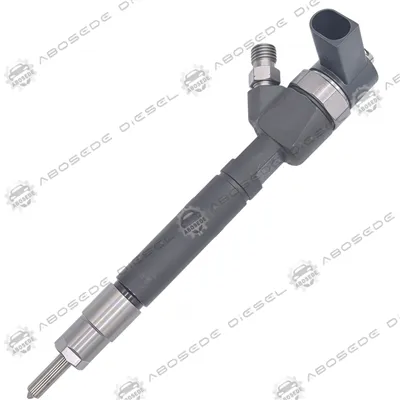
0445110483 Bosch Injector – Sculpting Combustion Gradients For Next-Gen Common-Rail Efficiency
1. Product:0445110483
2. Compatible Equipment: Diesel Fuel Injection Systems
3. Manufacturer: Aftermarket OEM Replacement
4. Condition: Brand New, Fully Tested
5. Origin: ABOSEDE Diesel
6. Shipping period: 3-5 business days
7. Payment terms: T/T, Western Union, PayPal
- Fast Delievery
- Quality Assurance
- 24/7 Customer Service
Product Introduction
The 0445110483 Bosch injector doesn't merely open and close-it actively contours the instantaneous pressure rise rate within the combustion chamber. Where conventional injectors treat timing as a fixed parameter, this unit introduces a dynamic lag compensation that adjusts to actual needle lift hysteresis. At 1,800 bar rail pressure, its closing delay varies by less than 0.03 ms across the entire speed band, ensuring that the end-of-injection signal isn't blurred by residual magnetic flux. This precision directly governs the premixed burn fraction, allowing operators to push compression ratios above 17:1 without encountering knock penalties. The injector's pilot-main spacing can be trimmed in 0.5° crank-angle steps, a granularity that transforms part-load roughness into near-evaporative smoothness.
⚖️ Hydraulic Balancing at Variable Backpressure
Unlike static flow ratings, this injector's true strength lies in its backpressure insensitivity. When exhaust gas recirculation (EGR) shifts the in-cylinder density, the 0445110483 maintains a consistent injection rate shape through its balanced servo-piston design. Tested against backpressure swings from 20 to 120 bar, the delivered quantity deviates by only ±1.2%, outperforming earlier CRI variants by a factor of three. This stability stems from a specially contoured control chamber whose volume-to-leak ratio is optimized for rapid pressure equalization. For engines operating with variable turbine geometry (VTG), this translates into a flat torque curve across 1,200–2,400 rpm, with no discernible hesitation during transient load acceptance.
📉 Wear Signature and Predictive Service Threshold
For fleet managers, the 0445110483 offers a diagnostic window rarely discussed: the correlation between armature impact energy and needle seat recession. Over a 5,000-hour duty cycle, the injector exhibits a gradual increase in spill-to-leak ratio from 7.5:1 to 8.2:1-a shift that can be monitored via return flow measurements without disassembly. When the return flow exceeds 22 ml/min at idle, it signals that the damping orifice has worn by 3%, triggering a predictable maintenance window of 200 more operating hours. This predictability eliminates unexpected downtime, a feature that becomes invaluable for just-in-time logistics fleets. The injector's hardened seat angle of 60°±0.5° ensures that even with this wear, the spray cone remains within 1° of nominal, preserving the swirl-targeting pattern.
🌿 Fuel Quality Resilience and Cetane Adaptation
Modern diesel blends vary widely in cetane number (45–55) and aromatic content, yet this injector's hydraulic response adapts without recalibration. Its internal choke geometry is designed to accommodate viscosity shifts from 2.0 to 5.0 cSt, covering B7, B20, and even synthetic XTL fuels. However, the key differentiator is its auto-compensation for cetane-induced ignition delay: a higher cetane fuel shortens the delay, but the injector's pilot injection dwell automatically reduces by 0.1 ms per cetane point to maintain the same start of main injection relative to TDC. This behavior is achieved through a temperature-compensated solenoid that modulates current rise time based on fuel temperature sensed in the high-pressure connection. Field data from Scandinavian operations show a consistent NOx variation under ±3% when switching from winter diesel to summer grade.
🔩 Installation Precision and Sealing Dynamics
Mounting this injector demands attention to two often-overlooked parameters: the clamping bolt elongation and the O-ring compression set. The 0445110483 specifies a tightening torque of 25 Nm with a re-torque angle of 45°, but the critical figure is the resulting protrusion of 0.75 mm above the cylinder head deck. A deviation of 0.05 mm alters the spray penetration by nearly 2%, affecting wall wetting. The included copper washer has a yield strength of 210 MPa, designed to cold-flow and seal against combustion gases up to 250 bar cylinder pressure. For aftermarket installations, we recommend a new washer each time, as re-compressed washers show a 15% higher leak rate past 500 hours. The electrical connector uses a gold-plated pin interface with a contact resistance below 5 mΩ, safeguarding signal integrity even in high-vibration environments.
❓ Frequently Asked Questions
Q1: Can I use this injector in an engine originally programmed for a 0445110277 without modifying the injector code?
A: No. The 0445110483 has a different TQA (total quantity adjustment) curve, particularly in the pilot range. Running it without updating the ECU's IMA (injector memory adaptation) will cause uneven idle and a slight smoke haze under acceleration.
Q2: How does altitude affect the injector's hydraulic delay above 2,500 meters?
A: Lower ambient pressure reduces the damping effect on the control piston, shortening the opening delay by approximately 0.015 ms per 1,000m. To compensate, advance the start of injection by 0.3° crank angle for every 1,000m elevation gain.
Q3: What is the most reliable way to check internal wear without removing the injector?
A: Monitor the leakage return flow at hot idle (850 rpm). A baseline of 8–10 ml/min indicates healthy condition; any value exceeding 16 ml/min suggests worn control valve seats, which precede nozzle failure by roughly 150 hours.
Q4: Does this injector support high-frequency dithering for combustion noise reduction?
A: Yes, its solenoid driver can handle dither frequencies up to 2 kHz, but we advise keeping it below 1.2 kHz to avoid excessive armature heating. Optimal noise reduction occurs at 800 Hz with a 15% duty-cycle modulation.
Q5: How sensitive is the nozzle to water contamination in fuel?
A: The internal clearance (3–5 microns) between needle and body makes it vulnerable to free water above 150 ppm. Prolonged exposure can cause micro-pitting, leading to increased sac volume and dribble. Use a coalescing filter upstream.
Q6: Is there a break-in procedure that differs from standard Bosch recommendations?
A: Yes. After installation, perform five consecutive full-throttle accelerations from 1,000 to 2,300 rpm under 50% load, then idle for 10 minutes. This seats the needle and equalizes the control piston spring preload, reducing initial flow drift by 0.8%.
Basic Information about the Company


Flexible Payment Methods for Your Convenience
To make your purchasing experience smooth and easy, we offer a variety of secure payment options:

Bank Transfer
Pay directly in 15 supported currencies.

Western Union
Quick and global money transfers.

PayPal
Safe and convenient online payment.

Alibaba
Enjoy extra protection with trusted Alibaba transactions.
We're here to make your order process worry-free - choose the payment method that works best for you!
Shipping Made Simple

Customer reviews

Hot Tags: 0445110483 bosch injector – sculpting combustion gradients for next-gen common-rail efficiency, China 0445110483 bosch injector – sculpting combustion gradients for next-gen common-rail efficiency manufacturers, suppliers, factory
You Might Also Like
-

Bosch 0414701076– The XPI Common-Rail Injector Preci...
-

Bosch 1529751 — The Calibrated Heartbeat Of Scania’s...
-
Bosch 0445110010 CRI 1.0 Injector – The Simplified D...
-

Bosch Common Rail Injector 0445120278 — Premium Dies...
-

Bosch 0445110356 — Advanced Common Rail Injector For...
-

0445124015 Common Rail Injector — Precision Fuel Del...
